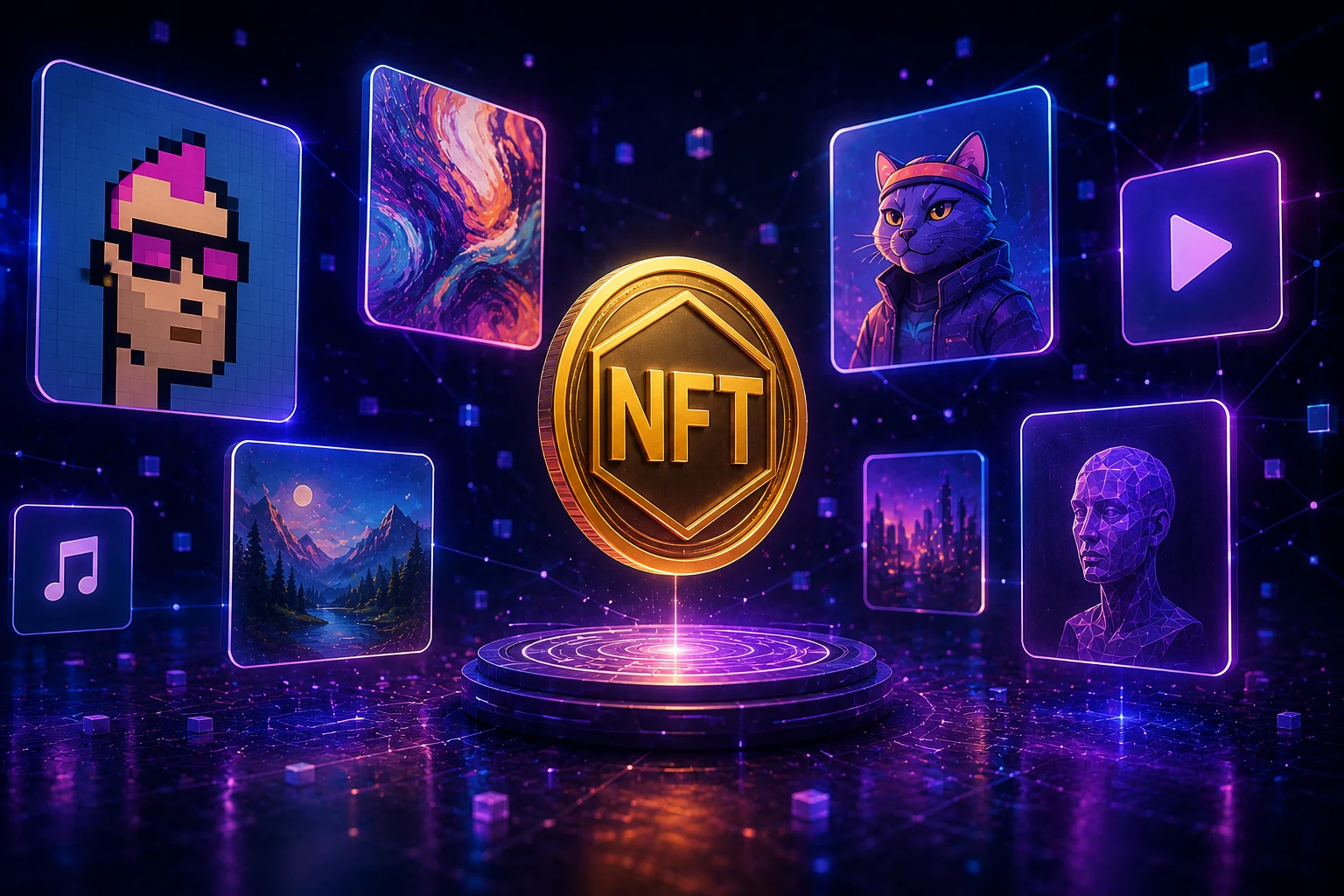
The basics: fungible vs non-fungible
To understand NFTs, start with what "fungible" means. A dollar is fungible — your dollar and my dollar are interchangeable. One Bitcoin is fungible — every BTC is identical to every other BTC. That sameness is what makes them useful as money.
An NFT is the opposite. Non-fungible means each token is unique and tracked individually. Like a deed to a specific house, or a certificate for a specific painting, an NFT points to one particular item that can't be swapped one-for-one with another. Your NFT and my NFT might both be from the same collection, but they're distinct tokens with distinct on-chain histories.
How NFTs actually work
An NFT is a record on a blockchain that contains a unique ID and a pointer — usually to metadata (image, attributes, name) stored on IPFS, Arweave, or a regular web server. The blockchain doesn't typically store the artwork itself; it stores ownership and a link to the artwork.
The standards: ERC-721 and ERC-1155
On Ethereum, NFTs follow technical standards that wallets and marketplaces can read. ERC-721 is the original NFT standard — one token, one owner, one ID. ERC-1155 is a multi-token standard that can represent both unique items and items with multiple identical copies (think 100 copies of a digital trading card). Every major chain — Solana, Polygon, Bitcoin via Ordinals — has its own equivalent.
Minting, transferring, burning
Creating an NFT is called minting. Anyone can mint one, on most chains for under a dollar. Once minted, the NFT can be transferred between wallets, sold on a marketplace, or burned (permanently destroyed by sending to a dead address). Every action lives on the public blockchain — you can trace the entire ownership history of a token back to its mint.
What people actually use NFTs for
The hype made NFTs synonymous with overpriced cartoon avatars, but the underlying tech has real uses beyond profile pictures.
- Digital art and collectibles. Artists sell editions directly to buyers without galleries taking 50%. Collectors get a provable, transferable claim.
- In-game items. Swords, skins, characters that you own across games or can sell outside the publisher's platform. Whether games actually want this is a separate question.
- Memberships and access passes. Holding an NFT can unlock a private Discord, a real-world event, or premium content.
- Ticketing. Concert and event tickets as NFTs — harder to counterfeit, programmable for resale rules.
- Identity and credentials. Diplomas, certifications, and on-chain reputation that follow you across apps.
- Domain names. ENS (.eth) and similar — wallet-readable usernames stored as NFTs.
The 2021 hype, the 2022 crash, the 2024 reset
NFT prices went vertical in 2021. A single CryptoPunk sold for millions. Bored Ape floor prices hit hundreds of thousands of dollars. Brands rushed in. By late 2022 most collections had lost 80–95% of peak value, and most projects from that era either died quietly or sit dormant.
The honest read: most of that money was speculation, not ownership. People bought NFTs expecting to flip them, not because they wanted to hold them. When the music stopped, the floor fell out. The lesson isn't "NFTs are dead" — they aren't — it's that most JPEG collections weren't worth what people paid, and "floor price" thinking turned a tool for unique ownership into a momentum trade.
The risks worth knowing
- Liquidity. The price someone paid last month doesn't mean you can sell for the same. Many NFTs have zero bids — illiquid by default.
- Royalty enforcement. Creator royalties (the artist's cut on resale) became optional on most marketplaces after 2023. The economic model many projects built on partially collapsed.
- Storage. If an NFT's metadata or image is hosted on a regular web server and that server goes down, you own a token pointing at a 404. IPFS pinning helps but isn't automatic.
- Phishing. Fake mints, drainer contracts, and signature scams target NFT users specifically. Signing the wrong message can empty a wallet.
- Copyright confusion. Owning an NFT does not automatically mean you own the copyright to the underlying art. Read the license — most collections grant only limited personal use.
How to start (carefully)
If you're curious, treat NFTs as collecting, not investing. Buy what you'd be happy to keep even if the price went to zero, on a chain with low fees so the mint cost isn't punishing. Use a separate wallet for NFT activity, keep your main holdings on a hardware wallet, and never sign a transaction you can't read. If you want the broader context, our guides on what is a smart contract and how to store crypto securely are the right next stops.
Read the NFT market without the noise
NFTs move on cultural moments — a new launch, a celebrity drop, a marketplace policy change — and most of the price action happens before mainstream coverage catches up. Zippfeed tracks NFT and on-chain news across multiple sources with sentiment and importance scoring, so you can tell the difference between a real shift and a paid hype cycle. The market is small enough that being early to the actual news matters more than reading takes after the fact.

 CryptoSlate
 TheBlock
 CoinDesk
 WuBlockchain