The problem it solves
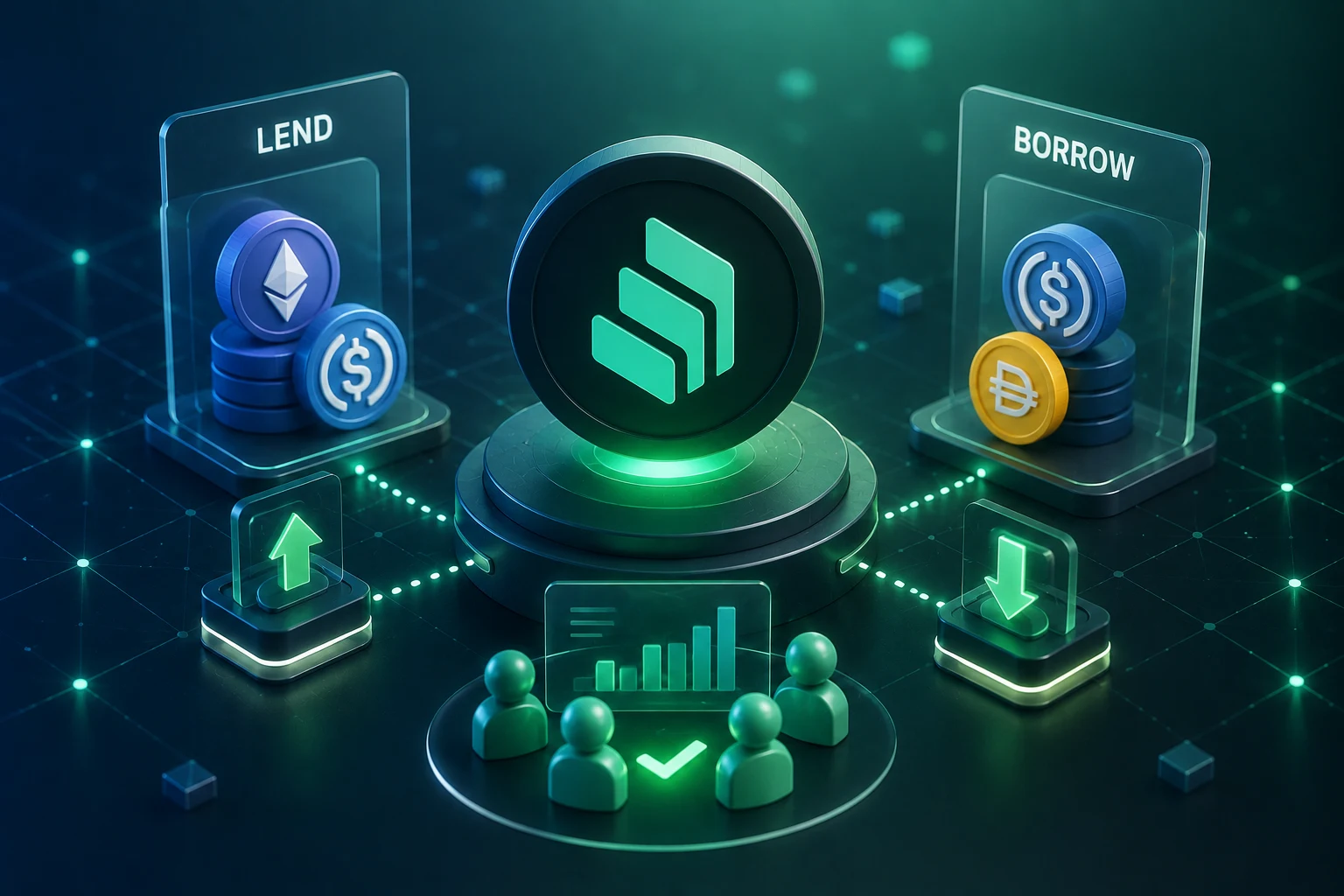
In 2018, holding tokens just meant they sat in your wallet. There was no equivalent of a savings account, and no way to borrow against your crypto without trusting a centralized lender. Compound, alongside a few other early protocols, made the simplest part of finance — lending and borrowing — work on-chain.
Today most DeFi users have used Compound, MakerDAO, or Aave at some point. The pattern they share — pooled deposits, algorithmic rates, over-collateralized loans — became one of the foundations of every later money market.
How it works
The protocol is a set of contracts called cTokens (later v3 markets using a base asset and many collateral assets). Each represents an asset pool.
When you deposit USDC into Compound, you receive cUSDC. As borrowers pay interest, the exchange rate between cUSDC and USDC slowly grows — you do not see new tokens appear; the value of the ones you hold rises. Withdraw at any time the pool has liquidity.
To borrow, you supply assets as collateral and draw a different asset against it. As with any over-collateralized money market, your borrow capacity is a fraction of your collateral value. Cross a liquidation threshold, and a liquidator can repay part of your debt in exchange for some of your collateral at a discount.
Interest rates float automatically with utilization. The more of a pool is borrowed, the higher both the borrow rate (to discourage more borrowing) and the supply rate (to attract more deposits). At idle pools, both rates fall toward zero.
The COMP token
COMP is the governance token. Holders propose and vote on changes — adding markets, adjusting interest-rate curves, changing collateral factors, deciding what to do with reserves. There is no automatic dividend to COMP holders.
COMP was the token that kicked off the 2020 "yield farming" wave. By distributing COMP to users who supplied or borrowed assets, the protocol bootstrapped enormous activity in weeks. Every later DeFi protocol borrowed some version of that playbook. Today, COMP's role is mostly governance; the original "farm-and-dump" pressure is long gone.
Real use cases
- Earning yield on stablecoins. Depositing USDC or USDT into a Compound market is one of the simplest ways to earn an on-chain rate without leaving stables.
- Borrowing against held assets. Want to spend without selling? Lock ETH and borrow USDC. You keep the upside (and the downside) of your collateral.
- Building structured strategies. A lot of DeFi automation — vaults, leveraged tokens, rate arbitrage — runs through Compound under the hood.
- Backing other protocols. Compound's stability and reputation make its pools attractive plumbing for higher-level products.
Risks worth knowing
- Liquidation risk. Borrowing aggressively in a market that suddenly drops is the fastest way to lose money. Watch your borrow health and leave margin.
- Smart-contract risk. Compound is one of the most-audited and oldest live protocols in DeFi, but smart-contract risk is never zero. New versions, like Compound v3, have their own attack surface.
- Oracle risk. Compound relies on price oracles to set collateral values. Oracle manipulation has caused incidents on other money markets and is a recurring risk class.
- Governance risk. Protocol parameters — collateral factors, supported assets — can be changed by COMP governance. A bad proposal that passes can change your risk profile overnight.
- Stablecoin and collateral-specific risk. The asset you deposit or borrow matters. A de-pegging stablecoin or a thinly traded collateral can hit you even if Compound itself is fine.
None of this is financial advice. Compound is well established but not risk-free, and any borrow position needs active monitoring.
Following Compound with the right lens
Compound's headlines are dominated by governance — proposals to add or pause markets, adjust parameters, or migrate users between v2 and v3. Each one can change rates or risk for active users. Zippfeed surfaces Compound-related headlines with sentiment and importance scoring across sources, so you can tell whether an asset listing is freshly proposed, in voting, or live — and whether a broader DeFi event might ripple into Compound's pools. This is education, not financial advice — but the lenders and borrowers who manage positions calmly are the ones reading governance, not just the chart.

 CryptoSlate
 CoinDesk
 TheBlock
 Lookonchain