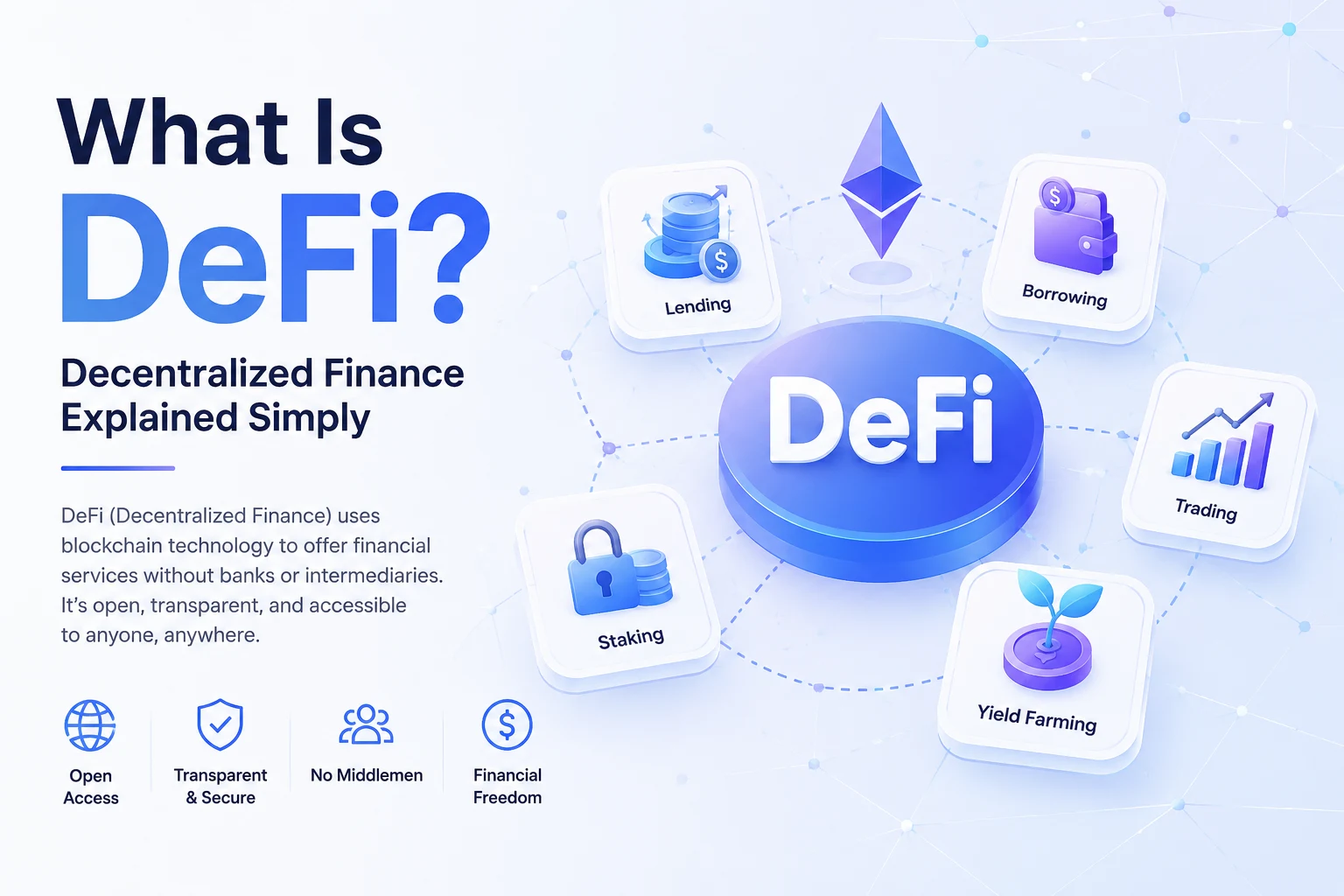
DeFi in plain terms
DeFi — short for decentralized finance — is a way of doing financial things like lending, borrowing, trading, and earning interest without a bank, broker, or any central company in the middle. Instead of trusting an institution, you interact directly with software running on a public blockchain.
That software is made of smart contracts: self-executing programs that hold and move funds according to rules anyone can inspect. If you deposit into a DeFi lending pool, no loan officer approves it — code does, automatically, the same way for everyone.
Why anyone bothers
Traditional finance has gatekeepers, hours, borders, and paperwork. DeFi's pitch is the removal of all four:
- Open to anyone with an internet connection and a wallet — no account approval.
- Always on. Markets never close.
- Transparent. The rules are public code, and every transaction is on a public ledger.
- Composable. Apps snap together like building blocks, so a position in one protocol can plug into another.
That openness is genuinely powerful. It is also exactly why the risks are real, which we will get to.
The main things people do in DeFi
Trade on DEXs
A decentralized exchange (DEX) lets you swap one token for another directly from your wallet, with no company holding your funds. Instead of matching buyers and sellers through an order book, most DEXs use liquidity pools and an automated pricing formula. You never give up custody.
Lend and borrow
DeFi lending protocols let you deposit assets to earn interest, or post collateral to borrow against. There is no credit check — loans are over-collateralized, meaning you lock up more value than you borrow. It is a different model from a bank loan, with its own risks.
Earn yield (carefully)
"Yield farming" and staking-style strategies let you put assets to work for returns. High advertised yields attract attention — and they should attract suspicion. Unusually high returns usually mean unusually high risk, hidden somewhere in the design.
Track value with TVL
The headline health metric for DeFi is Total Value Locked — how much capital is deposited across protocols. Our what is TVL explainer covers how to read it and where it misleads.
The risks nobody should gloss over
This is the section that protects your money.
- Smart-contract risk. Code can have bugs. A flaw can be exploited, and funds can vanish in minutes. Audits help but guarantee nothing.
- No safety net. There is no deposit insurance, no fraud reversal, no customer support to call. A mistake or a hack is usually permanent.
- You are your own custodian. Lose your keys, lose your funds. Sign a malicious transaction, lose your funds.
- Scams and rug pulls. Anyone can launch a protocol. Some are built purely to vanish with deposits.
- Complexity. Strategies that stack protocols multiply the points of failure.
DeFi rewards people who go slow, read carefully, and assume nothing. None of this is financial advice — it is the context you need before connecting a wallet to anything.
How to explore DeFi without getting wrecked
If you are curious, start defensively: use established, well-audited protocols; commit only small amounts you can afford to lose entirely; use a separate wallet funded with just what you need; and never sign a transaction you do not understand. Understanding how to store crypto securely first is not optional.
Read DeFi like a pro
DeFi moves at the speed of code — exploits, depegging events, and protocol drama unfold in hours, and the first warning is almost always in the news flow, not the official announcement. Zippfeed tracks DeFi headlines with sentiment and importance scoring across sources, so you can spot a brewing exploit or a collapsing protocol while there is still time to act, instead of reading about it after the fact.