HyperGPT in context
Two stories converged in the early 2020s. AI moved from research lab to consumer product faster than almost any technology in memory. At the same time, crypto kept searching for use cases where on-chain payments and tokens added more than friction. The AI tokens narrative — projects building infrastructure, marketplaces, or compute networks that pay in crypto — is one of the ways those two stories try to meet. Our overview what are AI tokens walks through that category.
HyperGPT sits inside that category. The product is a marketplace for AI applications and AI agents — a single place where users can discover, configure, and use a wide range of AI tools, and where developers can publish their work into a shared catalog. The crypto side is HGPT, the token that anchors the marketplace's economy.
How HyperGPT works
The marketplace layer
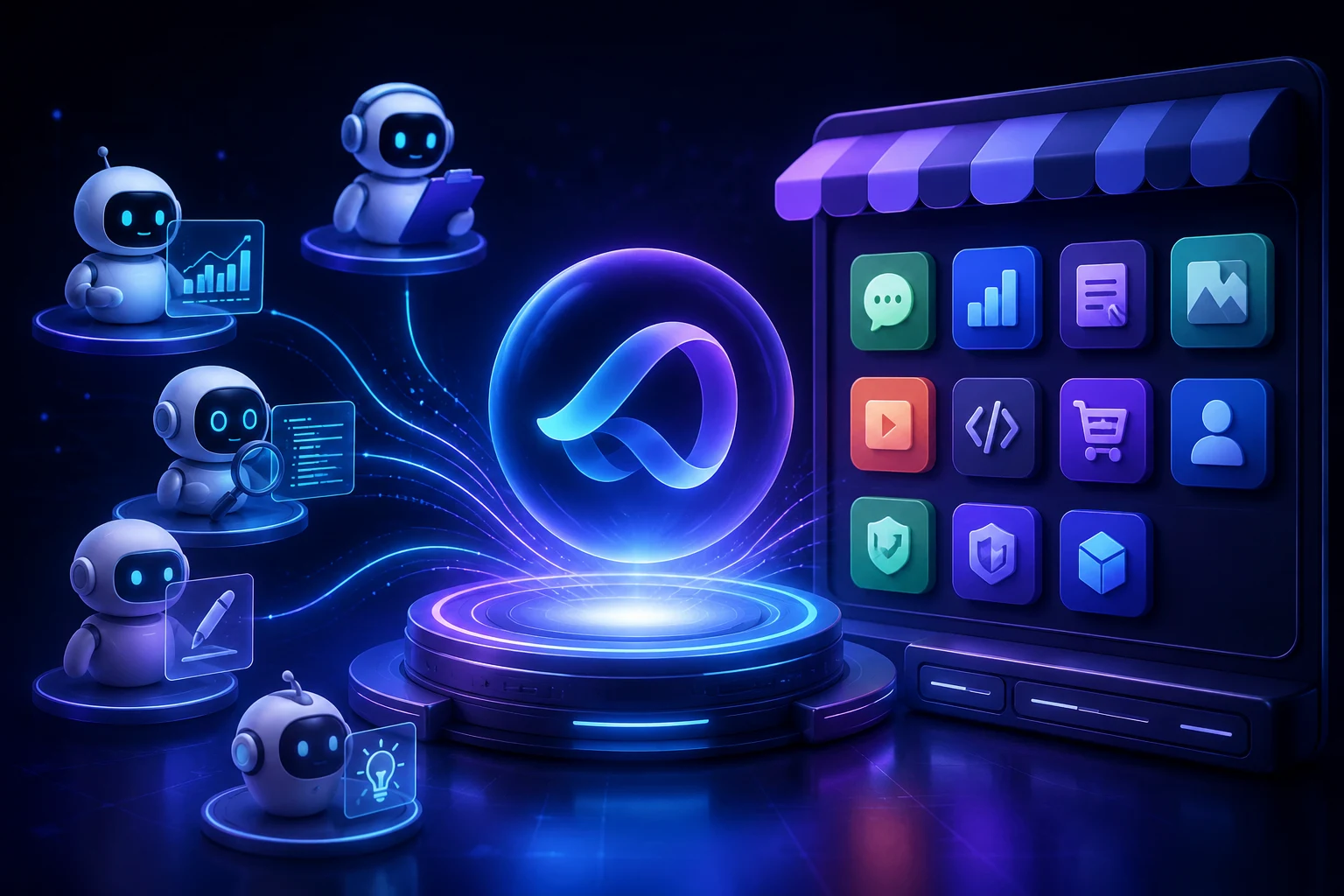
The marketplace at store.hypergpt.ai is the most visible product. It is a curated catalog of AI applications, with the goal of making discovery easier than searching across dozens of independent product sites. Categories span chat assistants, creative tools, productivity, research, finance, and more. Each entry is a self-contained AI tool that users can browse and try.
For developers, the value proposition is distribution: instead of marketing a standalone AI tool from scratch, publishers list inside an aggregated storefront whose users are already shopping for AI capabilities.
AI agents and orchestration
The newer story HyperGPT tells is about AI agents — software that takes a user's intent, picks the right AI tools, and executes a sequence of steps without constant human prompting. Our deeper how AI agents could transform blockchain explainer walks through the broader implications. HyperGPT's bet is that as agents become more capable, the marketplace plus orchestration model becomes more valuable than any single AI app — because what users want is outcomes, not specific tool selection.
HGPT as the marketplace token
HGPT is the project's native utility token. Treat the precise mechanics as evolving rather than fixed — like most newer tokens, the design is still being worked out in practice. The general role is to act as the economic substrate of the marketplace: token-denominated access, incentive flows for builders and users, and a long-term governance role as the project decentralizes.
HyperGPT's ecosystem and product surface
What sits inside the HyperGPT umbrella:
- The marketplace at store.hypergpt.ai — the discovery and access layer for AI applications.
- Agent infrastructure — the tooling that lets agents chain together apps to accomplish broader tasks.
- Developer tooling — the path for AI builders to publish their app into the marketplace.
- HGPT-denominated flows — economic activity in the marketplace tied to the native token.
HyperGPT versus other AI-crypto projects
The honest comparison is with other AI-meets-crypto projects: decentralized compute networks (Akash, Render), AI inference markets, agent frameworks (Fetch.ai, Bittensor), and data marketplaces (Ocean). Each picks a different slice of the AI value chain. HyperGPT picks the discovery and access layer for end-user AI applications, with agents as the bridge to outcome-oriented usage.
That niche is reasonable but contested. Discovery competes with general AI app stores and chat-native distribution. Agent orchestration is a fast-moving space with many builders, from open-source frameworks to large model providers. Whether HyperGPT wins depends on execution and on whether the crypto-native economic layer becomes a real differentiator or remains a side note.
The risks worth knowing
An honest guide is important here, because HyperGPT is a newer project in a space where promises are easy and execution is hard:
- Execution risk. Building a marketplace, agent orchestration, and a token economy at once is a lot to deliver well. Any of those legs can wobble.
- Competition. Both the AI app store space and the AI agent space are extremely active. Large model providers, OS vendors, and well-funded crypto projects all overlap with HyperGPT's territory.
- Quality and curation. A marketplace's value depends on the quality of what is in it. Curation problems are existential for stores at this stage.
- Token volatility. HGPT is a volatile asset with a structure tied to a young project. Past returns mean very little here.
- Hype dynamics. AI tokens as a category have ridden waves of attention that do not always reflect underlying product progress. Reading actual usage matters more than reading narratives.
- Regulatory framing. Tokens used in marketplaces face regulatory questions that vary by jurisdiction, especially around how revenue and incentives flow.
None of this is investment advice. Treat any crypto position as money you can afford to lose, especially for newer or smaller projects.
Following HyperGPT without the noise
HyperGPT lives at the intersection of two of the noisiest topics in tech — AI and crypto tokens. Zippfeed surfaces HyperGPT headlines with sentiment scoring (bullish, neutral, or bearish) and an importance rating, so you see what actually moves the project (new product launches, partnerships, regulatory news) instead of every AI-token think piece. That is the difference between reading the signal and getting buried under the AI hype cycle.