What it really is
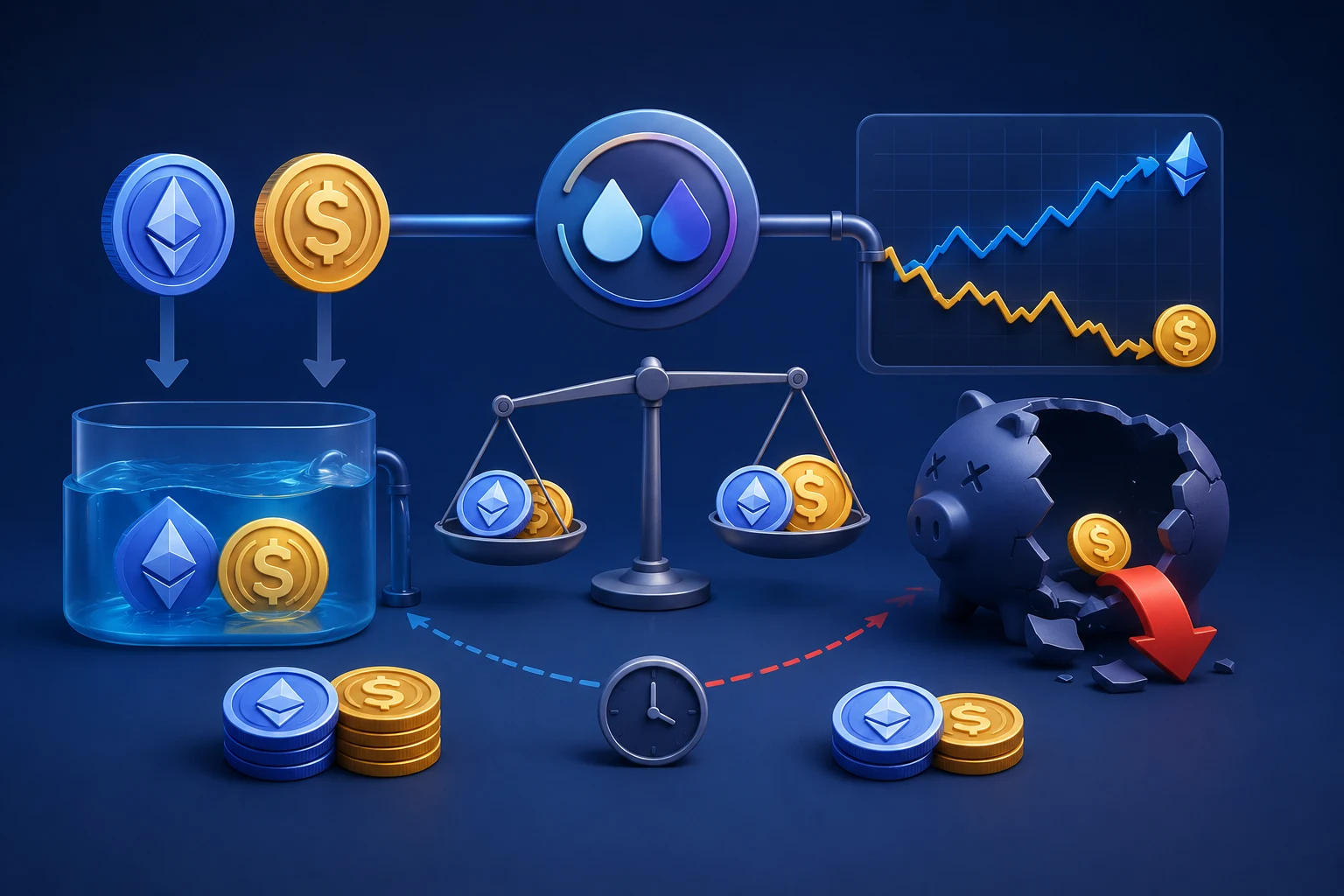
If you have read what is a liquidity pool, you know that becoming a liquidity provider (LP) means depositing two tokens — say ETH and USDC — into a pool, and earning fees from every swap that happens. What that page mostly skipped: when the prices of the two tokens drift apart, your deposit ends up worth less in dollars than if you had simply held the two tokens separately. That gap is impermanent loss.
The name is unfortunate. "Impermanent" suggests it might just go away, and that part is technically true: if prices return exactly to the ratio you deposited at, the loss disappears. But most of the time prices do not return, and when you withdraw your liquidity at a different price ratio, the loss becomes permanent and you realize it. A more honest label would be "rebalancing loss" — that is what it is.
How it actually works
The mechanic comes straight from the x × y = k formula that classic AMM pools use. The pool's two reserves multiply to a constant. When the external price of one token moves, arbitrageurs trade with the pool until its ratio matches the outside world — and that trading rebalances your share in a specific direction: you end up with more of whichever asset got cheaper, and less of whichever got more expensive.
Put another way: as an LP you are an automated, unwilling seller of the asset going up and an automated, unwilling buyer of the asset going down. That is the opposite of what a directional holder wants. Hold the trade-off in your head and the rest of the math just confirms it.
Simple example with numbers
You deposit into an ETH/USDC pool at the moment ETH is priced at $4,000:
- 1 ETH worth $4,000
- 4,000 USDC worth $4,000
- Total deposit value: $8,000
You receive an LP token representing your share. Now suppose ETH's market price doubles to $8,000 and stays there.
Arbitrageurs notice ETH in the pool is cheaper than outside and buy ETH from the pool until its internal price matches $8,000. Under x × y = k, that rebalancing leaves the pool roughly with:
- ~0.707 ETH worth $5,656
- ~5,656 USDC worth $5,656
- Total pool value of your share: ~$11,313
If you had just held the original 1 ETH + 4,000 USDC, your stack would now be worth $8,000 + $4,000 = $12,000.
The gap — $12,000 - $11,313 = $687, or roughly 5.7% of HODL value — is your impermanent loss. You still gained in dollar terms compared to your starting $8,000, but you gained less than you would have by holding. The pool quietly sold your appreciating ETH along the way to maintain its 50/50 balance.
The relationship is non-linear: a 2× move costs about 5.7% IL, a 4× move costs about 20%, a 10× move costs about 50%. Pools are gentle for sideways markets and brutal for breakout markets.
The mechanics behind
The role of trading fees
Impermanent loss is only half the story. The other half is the swap fees you earned along the way. On a heavily traded pool, fees can fully offset IL — sometimes by a lot. On a thinly traded pool with a volatile pair, fees usually fall far short of IL during a strong trend. The clean way to evaluate an LP position is:
Net result = Fees earned + (Pool value - HODL value)
If that number is positive, you beat just holding. If it is negative, you would have been better off holding. Many LPs check only fees earned and forget the HODL comparison — and then are surprised when a profitable-looking position underperformed simple holding.
When IL is minimal
Some pools structurally minimize IL:
- Stablecoin pairs (USDC/USDT, USDC/DAI). The two assets are designed to move together. IL is close to zero unless one depegs.
- Correlated pairs (stETH/ETH, wBTC/BTC). Designed to track each other. Small divergence means small IL.
- Single-asset staking that uses an LP under the hood. Some protocols hide the LP from you and absorb IL internally — read the docs carefully.
The reason "stable farming" is so popular is that IL on stable pairs is usually small enough to ignore — until one of the stables loses its peg, at which point the formula rebalances you into the depegged side at the worst possible time.
How concentrated liquidity changes things
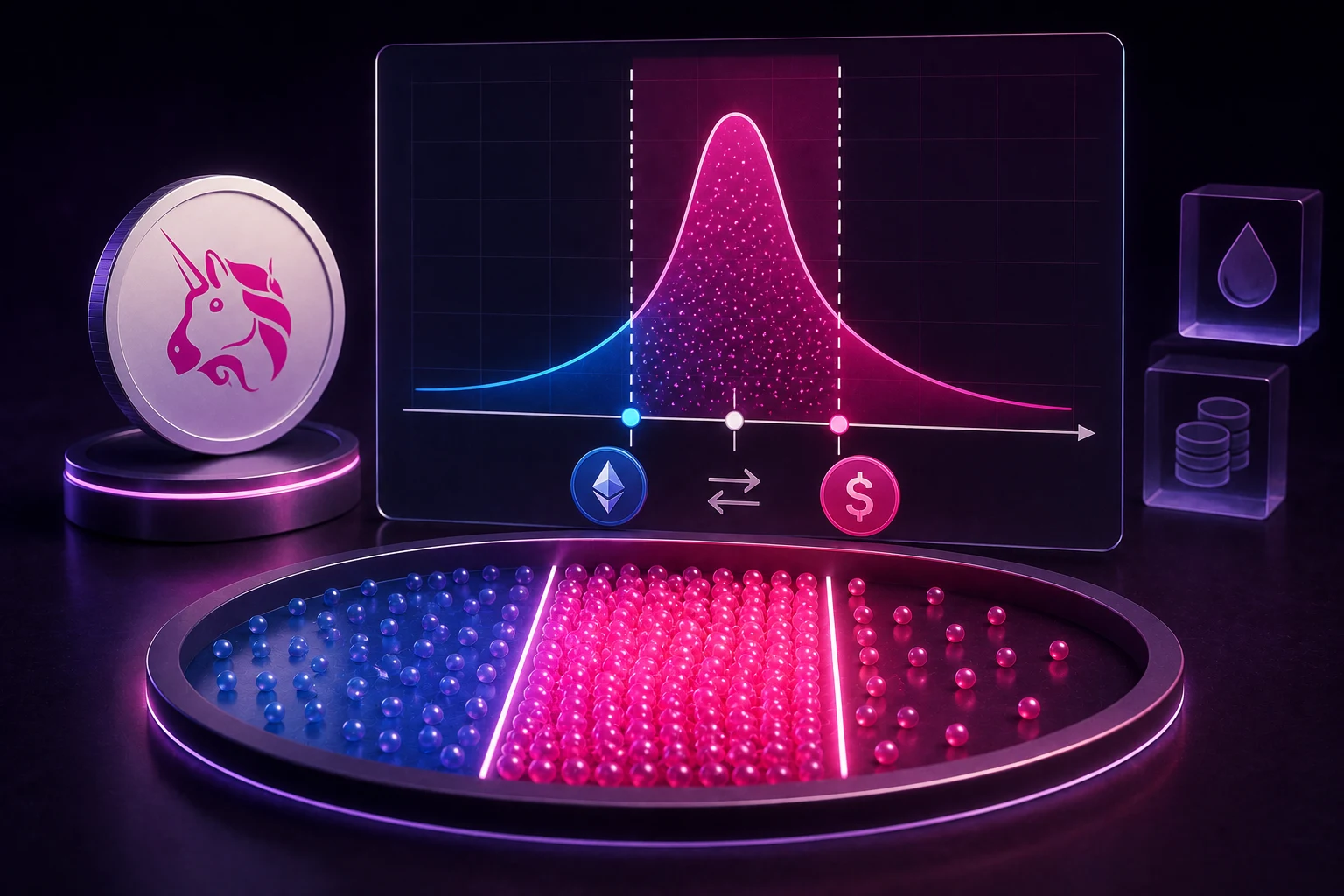
Uniswap V3 and similar models let LPs choose a price range. If the price stays in your range, you earn fees on a tighter band and IL behaves similarly to V2 within that band. If the price leaves your range, your position becomes entirely one-sided — you end up 100% in the asset that fell out of your range, you stop earning fees, and the IL behavior gets sharper. Concentrated liquidity is a more sophisticated tool with a steeper learning curve.
The risks worth knowing
- IL is a real, frequent cost. On volatile pairs in trending markets, it routinely eats double-digit percentages of your principal.
- Fees are not guaranteed. They depend on the pool's volume, which can dry up overnight if traders migrate to another DEX or the pair loses interest.
- Depegs are IL on steroids. A stablecoin pool that looked safe can become catastrophic if one stable depegs — the formula keeps buying the broken asset until the pool is drained of the good one.
- Loop strategies amplify IL. Looping (e.g. borrow against your LP, redeposit) multiplies your exposure. IL stacks across each layer.
- Exit timing matters. If you withdraw at the moment prices have diverged maximally, you realize the maximum IL. Waiting for prices to return to your entry ratio (if they ever do) makes the loss go to zero.
None of this is financial advice. It is a description of the math that governs any AMM pool you join.
Who it actually suits
Becoming an LP suits people who can model impermanent loss against expected fee income and judge whether the trade-off makes sense. Stable-stable pools are a reasonable starting place because IL is usually tiny. ETH/USDC and BTC/USDC are middle ground — meaningful fee income, real IL exposure when prices trend. Pools containing a volatile minor altcoin paired with a stablecoin or ETH are the most dangerous — IL can dominate and the headline APR can be misleading.
Who it does not suit: anyone who thinks of LP positions as "interest accounts"; anyone who has not done the HODL comparison before entering; anyone whose strategy depends on prices staying close to the entry ratio without a clear reason for them to. The pools advertising the most spectacular yields are usually exactly the pools where IL will dominate fees.
Watch the prices, watch the news
Impermanent loss is driven by price divergence, and price divergence is driven by news, market structure shifts, and large position flows. Zippfeed tracks crypto headlines with sentiment and importance scoring, so you can see catalysts — a token upgrade, a depeg event, a major listing — early enough to make a decision about an LP position before the move plays out. Useful whether you are actively LPing or just trying to understand why a pool you watched suddenly diverged.

 WuBlockchain
 Crypto Capital Venture
 Lookonchain
 TheBlock