The problem it solves
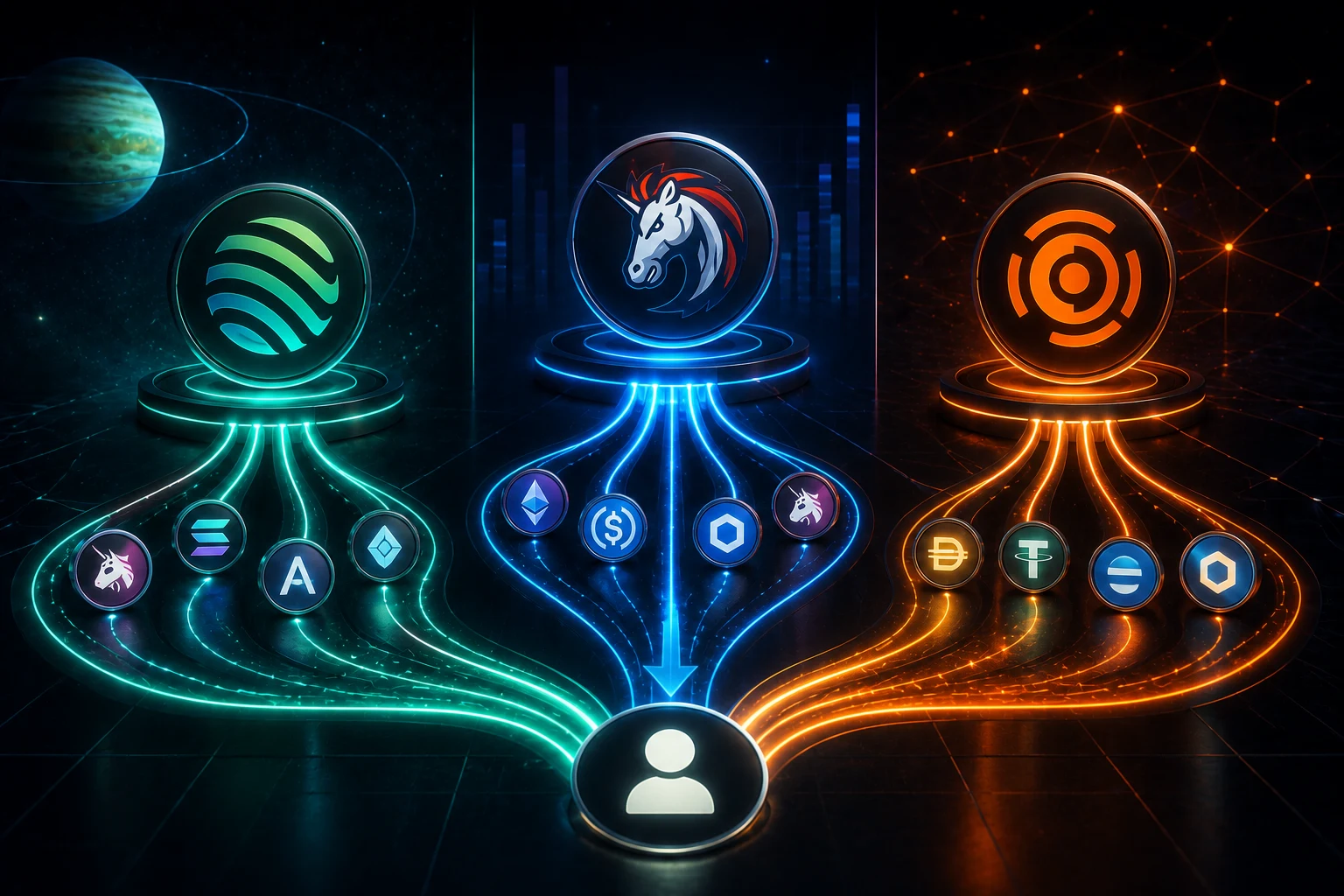
Solana has many DEXes. A trader who manually visits each one will rarely get the best deal — and on a chain where transactions cost cents, the upside of comparison shopping is concrete. Jupiter does that hunt automatically: for any pair, it solves for the best route across multiple venues in one transaction.
How it works
Two pieces.
Routing
Jupiter's router considers all integrated Solana DEXes, plans the best route — possibly across several pools and venues in parallel — and executes the swap as a single Solana transaction. Because Solana is fast and cheap, complex multi-venue routes are practical in a way they often aren't on Ethereum L1.
Built-in products
On top of the swap engine, Jupiter offers limit orders, DCA (recurring buys), perps (an integrated perpetual exchange built on Jupiter's infrastructure), and a launchpad for new tokens.
The JUP token
JUP is the protocol's governance token. Holders vote on protocol direction — incentives, treasury moves, product priorities. It was distributed via airdrops to active Solana users, broadly spreading initial holders, and continues to play a role in incentive design.
Real use cases
- Best-price swaps on Solana. Default tool for traders who want a competitive quote without checking each DEX.
- Limit orders and DCA. Schedule a series of buys or post a limit order without needing to babysit the trade.
- Jupiter Perps. Solana-native perps with shared liquidity for leveraged trading.
- Backend for wallets and apps. Many Solana wallets route swaps through Jupiter under the hood.
Risks worth knowing
- Router contract risk. An aggregator executes complex multi-venue routes via smart contracts. A router bug is rarer but more painful than a single-pool bug.
- Sandwich and MEV risk. Solana has its own MEV landscape; large swaps can still be detected and attacked. Use sane slippage.
- Token-listing risk. Solana has a massive long tail of scam tokens. The aggregator routes — it does not vouch.
- Solana liveness risk. Solana has had outages historically. Aggregator users inherit that operational profile.
- Approval and permission risk. Sign only the operations you understand; revoke when finished.
None of this is financial advice — it is the context you need before using Jupiter on Solana.
Following Jupiter with the right lens
Jupiter headlines move on product launches (perps, lending), JUP tokenomics changes, Solana outages and upgrades, and Solana DEX integration shifts. Each one matters differently for a swap user, a perps trader, and a JUP holder. Zippfeed surfaces Jupiter-related headlines with sentiment and importance scoring across sources, so you can tell whether a release is live or proposed and whether a chain event ripples through. This is education, not financial advice — but users who manage exposure calmly are the ones reading the protocol, not just the chart.