What it really is
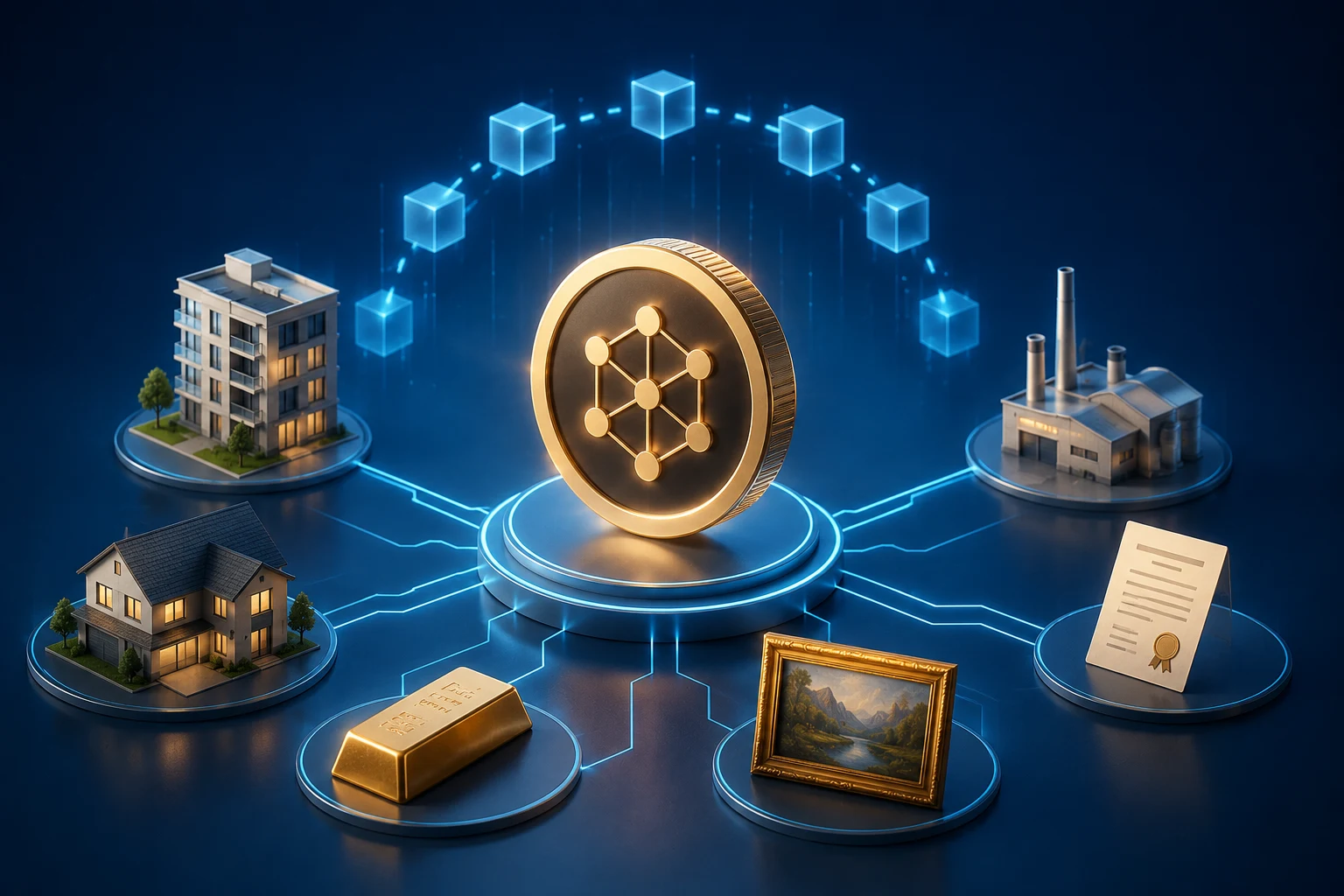
For most of crypto's history, on-chain assets were native to the chain: ETH, BTC, the long tail of altcoins, NFTs, governance tokens. Almost nothing on-chain represented a claim on anything in the physical world. That gap is what RWA tokenization closes — taking an off-chain asset (a Treasury bill, a building, a loan, a bar of gold) and issuing an on-chain token that represents ownership, a share, or a redemption claim.
The promise is enormous: programmable, 24/7, globally accessible representations of traditional assets, with crypto-style settlement and DeFi-style composability. The actual deliverable in 2026 is more modest and more interesting: a handful of categories have crossed the chasm, while the most-hyped categories (mass-market real estate) are still mostly narrative. Understanding which is which is most of the value of reading about RWAs.
It is the production-ready version of what is tokenization applied to real-world assets specifically — same primitive, with the harder legal and operational requirements that come from anchoring to off-chain things people care about.
How it actually works
The structure varies per asset class but the pattern repeats:
- An asset exists off-chain — Treasuries in a fund, a loan agreement, a deed, a vault of gold, equity in a company.
- A regulated wrapper (a special purpose vehicle, a fund, a trust, an EMI license, a Reg D fund, a securitization) is structured around that asset. This is the legal claim layer.
- The wrapper issues an on-chain token (usually ERC-20, sometimes a more constrained security token standard like ERC-3643) that represents either fractional ownership, a debt claim, or a redemption right against the wrapper.
- Holders may be required to KYC; transfer may be permissioned to a whitelist; redemption may be daily, periodic, or absent (in which case secondary markets are how you exit).
- The token can usually move on-chain like any other ERC-20 within the constraints set by the issuer — composable with DeFi, transferable between whitelisted wallets, usable as collateral if a protocol accepts it.
The pattern: regulated wrapper anchors the legal claim, on-chain token provides settlement and (limited) composability, KYC and transfer restrictions enforce who can hold the token, and a custody arrangement holds the underlying. Every detail matters more than the chain choice.
The categories that actually scaled
1. Tokenized treasuries (the biggest)
Short-dated US Treasury bills wrapped on-chain — BlackRock BUIDL, Ondo USDY and OUSG, Franklin FOBXX, Mountain Protocol USDM, Superstate USTB, Hashnote USYC, others. Several billion dollars in AUM by 2026 and growing. This is by far the most successful RWA category — see what are tokenized treasuries for the dedicated treatment.
2. Private credit
Loans to businesses — small-medium enterprises, fintech receivables, trade finance — packaged into pools whose tokens represent claims on the cash flows. Maple Finance, Centrifuge, Goldfinch, Clearpool are the leading platforms. The yields are higher than treasuries (often 8-15%) and so is the risk: borrower defaults are real and have happened. The product is best understood as on-chain private credit funds with the usual private credit risks plus smart contract risk on top.
3. Tokenized gold
PAXG (Paxos), XAUT (Tether), and a handful of others wrap allocated physical gold bars stored in vaults (often LBMA-good-delivery in London). The token tracks gold price; the holder has a claim on the underlying gold. The category is small compared to treasuries but has been operating successfully since 2019, which is a long time in crypto.
4. Money market funds and corporate cash management
Adjacent to tokenized treasuries but worth calling out: companies and DAOs increasingly hold treasury reserves in tokenized money-market products rather than custodied USDC. The mechanics are the same as tokenized treasuries; the use case is corporate.
The categories where reality lags hype
Real estate tokenization
The most-pitched RWA use case for years. The on-chain part is trivial; the legal part is hard. Fractionalizing a building requires a regulated wrapper (REIT, SPV, securitization vehicle) plus disclosure, plus a secondary market with enough liquidity to actually exit, plus jurisdictional recognition that the on-chain token represents a transferable interest. A handful of projects exist (Lofty, RealT, Propy adjacent, several Dubai-based and Singapore-based platforms), but cumulative AUM is small and secondary-market liquidity is often poor. The pitch keeps recurring; the at-scale product has not.
Equities and tokenized stocks
Periodic attempts (FTX's tokenized stocks pre-collapse, Backed's bSTOCK products, various 24/7 trading experiments) have shown the demand exists. Regulatory frameworks, broker integrations, and corporate-action handling (dividends, splits, votes) are non-trivial. As of 2026, this remains a frontier rather than a scaled product.
Carbon credits, art, collectibles, royalties
Many experimental issuances, mostly small. The on-chain plumbing is fine; the off-chain economics (carbon credit verification, art price discovery, royalty enforcement) are the bottleneck.
The mechanics behind
Why the legal layer dominates
A blockchain token can be issued in five minutes. A token that durably represents a real-world claim — enforceable in court, redeemable through a regulated process, transferable across borders without breaking securities law — takes months of legal work per jurisdiction. Most RWA projects fail or limp along because they got the token right and the legal claim wrong. The successful ones (BlackRock BUIDL, Maple, Centrifuge) are essentially financial-services firms that ship a blockchain settlement layer, not blockchain firms that ship a financial product.
The custody and oracle question
Every RWA needs a custodian for the off-chain asset (BNY Mellon, State Street, a vault operator for gold) and often an oracle to bring price or NAV data on-chain. Both add trust assumptions. "On-chain" RWAs are not censorship-resistant in the way Bitcoin is — they are settled on a public ledger but anchored at the human-and-institution level.
Composability vs constraint
The early RWA pitch was full DeFi composability: a tokenized treasury used as collateral in Aave, looped through a yield farm, etc. The reality is constrained composability — most issuers require allowlists, restrict transfers to whitelisted addresses, and only a few DeFi protocols are integrated. The composability story has improved (Ondo's USDY is widely accepted; protocols like Morpho and Aave have RWA-friendly markets) but it is still nowhere near "any DeFi protocol just works".
The risks worth knowing
- Wrapper risk. The legal entity holding the asset can be misgoverned, sued, frozen, or wound up. The token's value detaches from the underlying when this happens.
- Custody risk. The custodian holding the actual gold/treasuries/deed can fail or be compromised. Real-world losses have happened (early gold token issuers, some real estate platforms).
- Regulatory risk. RWA frameworks are still being written. A token that complies today may not next year. Several issuers have been forced to delist tokens or restrict jurisdictions on short notice.
- Liquidity risk. Secondary markets for RWA tokens are often thin. The advertised "24/7 tradable" can become "24/7 listed but no bid" in stress. Real estate and exotic RWA tokens are the most exposed.
- Oracle and pricing risk. If a token tracks an off-chain NAV via an oracle, the oracle failing or lagging during stress can cause mispricing and liquidations in dependent DeFi protocols.
- Smart contract risk. The token contract itself can be bugged. The blast radius is smaller than a DeFi farm but the loss is on something that was supposed to be conservative.
None of this is financial advice. RWA tokenization is a real, valuable category — but the working products are the ones that did the unglamorous legal work, and most marketing campaigns sell the easy on-chain part while skipping the hard off-chain part.
Who it actually suits
Treasuries: non-US accredited or qualified investors and institutions seeking on-chain dollar yield; DAOs holding treasury reserves; stablecoin issuers using them as reserves.
Private credit: investors who already understand private credit risk and want crypto-rails settlement and reporting; not for retail savers chasing yield without understanding the underlying loans.
Gold: users wanting blockchain-settled gold exposure with a credible custodian; useful as a non-correlated reserve asset.
Real estate, equities, exotics: mostly experimental in 2026. Suitable for users who understand they are testing a thesis rather than buying a finished product.
Watch the issuers, watch the regulators
RWA tokenization is most volatile not on-chain but in the regulatory and legal layer that sits behind every issuer. Frameworks change, custodians change, jurisdictions shift. Zippfeed tracks regulation, security, and major-token headlines with sentiment and importance scoring, so you can see issuer events, custody changes, and regulatory rulings early — useful whether you are holding tokenized treasuries, allocating to private credit, or just trying to understand which RWA products are real and which remain mostly slideware.