What it really is
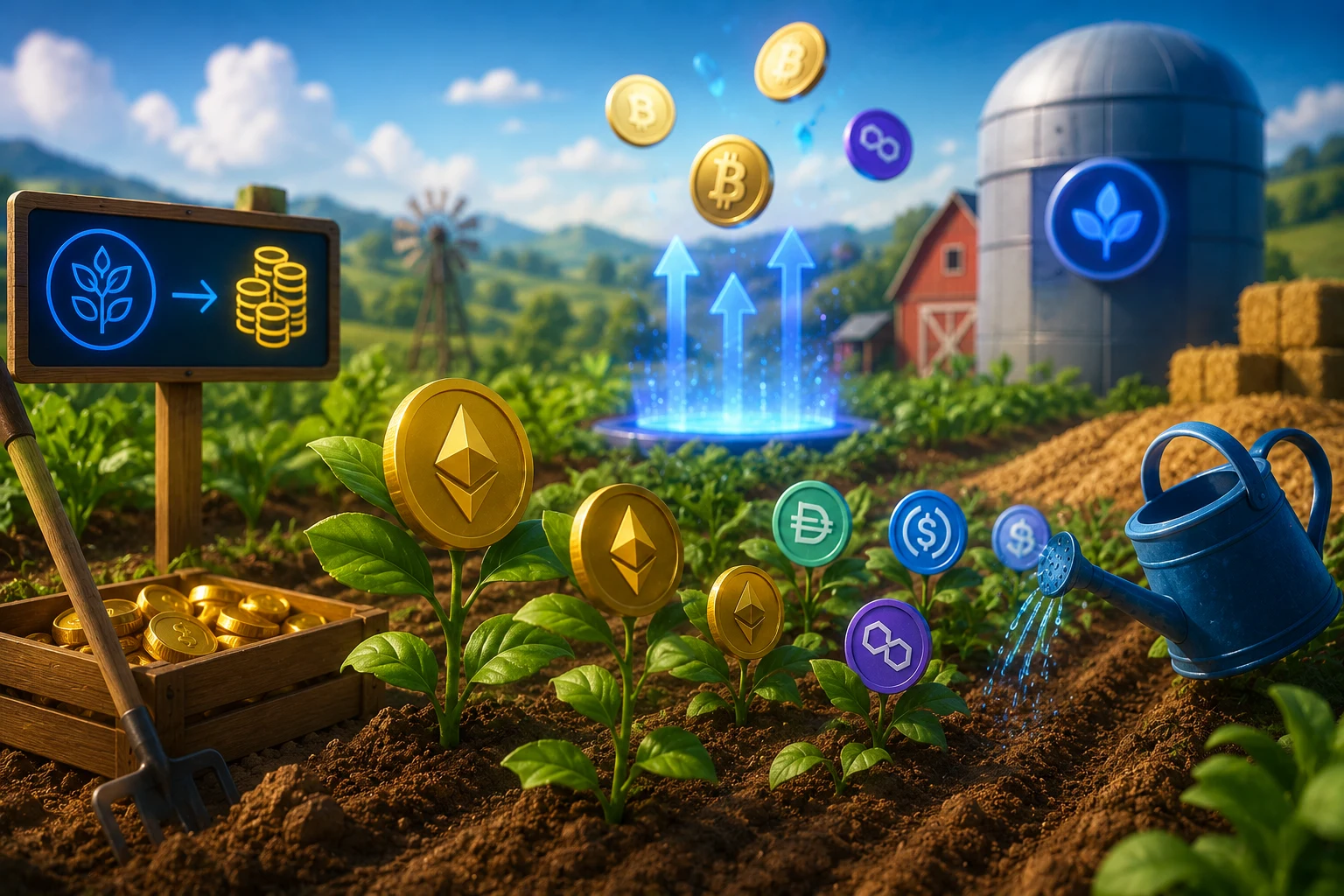
Yield farming means putting crypto to work inside DeFi protocols so it generates a return. Instead of holding ETH in a wallet, you might deposit it into a lending market that pays you interest, or pair it with another token in a liquidity pool that pays you a share of trading fees plus newly issued reward tokens. The collective name for all of this — chasing the best returns by moving capital between protocols — is yield farming.
The label became popular in the 2020 "DeFi summer" when protocols competed for capital by emitting their own tokens as rewards. Triple-digit APYs were normal for a few weeks, then collapsed as more capital arrived and emissions diluted. Yield farming has matured since, but the core dynamic — emissions-driven yields that may not survive a market cycle — is still very much alive.
How it actually works
Yield farming usually breaks down into three repeating activities:
- Provide liquidity. Deposit a pair of tokens (e.g. ETH and USDC) into an AMM liquidity pool on a DEX. You receive an LP token representing your share, and you earn a slice of every swap fee.
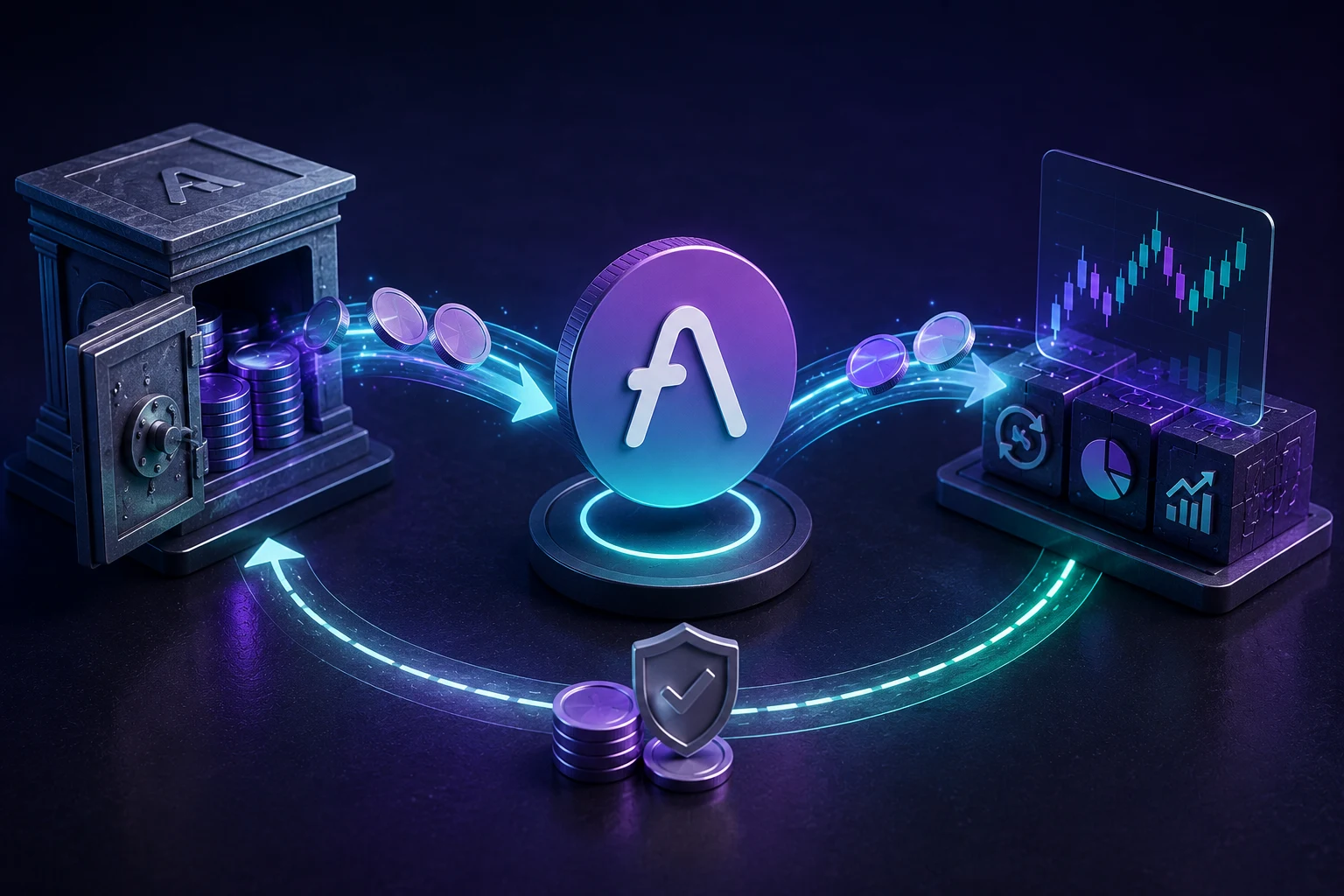
- Lend assets. Deposit a single asset into a money market (e.g. Aave, Compound). Borrowers pay interest; you earn it. Lending rates float with utilization.
- Stake LP tokens. Many DEXs offer extra rewards if you stake your LP tokens in a "farm". This pays you additional protocol tokens on top of swap fees.
Layered yield strategies combine these — for example, deposit stablecoins to a lending market, borrow against them, swap into a stable pair, deposit into a pool, then stake the LP for reward emissions. Each layer adds yield. Each layer also adds risk.
Simple example with numbers
You deposit $1,000 of stablecoins (half USDC, half USDT) into a stable-pair pool on a DEX. You receive an LP token representing your share.
- Trading fees on the pool average 0.04% per day, paid pro-rata. Your share earns roughly $0.16 per day.
- The DEX runs an emissions program rewarding LP stakers with its native token. Current advertised APR: 30%, paid in that token.
- You stake the LP, claim the emitted tokens weekly, and sell them for stablecoins to lock in returns.
That looks like a 30%+ APY. The reality:
- The token's price drifts down as farmers sell into demand. The 30% APR in tokens might be 8-10% in dollars after a month.
- Other farmers join, your share dilutes, your $1,000 now represents a smaller percentage of the pool.
- If one of the stablecoins depegs even briefly, your LP rebalances toward the depegged side — leaving you with more of the bad asset and less of the good one. This is impermanent loss in its meanest form.
The headline rate is often the most misleading number on the screen.
The mechanics behind
Where the yield actually comes from
Sustainable yield comes from three real sources: trading fees paid by users swapping in a pool, interest paid by borrowers in a lending market, and yield generated by the underlying asset (e.g. T-bill yields routed through tokenized treasury protocols). Anything beyond that is paid in protocol tokens — emissions — and those tokens have value only as long as buyers exist for them.
Emissions are not free money; they are a transfer from existing token holders to liquidity providers. They make sense as a bootstrap. They become a problem when they are the whole return.
The APR vs APY distinction
Advertised yields are usually quoted as APY (compounded) when they came in as APR (simple). Tools that auto-compound rewards inflate the number further. When you compare two farms, normalize to the same convention. "100% APY" with daily compounding is roughly 70% APR.
The Anchor cautionary tale
Anchor, on the Terra blockchain, advertised ~20% yields on UST stablecoin deposits in 2021-2022. The yield came from a combination of staking rewards and protocol-funded subsidies; when borrower demand fell, the subsidy was paid from a reserve fund that was visibly running out. In May 2022, UST lost its peg and collapsed. Anchor depositors who hadn't withdrawn lost most of their capital. The system burned about $40 billion of value in days.
The Anchor lesson is not "all yield is bad". It is: understand where the yield comes from, and what happens when the source stops. A yield paid from a subsidy that nobody is renewing is a countdown.
The risks worth knowing
- Smart contract risk. The protocol holding your funds is code. Bugs and exploits regularly drain pools of tens to hundreds of millions. Audits help but do not eliminate this.
- Impermanent loss. If the pair of assets in your pool moves apart in price, you lose value relative to simply holding them. We cover this in detail in what is impermanent loss.
- Token emissions decay. The reward token is usually unlocked and sold by farmers. Its price falls. Your real yield drops faster than the dashboard suggests.
- Stablecoin depeg. A stable-pair pool seems safe until one stable depegs. You end up holding the bad asset disproportionately.
- Lending market liquidation. Looped strategies (deposit, borrow, redeposit) can be liquidated by a price move on the collateral, cascading losses across positions.
- Protocol collapse. See Anchor. See many smaller protocols that simply ran out of funding for emissions and saw TVL exit.
- Bridge and oracle risk. If your strategy spans chains, you also hold bridge risk. If it depends on a price oracle, you hold oracle risk.
None of this is financial advice. It is a map of what "high yield" usually hides.
Who it actually suits
Yield farming is a reasonable activity for users who: already understand DeFi mechanics; can read a protocol's docs and audits and roughly assess their quality; size positions so a total loss is uncomfortable but not catastrophic; and treat advertised APYs as a starting hypothesis to verify, not a quote. Conservative farmers stick to blue-chip lending markets and major stable pools — the yields are lower but the failure modes are well-understood.
Who it does not suit: anyone treating it as a savings account; anyone who clicks "farm" on protocols they cannot name; anyone chasing the highest APY on a leaderboard without asking where it comes from. The pattern of new farmers chasing yield, getting depegged or rugged, and exiting at a loss has repeated many times. The protocols change; the script does not.
Watch the yields, watch the news
Yield farming rates move with protocol upgrades, governance votes, security incidents, and broader market conditions — all of which surface in the news before the dashboards update. Zippfeed tracks DeFi and protocol headlines with sentiment and importance scoring, so you can see security incidents, depegs, and emission changes early — useful context whether you are actively farming or just trying to understand why a "30% APY" suddenly halves overnight.