








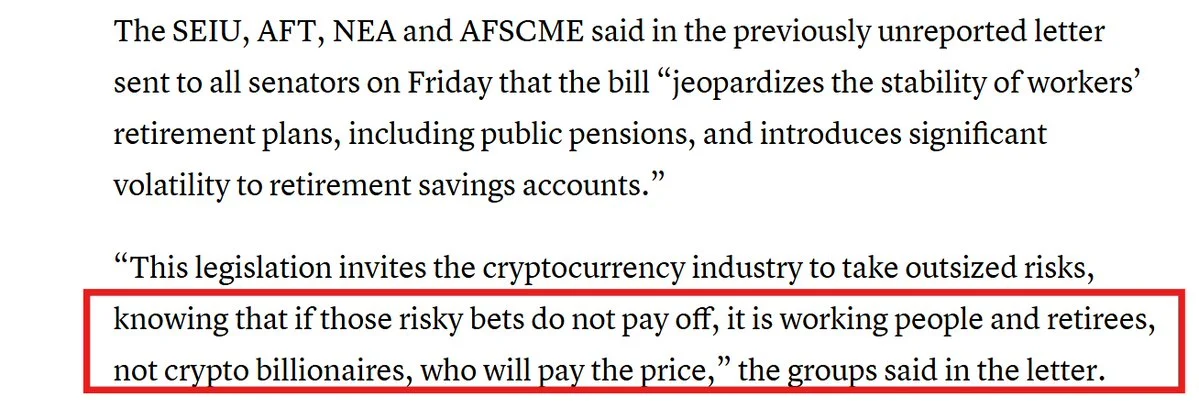

The AFL-CIO, SEIU, the American Federation of Teachers, the National Education Association, and AFSCME are pressing senators to vote against a crypto market-structure bill set for an initial committee vote on Thursday, arguing it would expose millions of workers' retirement accounts and public pensions to digital-asset volatility and weaken broader financial stability.
Why it matters
The bill — a "rules-of-the-road" framework for how digital assets would be traded, custodied, and disclosed — is the Senate's main legislative vehicle for bringing crypto under a single federal market-structure regime. Labor's late-stage opposition reframes the debate around retirement savers and pension funds rather than exchanges and issuers, a political fault line that has historically moved Senate votes more than industry arguments.
Market impact
A defeat or material amendment in committee would slow the bill's path to a floor vote and keep the current patchwork of SEC and CFTC jurisdiction in place. Crypto-aligned groups, including the Digital Chamber and several industry trade associations, have lobbied for passage. Watch Thursday's committee mark-up for amendments on self-custody, stablecoin yield, and disclosure standards — those are the provisions labor groups flagged as the most direct route into retirement portfolios.
Frequently asked questions
-
Which unions are opposing the crypto market-structure bill?
The AFL-CIO, SEIU, the American Federation of Teachers, the National Education Association, and AFSCME are urging senators to vote against the bill at its initial committee mark-up on Thursday.
-
What is the crypto market-structure bill?
It is a "rules-of-the-road" framework that would set federal standards for how digital assets are traded, custodied, and disclosed — the Senate's main vehicle for bringing crypto under a single federal market-structure regime.
-
Why are labor unions opposing it?
The unions argue the bill would expose millions of workers' retirement accounts and public pensions to crypto price volatility and weaken broader financial stability.
-
What happens if the bill fails in committee?
A defeat or material amendment would slow the bill's path to a floor vote and leave the current patchwork of SEC and CFTC jurisdiction over digital assets in place.
-
Which industry groups support the bill?
Crypto-aligned groups including the Digital Chamber and several industry trade associations have lobbied for passage, arguing a unified federal framework is preferable to the current fragmented oversight.

 CoinDesk
 Crypto News
 CoinTelegraph
 WatcherGuru
 TheBlock
 CryptoSlate