








 CoinDesk
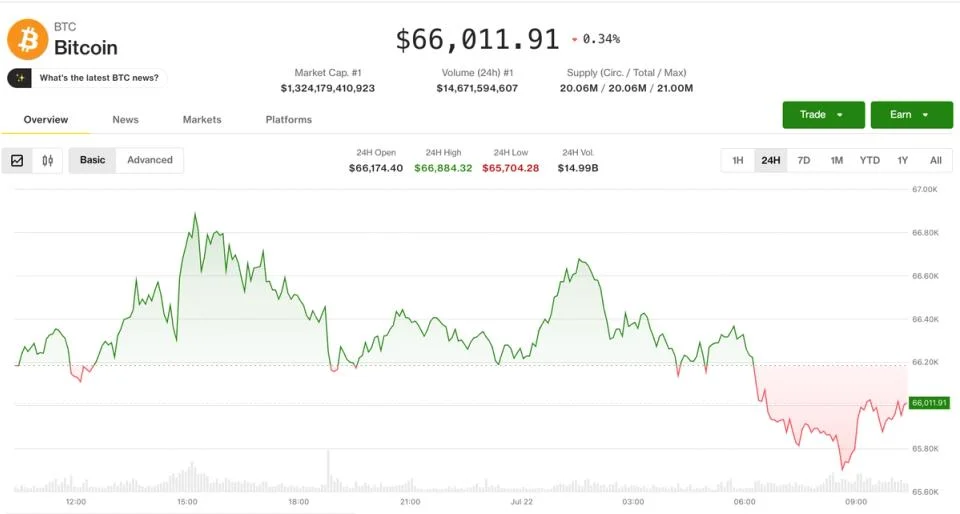



Bitcoin retreated from a one-month high on Wednesday, sliding roughly 0.9% to around $65,900 as WTI crude oil pushed above $85 a barrel for the first time since June. The move came a day after BTC touched its strongest level in over a month, with profit-taking meeting a fresh wave of inflation anxiety tied to the Iran conflict. Ether lost about 0.5% to $1,920 as the broader crypto tape edged lower alongside Nasdaq 100 and S&P 500 futures.
Why it matters
The macro impulse is doing the heavy lifting. Oil topping $85 has revived the inflation concerns that have weighed on risk assets for most of the year, sending gold up 0.95% to $4,118 and silver 1.2%. That same safety bid is visible inside crypto: BTC dominance climbed to 59% as capital rotated out of altcoins and stablecoins into the relative safety of the largest token. CoinMarketCap's Altcoin Season indicator slipped to 50/100, a clear signal that the recent speculative appetite is cooling.
Market impact
Derivatives positioning tells a more cautious story. The 24-hour long/short ratio tightened to 50.59/49.41, evaporating the bullish bias from a day earlier. Trading volume fell 12% to $150 billion while open interest held flat near $116 billion, suggesting the market is pausing rather than capitulating. Bitcoin's 30-day implied volatility index (BVIV) climbed to 40% from 37.5%, meaning traders are paying up for protection ahead of expected turbulence. Most major tokens, excluding XMR, XAUT and HBAR, posted negative 24-hour cumulative volume deltas, confirming broad-based selling pressure. Notable movers: HYPE dropped over 6% as futures open interest surged to 42.8 million tokens and funding rates turned negative, XLM saw short interest build for a third straight day, and Midnight (NIGHT) spiked 19% after Cardano founder Charles Hoskinson praised the project on X.




Frequently asked questions
-
Why did Bitcoin drop after hitting a one-month high?
Profit-taking met a fresh wave of inflation anxiety after WTI crude topped $85 a barrel for the first time since June, driven by the escalating Iran conflict. The macro shock pulled Nasdaq 100 and S&P 500 futures lower alongside crypto.
-
What is BTC dominance and why does it matter here?
BTC dominance measures Bitcoin's share of total crypto market capitalization. It climbed to 59% as capital rotated out of altcoins and stablecoins into the relative safety of the largest token, a classic risk-off signal inside crypto markets.
-
What do the derivatives data say about market positioning?
The 24-hour long/short ratio tightened to 50.59/49.41, evaporating yesterday's bullish lean. Open interest held flat near $116B while volume dropped 12% to $150B, suggesting a pause rather than capitulation. Most major tokens posted negative cumulative volume deltas.
-
Which tokens bucked the broader selloff?
Midnight (NIGHT) surged 19% after Cardano founder Charles Hoskinson praised the project on X. Ether.fi (ETHFI) rose 2.63%, Ethena (ENA) gained 1.27%, and Ondo (ONDO) extended a 26% weekly rally as tokenized real-world assets continued attracting speculative interest.
-
Why are traders paying up for Bitcoin options protection?
Bitcoin's 30-day implied volatility index (BVIV) climbed to 40% from 37.5%, meaning options premiums are rising as traders anticipate more turbulent price action ahead. Despite the cautious tone, BTC calls remain dominant on Deribit, concentrated in the $70,000 and $72,000 strikes.
 CoinTelegraph
 CryptoSlate
 TheBlock
 Crypto News
 WatcherGuru