








 CoinDesk
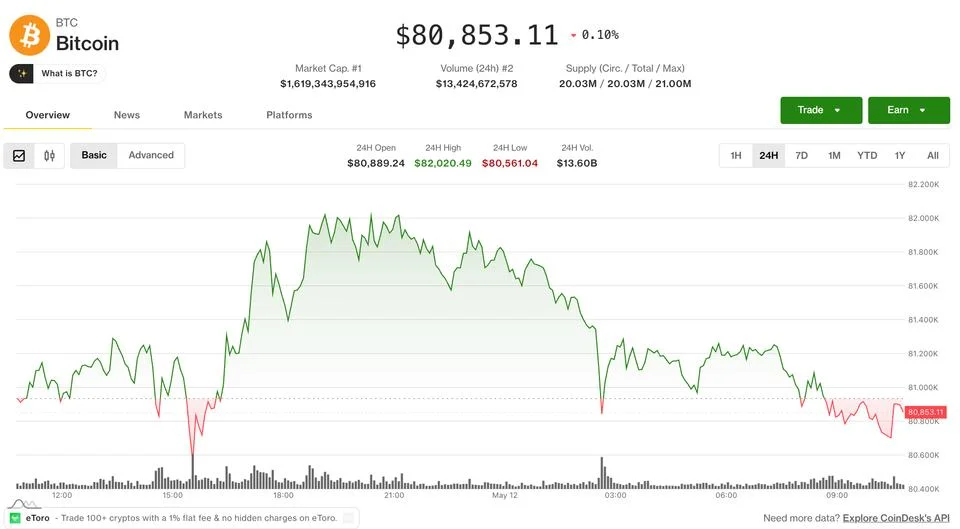
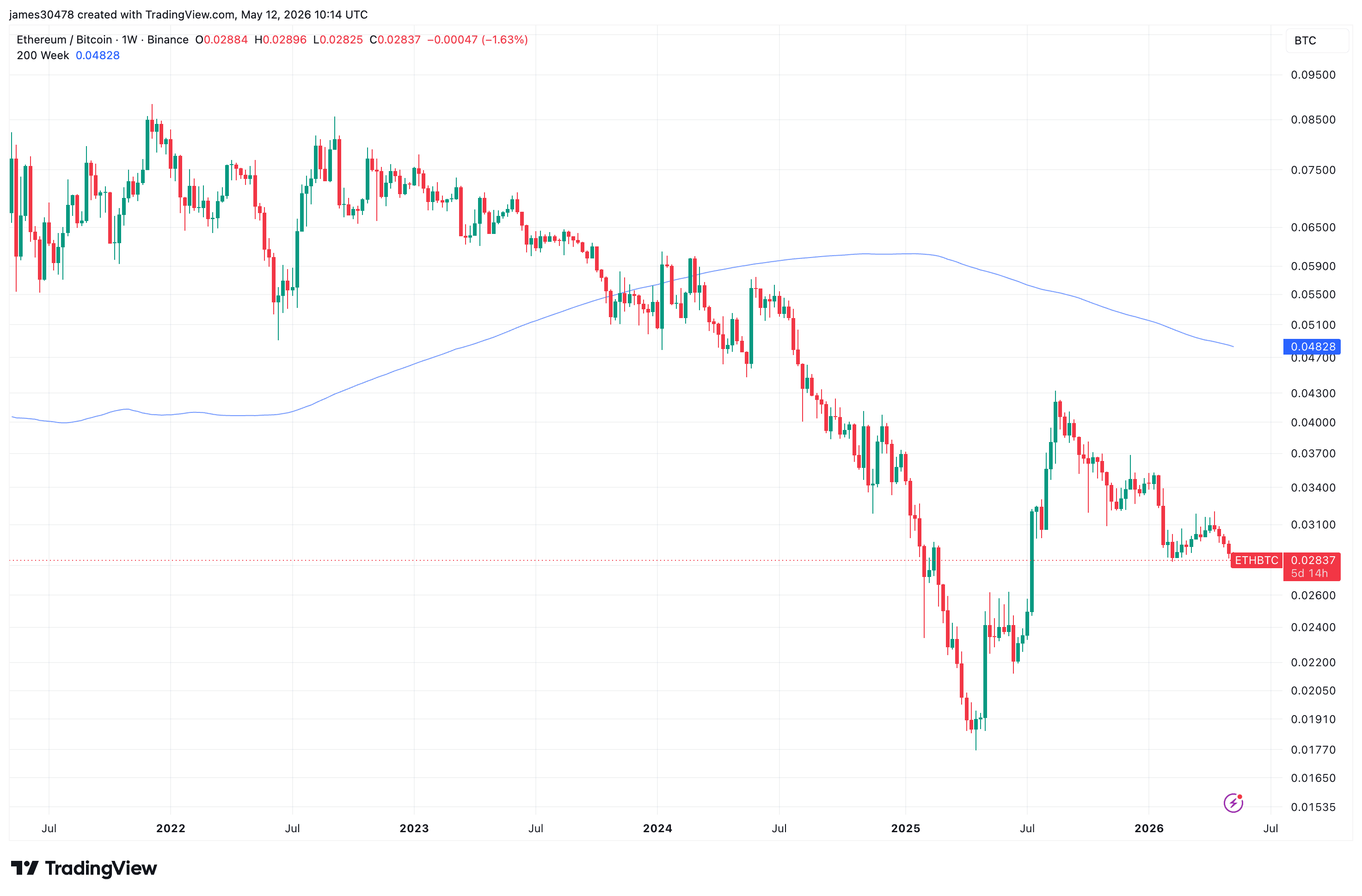


Bitcoin fell about 1% to around $80,800 and ether dropped roughly 2% to $2,290 in the 24 hours through Tuesday midday UTC, as a fresh burst of geopolitical risk pushed crude oil higher and lifted the U.S. dollar. U.S. equity futures slid after President Donald Trump said the ceasefire with Iran was "on massive life support," sending Brent crude to $107 a barrel and the DXY up 0.4%. The move dragged the broader crypto market with it, with CoinDesk's DeFi Select Index (DFX) and Computing Select Index (CPUS) leading losses at -2.7% and -2.3% respectively since midnight UTC.
Why it matters
Bitcoin is now hovering just above the $76,000 level that Bitmine (BMNR) Chairman Tom Lee has flagged as the line that would "confirm the end of a bull market" if BTC fails to hold it by month-end. The current pullback is being driven less by crypto-native flows than by the same macro shock hitting equities and oil — a regime that historically tests BTC's safe-haven thesis in real time. The cross-asset signal is the story: rising DXY, spiking crude, and falling equity futures all hit the same day, and crypto followed equities lower rather than decoupling.
The derivatives picture adds nuance. Market-wide notional open interest in crypto futures actually rose to $125 billion even as 24-hour volumes fell 6% to $174 million — a sign traders are positioning, not actively fading. ZEC saw open interest crash over 10% to 1.9 million tokens from a 4.5-month high, with price sliding to $550 from $642, suggesting bullish bets are being unwound rather than fresh shorts being opened. SUI, CORE, and HBAR were also notable OI decliners, while ETH, XMR, and Canton's CC token saw OI rise.
Market impact
The altcoin tape is split. JUP, MON, and SEI tumbled between 5.6% and 6.3% on thin liquidity, while CRO, CRV, and TON bucked the weakness with 5–10% gains — CRO's move tied to a governance proposal to replace inflation-driven staking rewards with yields funded by actual protocol revenue.





Frequently asked questions
-
Why is Bitcoin falling when there's no crypto-specific bad news?
The selloff is being driven by macro and geopolitical cross-currents — Trump's "massive life support" comment on the Iran ceasefire pushed Brent crude to $107, lifted the DXY 0.4%, and dragged U.S. equity futures lower. Crypto is following equities rather than decoupling from them.
-
What is the $76,000 level that Tom Lee flagged?
Bitmine (BMNR) Chairman Tom Lee has said that if Bitcoin fails to hold $76,000 by month-end, it would "confirm the end of a bull market." Bitcoin was trading around $80,800 on Tuesday, still above the line but with a thinning cushion.
-
Why did ZEC open interest drop so sharply?
ZEC's notional open interest fell over 10% to 1.9 million tokens from a 4.5-month high of 2.48 million, with price sliding from $642 to $550. The pattern — falling OI alongside falling price — typically signals the unwinding of existing bullish bets rather than the opening of fresh short positions.
-
What does the Deribit options flow suggest about trader positioning?
The 24-hour volume ranking on Deribit featured BTC calls at $80,000, $82,000, and $84,000 strikes — bets on a near-term rally — alongside puts at $65,000 and $74,000. The skew implies traders are hedging a deeper drawdown while leaning modestly bullish on a bounce from current levels.
-
Why are CRO, CRV, and TON rallying while the rest of altcoin market sells off?
The move is idiosyncratic, not sector-wide. CRO's 4.1% gain extends a three-day winning streak tied to a governance proposal that would replace inflation-driven staking rewards with yields funded by actual protocol revenue. CRV and TON are also gaining 5%–10% on similar token-specific catalysts, while broader…
 Crypto News
 CoinTelegraph
 Altcoin Daily
 Crypto Rank News
 WatcherGuru
 Glassnode