








 CryptoSlate
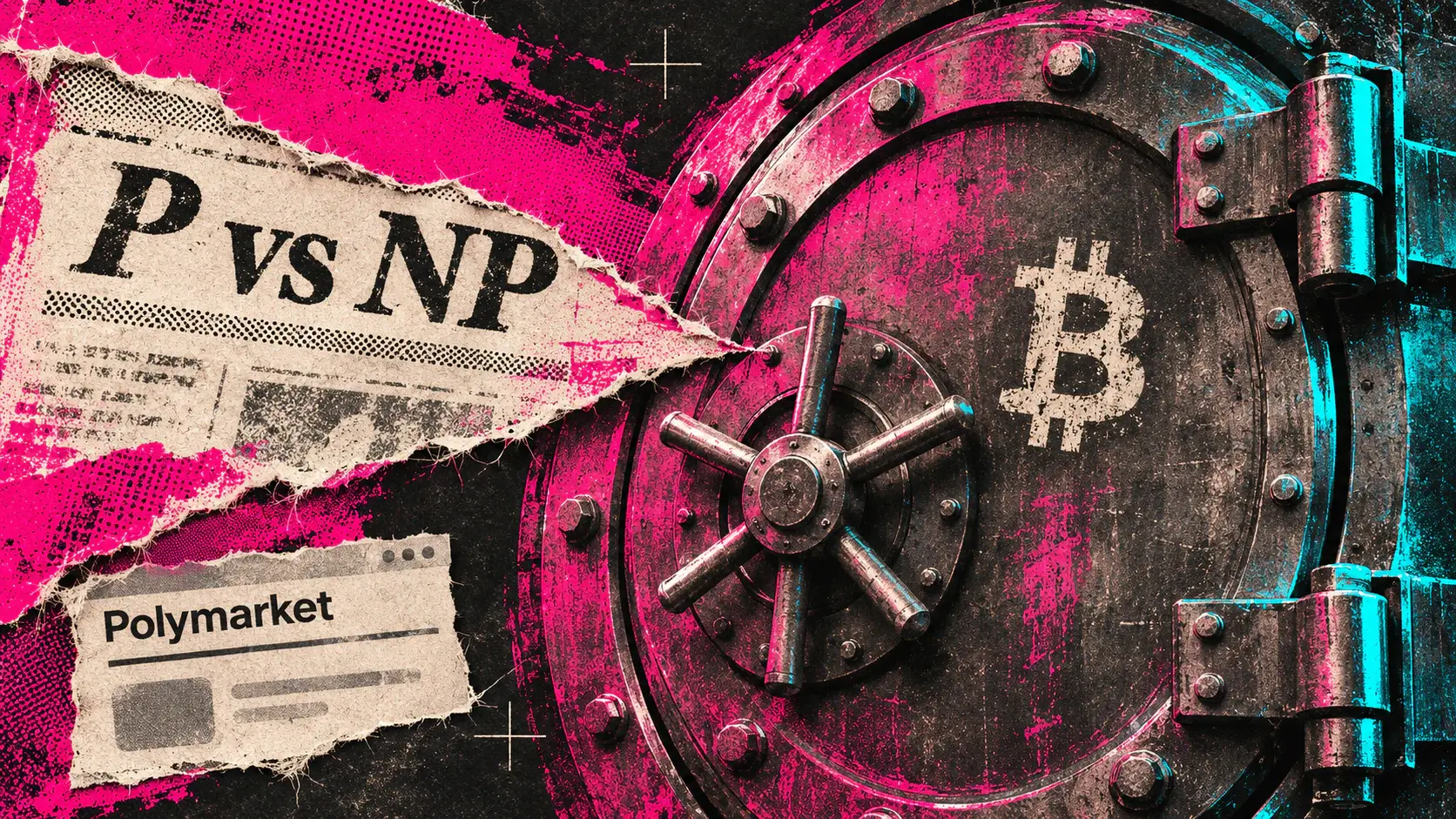
A proof that P equals NP would not necessarily give anyone a practical way to recover a Bitcoin private key. Although such a result would rule out standard one-way functions in their theoretical sense, an algorithm derived from it could still be too slow to use at Bitcoin's key size.
The distinction matters for a Polymarket contract on an AI lab solving the problem. Its rules leave the direction of the proof open, so an eligible announcement that P does not equal NP also appears to qualify. The contract does not price a Bitcoin signature break separately.
A proof that P does not equal NP would not establish that Bitcoin is quantum-resistant, either. Shor's quantum algorithm for discrete logarithms exists independently of the problem; its practical relevance depends on whether a quantum computer can run it at the scale needed for Bitcoin signatures.
For holders, a meaningful test of a claimed breakthrough would include independent reproduction on full-size keys, along with the hardware, time and memory required. Exposure also depends on when a public key becomes visible: a Taproot output includes one from creation, while a fresh P2WPKH output normally reveals its key when spent.

Frequently asked questions
-
Why would a P = NP proof not automatically expose Bitcoin keys?
A proof would rule out standard one-way functions in theory, but an algorithm derived from it could still be impractically slow at Bitcoin's key size.
-
Does the Polymarket contract require an AI lab to prove P = NP?
The contract's rules leave the direction open, so an eligible announcement that P does not equal NP also appears to qualify.
-
Would proving P does not equal NP make Bitcoin quantum-resistant?
No. Shor's quantum algorithm for discrete logarithms exists independently of P vs NP. Its practical relevance depends on whether a quantum computer can run it at the scale needed for Bitcoin signatures.
-
What evidence would make a claimed Bitcoin key breakthrough meaningful?
Independent reproduction on full-size keys, with details of the hardware, time and memory required, would help establish the practical significance of a claim.
-
When do Taproot and fresh P2WPKH payments reveal public keys?
A Taproot output includes a public key when it is created. A fresh P2WPKH output normally reveals its key when it is spent.
 CoinDesk
 Lookonchain
 WuBlockchain
 Benjamin Cowen
 Glassnode