








 CoinDesk

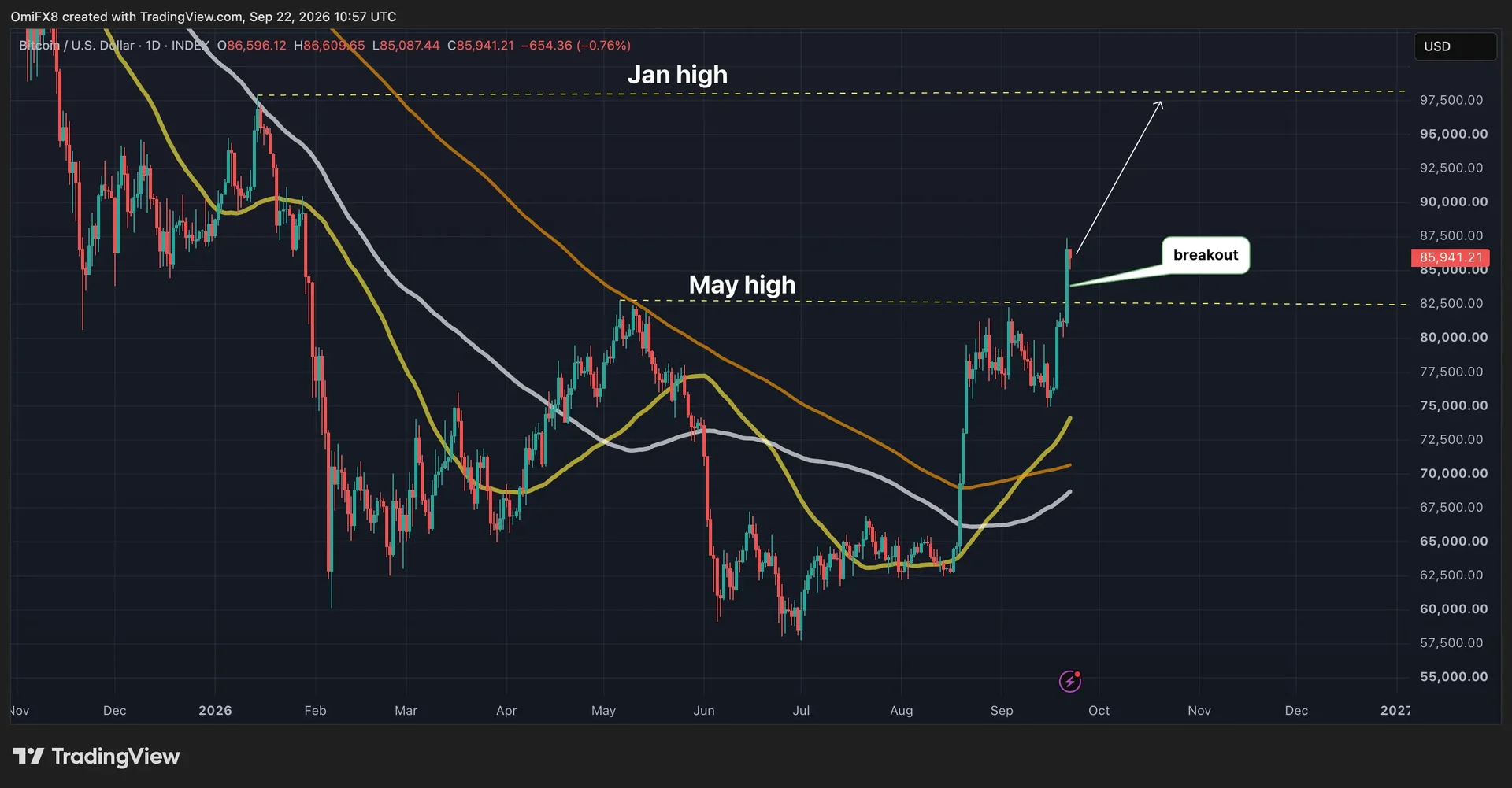


A trader paid $3.17 million in net premium for a long call bitcoin butterfly targeting a $95,000 settlement at the October 30 expiry. The structure, executed in five blocks according to derivatives data source Laevitas, bought Oct. 30 calls at $90,000 and $100,000 while selling twice as many $95,000 calls. Each block held 1,000 long $90,000 contracts, 2,000 short $95,000 contracts, and 1,000 long $100,000 contracts.
The trade makes the most money if bitcoin lands near $95,000 at expiry and pays zero outside the $90,000 to $100,000 range. The trader is therefore positioning for a measured push from roughly $85,000 today toward mid-five figures within four weeks, not a generic upside bet.
Why it matters
The directional conviction is reinforced by bitcoin's chart. BTC trades comfortably above its 50, 100, and 200-day moving averages, a configuration Glassnode calls bullish after roughly 300 days spent below them. Monday's daily candle closed well above the May high, marking another resistance break, with the next major overhead level sitting near the January high above $98,000.
The options market is also tilting bullish. Front-end risk reversals flipped aggressively in favor of calls during bitcoin's run to $85,000, Laser Digital said, before retracing modestly. The call-skew tells you traders are paying up for upside exposure, not just hedging existing longs.
Market impact
The butterfly caps both reward and risk at a known dollar amount, which is why the trade reads as conviction rather than speculation. A move below $90,000 or above $100,000 by October 30 wipes out the entire $3.17 million premium; the trader is choosing a defined payout over open-ended upside.
Vol pricing across majors shows traders are bracing for swings elsewhere. Coinbase Markets listed one-standard-deviation expected moves of 8.9% for XRP, 8.0% for SOL, 6.9% for ETH, and 5.0% for BTC through September 27. Bitcoin is the calmest of the four heading into expiry, which makes a clean push toward $95,000 look plausible from a volatility standpoint.

Frequently asked questions
-
What is a long call bitcoin butterfly?
A long call butterfly pays out most when the underlying settles near a chosen middle strike at expiry. This trade bought Oct. 30 calls at $90,000 and $100,000 while selling twice as many $95,000 calls for a $3.17 million net premium.
-
What price does the bitcoin butterfly need to print at expiry?
The trade pays off positively only between $90,000 and $100,000 at the Oct. 30 expiry, peaking near $95,000. Outside that band the entire $3.17 million premium is lost.
-
How much did the bitcoin butterfly cost the trader?
The combined position cost $3.17 million in net initial premium, executed across five blocks according to derivatives data source Laevitas. Each block held 1,000 long $90,000 calls, 2,000 short $95,000 calls, and 1,000 long $100,000 calls.
-
What does the broader bitcoin options market signal?
Front-end risk reversals flipped aggressively in favor of calls during bitcoin's run to $85,000, Laser Digital said, before retracing modestly. The call-skew tells you traders are paying up for upside exposure rather than just hedging existing longs.
-
How volatile is the crypto options market into the expiry?
Coinbase Markets listed one-standard-deviation expected moves of 8.9% for XRP, 8.0% for SOL, 6.9% for ETH, and 5.0% for BTC through September 27. Bitcoin is the calmest of the four into the window.
 Crypto News
 CoinTelegraph
 TheBlock
 CryptoSlate
 Lookonchain
 WuBlockchain
 Crypto Rank News