








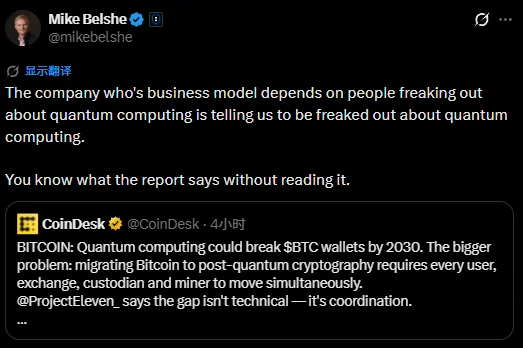

BitGo CEO Mike Belshe publicly disputed a recent report from post-quantum security firm Project Eleven, which warned that quantum computing could threaten BTC wallet security by 2030. Belshe argued the warning is self-serving, noting that Project Eleven's business model depends on stoking quantum-related anxiety.
Why it matters
Project Eleven's actual claim is more nuanced than the headline suggests. The firm did not say quantum computers will break Bitcoin's elliptic-curve cryptography on a fixed timeline — it said the harder problem is coordination. Migrating users, exchanges, custodians, and miners to post-quantum cryptography would require near-simultaneous action across the entire Bitcoin stack, and that has no precedent at this scale.
Belshe's framing — shooting the messenger — doesn't engage with the coordination argument. If a credible quantum breakthrough lands, the gap between "vulnerability disclosed" and "migration complete" becomes the actual attack window, not the time it takes to break a key.
Market impact
No price or protocol impact is expected in the near term. The story matters as a market signal about how the institutional custody side of Bitcoin — BitGo, Galaxy, Coinbase Custody — frames long-horizon cryptographic risk to clients. Watch for whether other custodians echo Belshe's dismissiveness or engage with the coordination point; the spread tells you how seriously the sector is taking the 2030 scenario.

Frequently asked questions
-
What did Project Eleven actually warn about?
The post-quantum security firm warned that quantum computing could threaten BTC wallet security by 2030, and argued the harder problem is coordination — getting users, exchanges, custodians, and miners to migrate to post-quantum cryptography at the same time.
-
Why did BitGo's CEO push back on the report?
Mike Belshe argued the warning is self-serving, coming from a firm whose business model depends on stoking public concern about quantum computing risks.
-
Could quantum computers really break Bitcoin's cryptography by 2030?
Project Eleven did not make a fixed technical claim. It framed the risk as a coordination problem — migrating the entire Bitcoin stack to post-quantum signatures simultaneously has no precedent, and that gap would define any real attack window.
-
Does this report change anything for Bitcoin holders right now?
No near-term price or protocol impact is expected. The story is a market signal about how seriously institutional custodians are taking long-horizon cryptographic risk.
-
What should the Bitcoin ecosystem watch next?
Whether other major custodians echo Belshe's dismissiveness or engage with Project Eleven's coordination argument. The spread of responses will indicate how seriously the sector treats the 2030 scenario.

 Crypto Capital Venture
 CryptoSlate
 Crypto News
 TheBlock
 Crypto Rank News
 CoinDesk