








 CoinDesk
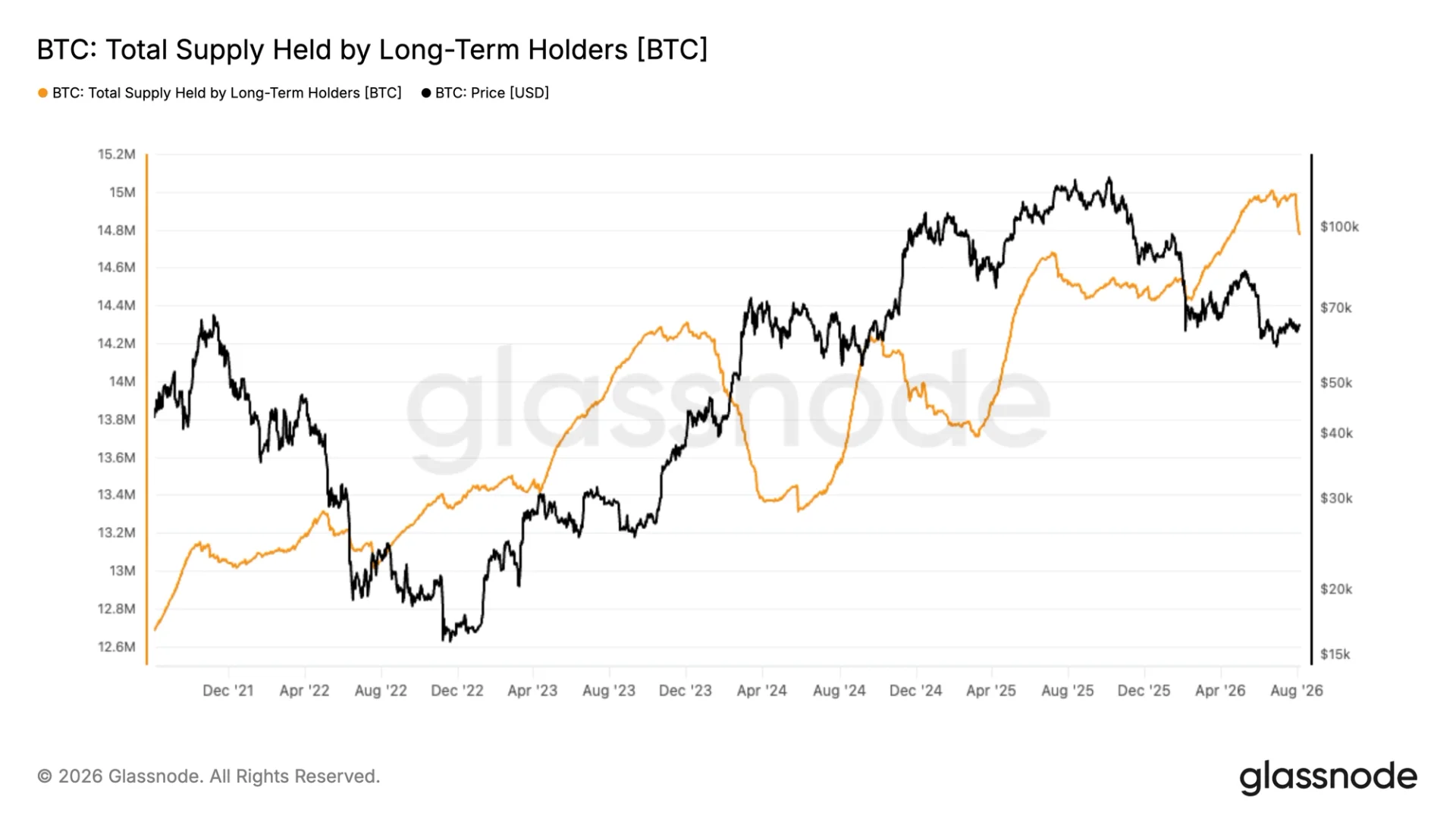



Roughly 210,000 BTC have moved out of long-term holder wallets over the past week, the largest decline since December 2024, according to Glassnode data. The migration follows the Coldcard firmware breach that allowed attackers to reconstruct some users' wallet recovery phrases and drain funds. Bitcoin trades near $64,000, roughly 50% below its October all-time high, an unusual backdrop for heavy long-term holder distribution. Glassnode classifies LTHs as entities whose coins have remained dormant for about 155 days.
Why it matters
Heavy spending from long-term holders has historically coincided with market tops, as experienced holders distribute into rising demand. Similar waves played out in March 2021, March 2024 and December 2024. This time the move is happening near the lows, not the highs, and bitcoin has not made new lows following the hack. That context changes the read: this looks like a custody migration triggered by the Coldcard incident rather than a conviction unwind or profit-taking event.
Market impact
The Coldcard breach stemmed from weak randomness in affected firmware, allowing attackers to reconstruct some users' wallet recovery phrases. Thousands of addresses were affected, with estimated losses reaching as much as $114 million. Coldcard urged affected users to generate new wallets and move funds, noting that updating firmware alone cannot secure keys that may already be compromised. As a result, the decline in long-term holder supply likely captures users shifting BTC to freshly generated wallets, regulated custodians, or spot bitcoin ETFs. US spot bitcoin ETFs attracted roughly $754 million over the past week, with BlackRock's iShares Bitcoin Trust accounting for the bulk of those inflows. LTH supply now sits at approximately 14.7 million BTC, down from just under 15 million BTC before the incident. The on-chain movement does not necessarily equal selling, but the next leg will tell whether this is steady custody migration or follow-through distribution into ETF demand.

Frequently asked questions
-
Why did ~210,000 BTC leave long-term wallets last week?
Glassnode data shows the biggest LTH supply decline since December 2024, with ~210,000 BTC moving out of wallets where coins had been dormant for about 155 days.
-
Was the Coldcard breach the cause of the bitcoin movement?
The Coldcard firmware flaw let attackers reconstruct some users' recovery phrases, with losses estimated at up to $114 million. Affected users were urged to generate new wallets, which likely explains a portion of the on-chain movement.
-
Is this distribution or custody reshuffling?
Bitcoin is trading about 50% below its October all-time high near $64,000, an unusual backdrop for LTH profit-taking. Analysts frame the move as users shifting to new wallets, regulated custodians, or spot ETFs rather than selling into the market.
-
How did spot bitcoin ETFs respond?
US spot bitcoin ETFs attracted roughly $754 million in inflows over the same week, with BlackRock's iShares Bitcoin Trust accounting for the bulk of that flow.
-
What is the current long-term holder supply?
LTH supply has fallen from nearly 15 million BTC to approximately 14.7 million BTC, the largest weekly drop since December 2024.
 Crypto News
 Whale Alert
 TheBlock
 Glassnode
 CoinTelegraph
 WatcherGuru
 WuBlockchain
 Benjamin Cowen