








 CoinDesk
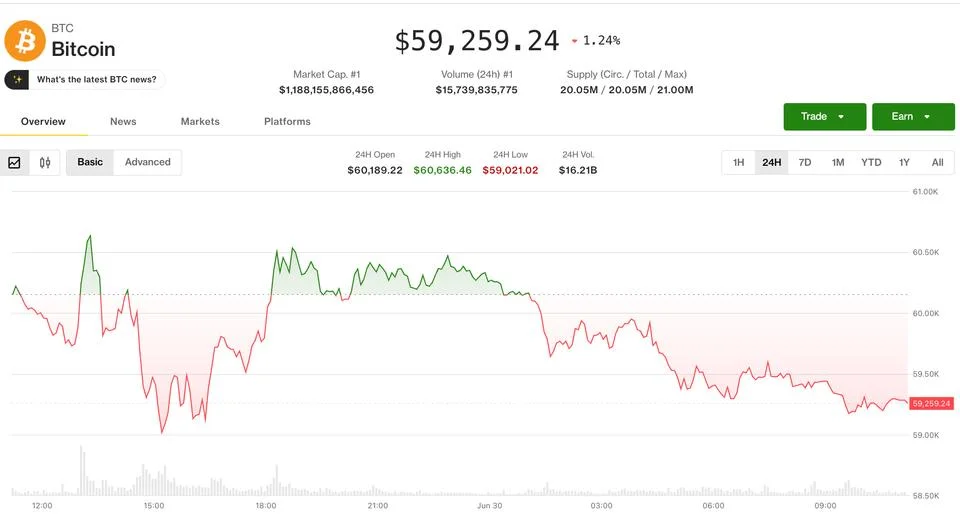



Bitcoin slipped 1.5% on Tuesday to $59,250 after failing to hold $60,000 on Monday, putting it within striking distance of the weekend lows near $58,800 and its weakest point since late 2024. Ether fell 1.73% to $1,580, the same multiyear support zone it bounced from in April 2025 and October 2023, leaving both majors without an obvious floor if that level gives way.
The path lower has not come cheap to hedge. On Deribit, BTC puts are trading at a 10%-plus premium to calls across every expiration, and ETH's weekly puts carry a comparable premium on the short end. That demand for downside protection is sitting alongside muted implied volatility, the BTC 30-day gauge (BVIV) down 11% to 44% on Monday, a divergence that historically resolves fast when it resolves at all.
Why it matters
Puts at a double-digit premium means desks are paying real money to insure a move lower even when the volatility complex is signalling calm. The asymmetry is the story: hedges are pricing in the next drawdown, but the index that usually accompanies one has stayed compressed, leaving the market short convexity into a level that has already rejected twice on the ether side. SOL's open interest is also hovering near record highs, adding another pocket of one-sided leverage into the mix.
Market impact
Dogecoin captured the cleanest signal of the session, with open interest jumping to 16 billion DOGE, the highest since the October 10 crash, on negative funding and a cumulative volume delta that flags aggressive sellers crossing the spread. DeFi majors ethena (ENA), jupiter (JUP) and ether.fi (ETHFI) fell 3.3% to 7.5%, while AI cohort FET, TAO and RENDER slid alongside privacy coins ZEC and XMR. Even hyperliquid (HYPE), the recent outperformer, gave back 2.2% to $65.3, with OI flat at around 40 million tokens and funding running close to an annualized 10% that leaves perps tilted long into a tape that does not want to extend higher. Equities sat still in the same window, the S&P 500 and Nasdaq 100 futures up 0.03% and the DXY adding 0.25%, so the bid has come out of crypto specifically and not out of risk assets broadly.





Frequently asked questions
-
How low is bitcoin trading and what is the next support level?
BTC is at $59,250 after a 1.5% slide on Tuesday, putting the weekend low near $58,800 within reach. A break below that leaves the chart without an obvious floor until the next multiyear support zone from late 2024.
-
What does it mean that BTC puts are trading at a 10% premium to calls?
It means options desks are paying real money to insure a downside move even though the 30-day implied volatility gauge has actually compressed to 44%. The bid for protection is running ahead of the volatility index, a divergence that has historically resolved with a fast move once it resolves.
-
Why are dogecoin and SOL derivatives flashing warning signs?
DOGE open interest jumped to 16 billion tokens, the highest since the October 10 crash, with negative funding and a cumulative volume delta flagging aggressive sellers crossing the spread. SOL open interest is hovering near record highs, leaving both contracts crowded into one side of the book heading into a fragile…
-
How is the altcoin market reacting to bitcoin's slide?
DeFi majors ENA, JUP and ETHFI fell between 3.3% and 7.5%, AI tokens FET, TAO and RENDER sold off, and privacy coins ZEC and XMR caught the same wave. Even HYPE, the recent outperformer, gave back 2.2% to $65.3 with funding still close to an annualized 10%.
-
Are broader risk assets selling off alongside crypto?
No. S&P 500 and Nasdaq 100 futures were up 0.03% on Tuesday and the DXY added 0.25%, so the bid has come out of crypto specifically and not out of risk assets broadly. XLM held on DTCC's tokenized securities news and LIT traded up 23% on the week.
 CryptoSlate
 Crypto News
 TheBlock
 Crypto Rank News
 CoinTelegraph
 Altcoin Daily
 WuBlockchain