








 CryptoSlate


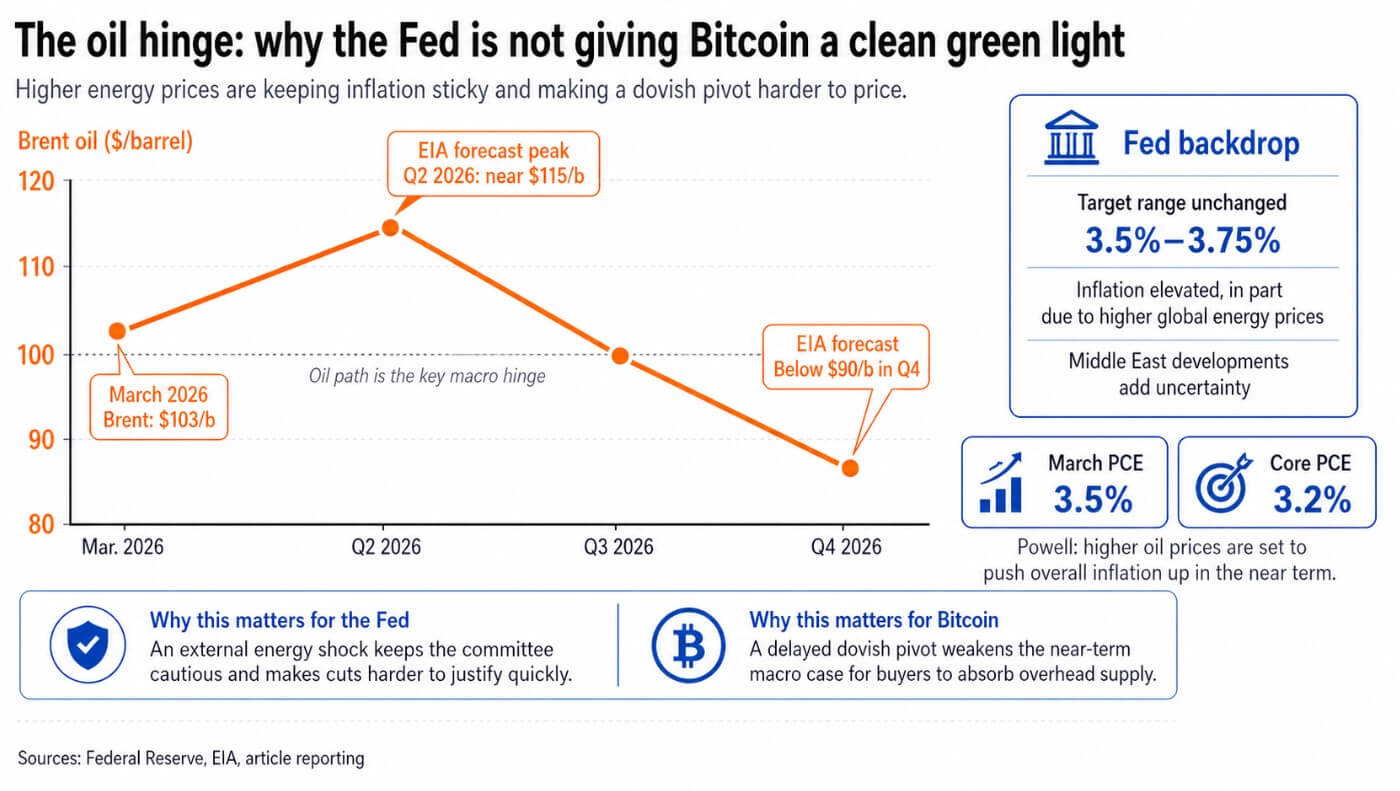
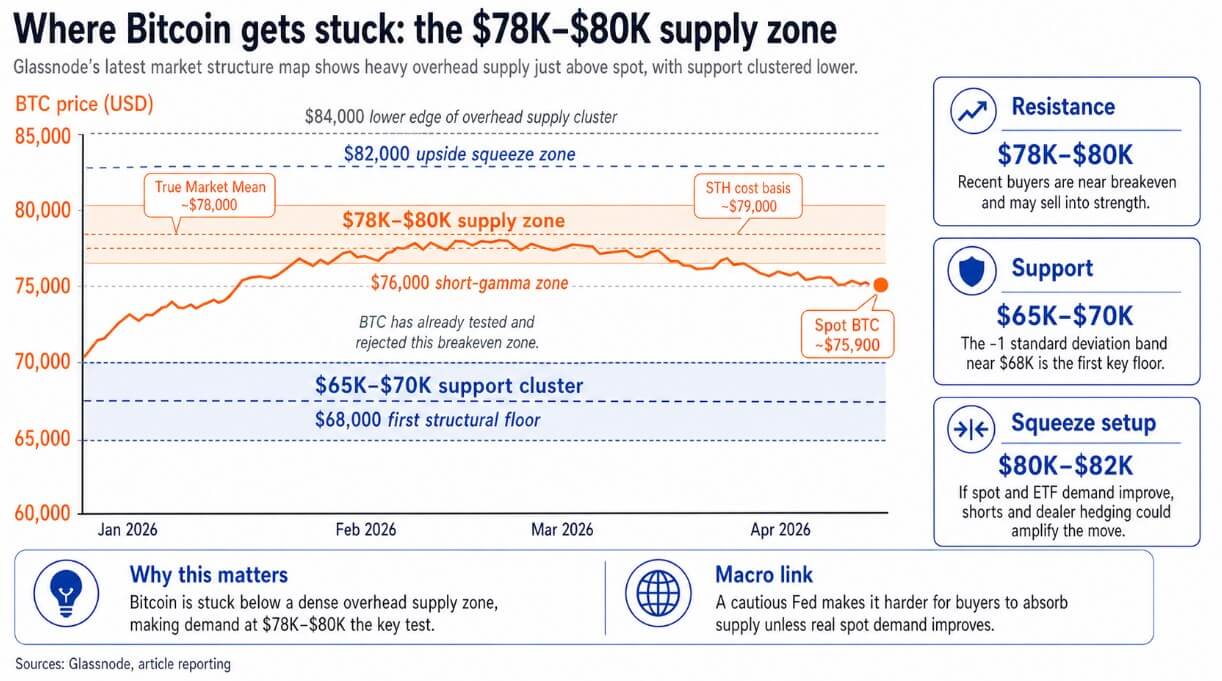
Spot Bitcoin traded near $75,900 in late April 2026, stuck below a dense on-chain supply zone between $78,000 and $80,000 where Glassnode's True Market Mean and short-term holder cost basis converge. The Federal Reserve held the target range at 3.5%-3.75% at its most recent meeting, with Powell estimating total PCE at 3.5% and core PCE at 3.2% through March, and explicitly tying elevated inflation to higher global energy prices. The committee also fractured in its most divided vote since 1992: one official wanted a cut, while Hammack, Kashkari, and Logan objected to retaining the easing bias in the statement at all.
Why it matters
The dovish pivot the market had been waiting for has become harder to price. Powell framed the inflation problem as an external energy shock the central bank cannot calibrate away, and Brent averaged $103 per barrel in March with the EIA forecasting a peak near $115 in Q2 before falling below $90 in Q4. Headline and core inflation are running hot through separate channels, which means the committee must first confirm that higher energy costs are not feeding into inflation expectations before justifying a cut.
Futures markets came away pricing little chance of the March SEP's implied cut materializing by year-end, with some traders even putting a small probability on a hike over the next twelve months. Oil is the deciding variable — BTC bulls need crude to cooperate at least as much as they need Powell to soften his tone.
Market impact
Glassnode's positioning data adds asymmetry to an otherwise cautious picture. Perpetual futures are at a record net-short level, building deep fuel for a squeeze, and spot selling is already easing with ETF AUM beginning to stabilize. The $76,000 level is flagged as a short-gamma zone where dealer hedging flows amplify moves in either direction, while the $82,000 zone above could force dealer buying on a clean break of $80,000. Main support sits between $65,000 and $70,000, with the -1 standard deviation band near $68,000 as the first meaningful structural floor — the level below which distribution accelerates and the broader base weakens.

Frequently asked questions
-
Why is Bitcoin stuck below $80,000 right now?
Spot BTC is trading near $75,900, pinned below a dense supply zone between $78,000 and $80,000 where Glassnode's True Market Mean and short-term holder cost basis converge. Recent buyers distribute into strength at that level, and incoming demand has not been enough to absorb the supply.
-
What did the Fed decide at the latest FOMC meeting?
The Federal Reserve held the target range at 3.5%-3.75% and Powell estimated total PCE at 3.5% and core PCE at 3.2% through March. The vote was the most divided since 1992: one official wanted a cut, while Hammack, Kashkari, and Logan objected to retaining the easing bias in the statement.
-
Why can't the Fed just cut rates to help risk assets?
Powell framed the inflation problem as an external energy shock the central bank cannot calibrate away. With headline and core inflation running hot through separate channels, the committee must first confirm that higher energy costs are not feeding into inflation expectations before justifying a cut.
-
What oil price path does the Fed scenario depend on?
Brent averaged $103 per barrel in March 2026, and the EIA forecasts a peak near $115 in Q2 before falling below $90 in Q4. The bull case for BTC and a Fed cut hinges on oil following that base path lower; the bear case has oil staying elevated through the Q2 peak and keeping headline inflation sticky into late 2026.
-
What are the key Bitcoin levels to watch next?
Above the market, $80,000 is the breakout trigger and $82,000 is a short-gamma zone that could force dealer buying. Below, $76,000 is the short-gamma trigger where hedging flows amplify moves, while $68,000 — the -1 standard deviation band — is the first meaningful structural floor and the level below which…
 Lookonchain
 CoinTelegraph
 Altcoin Daily
 Crypto News
 WatcherGuru
 Crypto Rank News
 CoinDesk