








 WuBlockchain

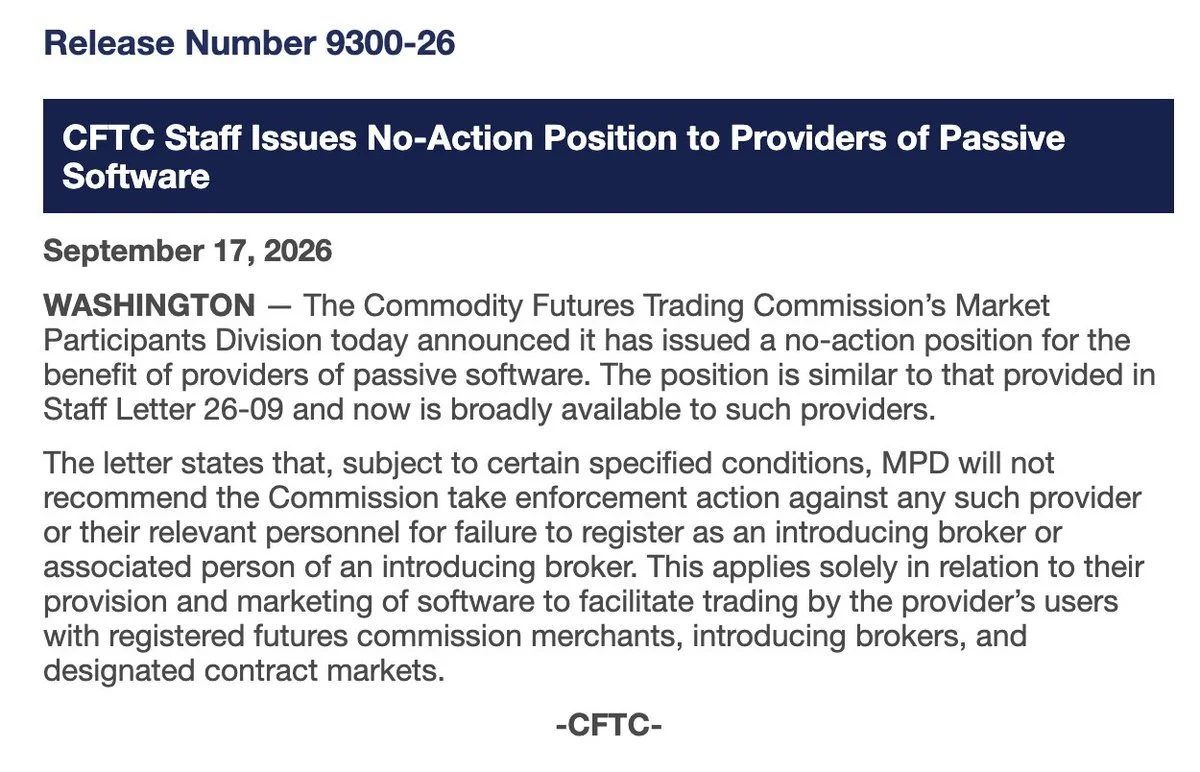
The CFTC’s Market Participants Division issued Staff Letter 26-25, extending the no-action position previously granted to Phantom to eligible passive software providers, including firms outside crypto. The software can connect users with registered futures commission merchants, introducing brokers and designated contract markets to submit orders for CFTC-regulated derivatives.
Why it matters
The position creates a clearer compliance path for front-end software that gives users access to regulated futures, event contracts and perpetual contracts. It also signals that the CFTC is distinguishing passive interfaces from platforms that actively intermediate trades or direct user behavior.
Eligibility depends on strict limits. The software cannot custody user assets, generate explicit buy or sell signals, or exercise discretion over order routing or execution.
Market impact
The immediate impact is structural rather than a direct token-price catalyst. More software providers can potentially build compliant access layers around registered derivatives venues, while those venues retain the regulated execution relationship.
The key test will be whether providers can offer a useful interface without crossing into custody, solicitation or discretionary trading. The framework applies beyond crypto, broadening its relevance across derivatives technology.
Source: [CFTC Staff Issues No-Action Position to Providers of Passive Software](https://www.cftc.gov/PressRoom/PressReleases/9300-26)
Frequently asked questions
-
What does Staff Letter 26-25 allow passive software providers to do?
Eligible providers can operate front-end interfaces that connect users with registered futures commission merchants, introducing brokers and designated contract markets for CFTC-regulated derivatives.
-
Which derivatives can users access through the permitted software?
The software may enable orders for CFTC-regulated futures, event contracts and perpetual contracts.
-
What restrictions apply to the passive software?
It cannot custody user assets, generate explicit buy or sell signals, or exercise discretion over order routing or execution.
-
Does the CFTC position apply only to crypto companies?
No. The extension covers eligible passive software providers, including providers outside the crypto sector.
-
Why is the CFTC position important for derivatives technology?
It creates a clearer compliance path for front-end interfaces while keeping regulated firms responsible for execution and market access.
 WatcherGuru
 TheBlock
 CoinTelegraph
 Crypto News
 CoinDesk
 CryptoSlate