








 CoinDesk

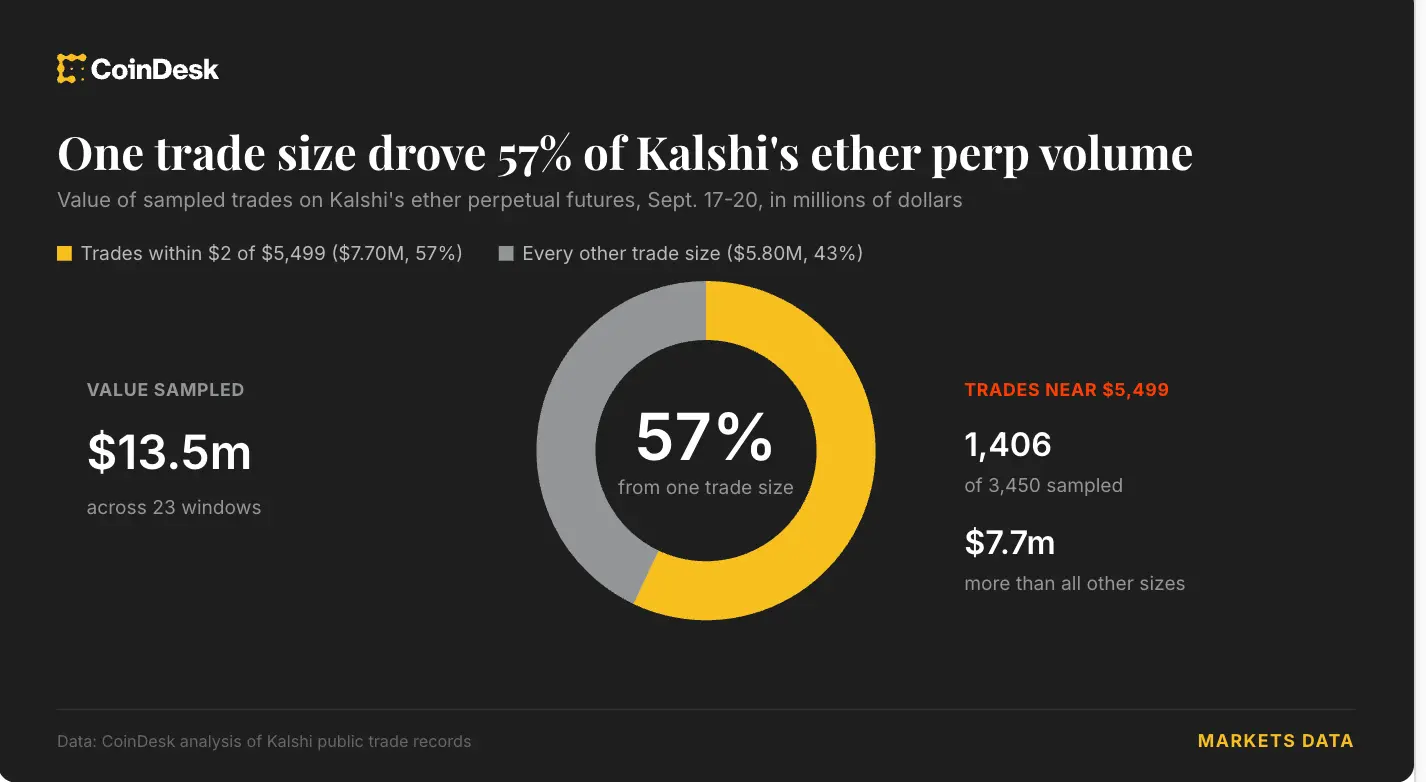
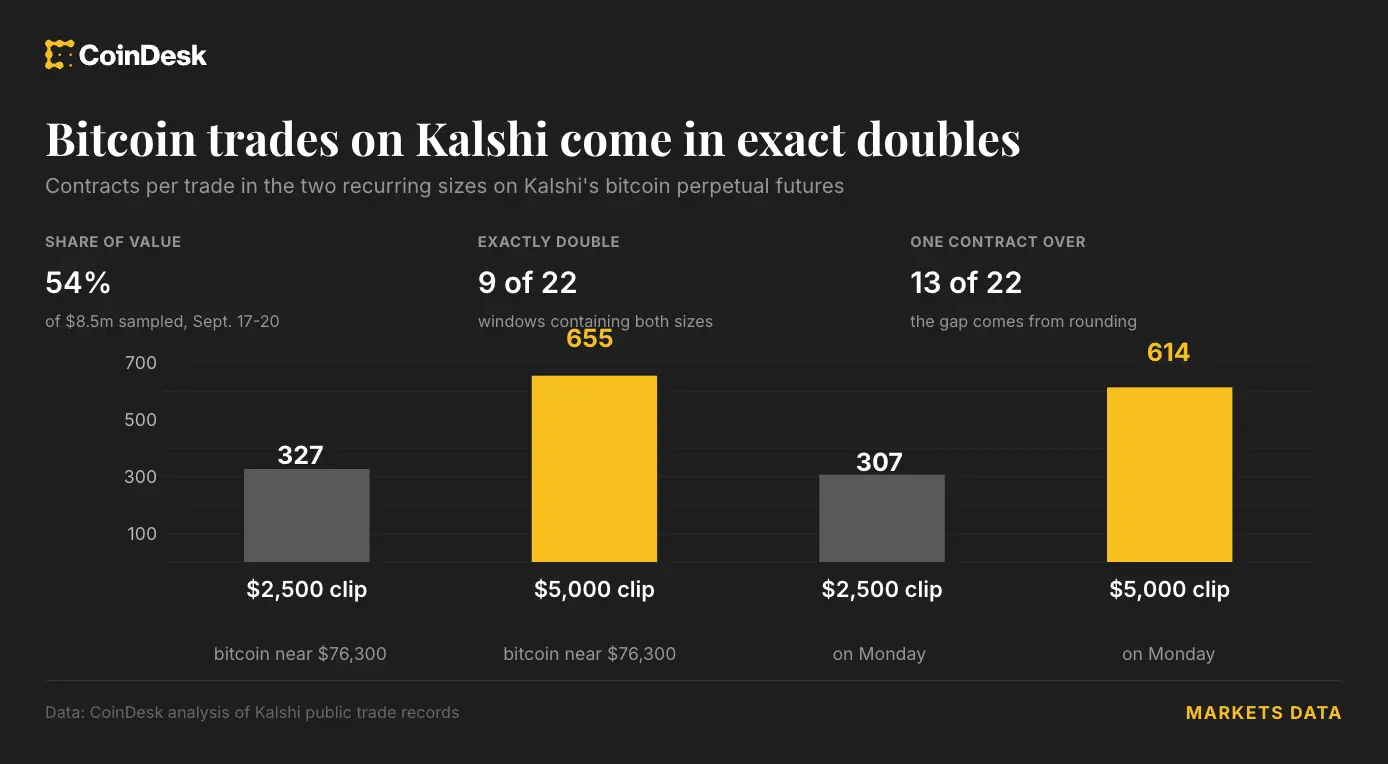

A CoinDesk analysis of Kalshi's public trade records found that a small set of repeating trade sizes accounted for more than half the value traded on the exchange's bitcoin and ether perpetual-futures markets. Trades within $2 of $5,499 made up $7.7 million, or 57%, of the $13.5 million in ether-perp volume sampled from Sept. 17 through Sept. 20, while recurring sizes near $2,500 and $5,000 accounted for 54% of the $8.5 million in bitcoin-perp volume over the same window. The pattern appeared in 43 of 46 hourly samples CoinDesk examined between June 19 and Sept. 20.
Why it matters
Volume is one of the first metrics traders use to judge whether a market is active and liquid enough to trade without moving the price, and it is also how a new market signals adoption. The recurring sizes held nearly fixed dollar values while contract counts adjusted as ether moved from around $1,700 to $2,500, a signature consistent with automated programs executing predetermined dollar amounts, known among traders as clips. The targets themselves shifted over time, from $4,999 to $3,999, $4,499 and $5,499, suggesting periodically adjusted strategy parameters.
Kalshi's ether perpetual also turned over at an extreme rate: a Monday snapshot showed roughly 93 million contracts of 24-hour volume against 1.5 million of open interest, a ratio of 61, second-highest among 20 Kalshi perpetual markets against a median of about eight. The bitcoin contract's ratio was 26.
Public order-book data cannot establish wrongdoing or identify the traders. Pseudonymous trader Beni flagged the pattern on X and accused Kalshi of faking crypto volume. Kalshi's crypto head disputed part of the argument, noting a cited chart covered prediction markets rather than perps, but did not identify who produced the trades.
Market impact
Kalshi, a CFTC-regulated exchange that launched bitcoin perpetuals in late May, had not answered questions about the pattern by press time, including whether any accounts were covered by market-making or incentive arrangements.
A rebate program filed with the CFTC took effect Sept. 16, cutting fees for self-settling firms to 0.003% with a matching market-maker rebate. It began nearly a month after the $5,499 trades first appeared, so it cannot explain their emergence, though it changes the economics of the later sample. What to watch: whether the recurring targets shift again, whether volume holds without them, and whether CFTC-regulated scrutiny follows.


Frequently asked questions
-
What share of Kalshi's ether perpetual volume came from repeating trade sizes?
Trades within $2 of $5,499 accounted for $7.7 million, or 57%, of the $13.5 million in ether-perp volume CoinDesk sampled from Sept. 17 through Sept. 20. On bitcoin, recurring sizes near $2,500 and $5,000 made up 54% of sampled volume.
-
What does the repeating trade pattern suggest is behind Kalshi's crypto volume?
Fixed dollar targets with contract counts adjusting to price are consistent with automated programs executing predetermined dollar amounts, known as clips. Public order-book data cannot establish wrongdoing or identify the traders.
-
How extreme was turnover on Kalshi's ether perpetual market?
A Monday snapshot showed a volume-to-open-interest ratio of 61, the second-highest among 20 Kalshi perpetual markets against a median of about eight. The bitcoin contract's ratio was 26.
-
Did Kalshi's fee rebate program cause the repeated trades?
No. A rebate program filed with the CFTC took effect Sept. 16, cutting fees to 0.003%, but the $5,499 trades first appeared almost a month earlier, so the program cannot explain their emergence.
-
Who flagged the Kalshi volume pattern and how did the exchange respond?
Pseudonymous trader Beni flagged the repeating sizes on X and accused Kalshi of inflating crypto volume. Kalshi's crypto head disputed part of the argument but did not identify who produced the trades, and the exchange had not answered press questions by press time.
 Whale Alert
 CoinTelegraph
 WatcherGuru
 Lookonchain