








 CoinDesk
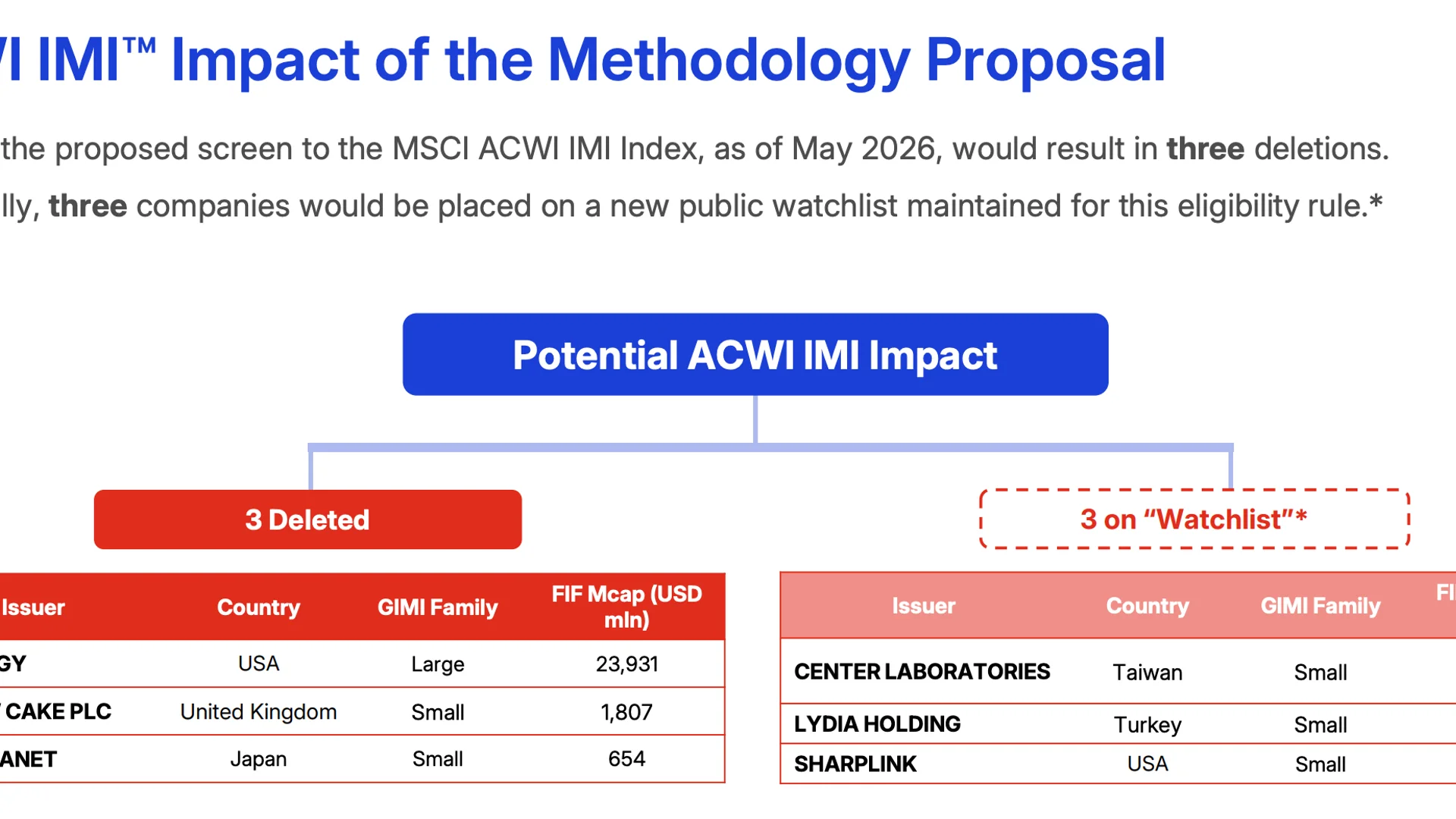



MSCI has opened a fresh consultation proposing to strip 'non-operating companies' from its Global Investable Market Indexes, with Strategy (MSTR), Metaplanet (3350.T) and uranium holder Yellow Cake directly in the crosshairs. The proposal uses a two-step screen: companies whose operating assets exceed 50% of total assets pass automatically, while the rest face five financial-ratio tests, failing four of which means removal. Feedback runs through Sept. 30, results land Oct. 16, and any approved changes would fold into the November 2026 index review.
Why it matters
This is the second MSCI swing at crypto treasury structures in under a year, and the framing matters more than the names. The October 2025 consultation targeted firms holding 50%+ of assets in bitcoin or other cryptocurrencies and named 39 companies; industry backlash and market volatility forced MSCI to defer it. This time the rule sidesteps the 'crypto' label entirely and defines a category: companies that 'create value by accumulating and holding non-operating assets,' generate little cash from operations, and depend on outside capital to grow. That definition fits Strategy's 840,447 BTC hoard ($53.18B, per Bitcoin Treasuries) and Metaplanet's 43,000 BTC ($2B+) almost perfectly, but it also catches any future treasury vehicle built on the same template.
Market impact
For Strategy and Metaplanet, exclusion from MSCI's benchmarks means a structural hit to passive flows: index-tracking funds and ETFs that benchmark against MSCI would be forced to sell, and the stocks lose a layer of buyer-of-last-resort support that has become part of their valuation thesis. The broader precedent is what worries the sector. If MSCI's 'non-operating company' screen survives consultation, any firm whose asset base is dominated by holdings rather than operations becomes harder to defend as an index constituent, from crypto treasuries to holding companies and SPACs. November 2026 is the operational deadline; the next eight weeks of consultation comments decide whether this becomes the new baseline or another deferred proposal.

Frequently asked questions
-
What is MSCI's 'non-operating company' screen?
It's a two-step test. First, a company must have operating assets above 50% of total assets. If it fails that, it faces five financial-ratio tests and is excluded if it fails four out of five.
-
Which companies would MSCI's new proposal remove from its indexes?
Strategy (MSTR), Metaplanet (3350.T) and uranium holder Yellow Cake would be deleted from the MSCI ACWI IMI Index under the proposed screen applied to current data.
-
Why is MSCI targeting bitcoin treasury firms now?
The rule defines non-operating companies as those that 'create value by accumulating and holding non-operating assets,' generate little cash from operations, and depend on outside capital to grow. That profile fits Strategy and Metaplanet almost perfectly.
-
When would MSCI's index exclusion take effect?
MSCI is accepting feedback through Sept. 30, will announce results around Oct. 16, and any approved changes would fold into the November 2026 index review.
-
Has MSCI tried to exclude crypto treasuries before?
Yes. An October 2025 consultation targeted firms holding 50%+ of assets in bitcoin or other cryptocurrencies and named 39 companies; that proposal was deferred after industry backlash and market volatility.
 TheBlock
 Lookonchain
 CryptoSlate
 WatcherGuru
 Crypto News