








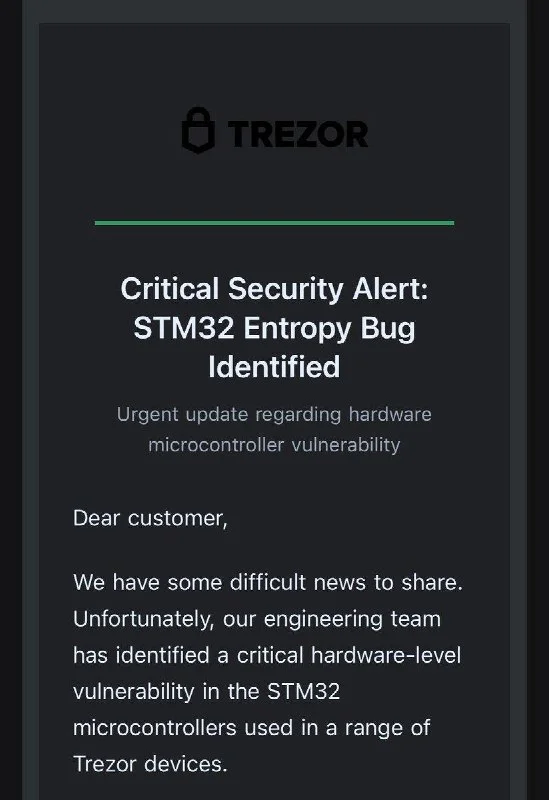
Trezor said a third-party email provider was breached and is still investigating, warning users not to click links in fake "Critical Security Alert" phishing emails. The immediate security concern is impersonation through the email channel and the need to verify messages independently.
Why it matters
Hardware wallets protect digital assets through device-level controls, but phishing attacks target the person using the device. A convincing security email can direct a user to a malicious link or prompt the disclosure of sensitive information. A breach at an email provider can make that social-engineering approach look more credible.
Market impact
For Trezor users, the immediate defense is to treat unsolicited security links as hostile and verify alerts through official channels rather than through the message itself. Trezor is still investigating, so the breach's scope and any effect beyond the email channel remain unclear. The broader signal is operational trust: wallet providers need secure communications alongside secure devices.
Frequently asked questions
-
What should Trezor users do with the fake security emails?
They should not click links in the fake "Critical Security Alert" messages and should verify any alert through Trezor's official channels.
-
Does the warning report a breach of Trezor hardware wallets?
The warning identifies a third-party email provider breach and does not state that Trezor hardware wallets were compromised.
-
Why can an email-provider breach increase phishing risk?
A compromised email channel can make malicious messages look legitimate, directing users toward unsafe links or requests for sensitive information.
-
What remains unclear about the provider breach?
Trezor is still investigating, so the breach's scope and any effect beyond the email channel remain unclear.
-
What broader security lesson does the incident highlight?
It shows that hardware-wallet security depends on secure communications as well as secure devices, since phishing attacks target the person using the wallet.

 Lookonchain
 CryptoSlate
 CoinDesk
 WuBlockchain
 TheBlock