








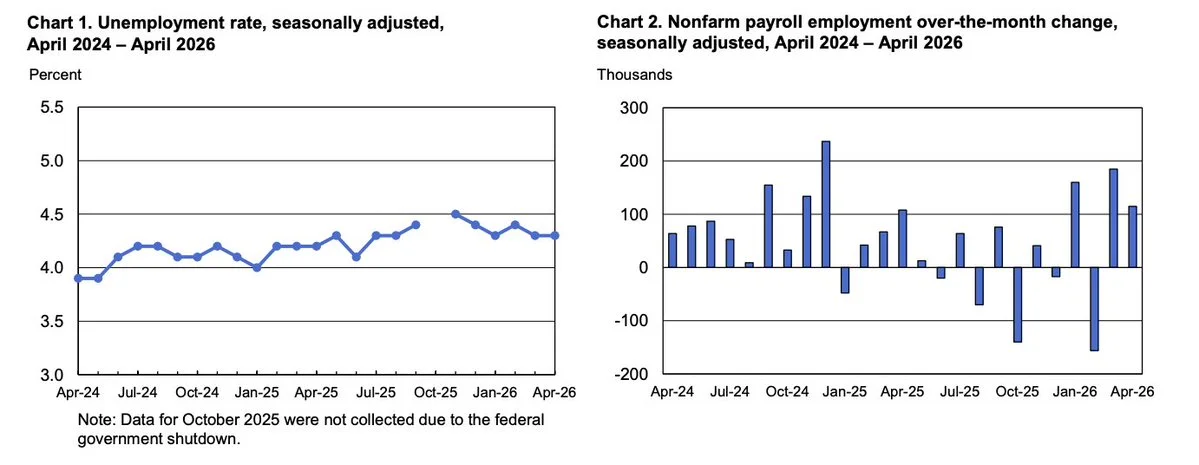

The U.S. economy added 115,000 jobs in April 2026, well above the 62,000 consensus estimate, according to the Bureau of Labor Statistics. March's print was revised up to 185,000. The unemployment rate held steady at 4.3%.
Job gains were concentrated in health care, transportation and warehousing, and retail trade. Federal government employment continued to decline, a pattern that has now persisted across multiple reports. Broader labor indicators, including the underemployment rate, softened modestly even as the headline held.
Why it matters
The size of the beat matters less than its composition. A 115K print against 62K expectations reframes the near-term policy path: a labor market still adding jobs at that pace is harder for the Fed to cut into without reigniting services inflation, especially with wages re-accelerating in cyclical sectors. The 4.3% unemployment rate is no longer falling, which is consistent with a slow-cooling rather than a hard-landing trajectory.
The split between resilient private hiring and sustained federal headcount reduction is the structural read. It implies the public sector is doing the cyclical work the private market no longer needs to do — the opposite of past late-cycle setups, where government hiring cushioned private weakness.
Market impact
Rates moved on the print: front-end yields rose as traders pared back the probability of a near-term cut. Equities initially faded before recovering into the close as the composition — services-led gains, no wage breakout — was read as soft-landing-compatible rather than reflationary. Crypto followed the risk turn, with $BTC giving back premarket gains before stabilizing.
Watch the June CPI print and the JOLTS quits rate for confirmation that the cooling is orderly.

Frequently asked questions
-
How many jobs did the US economy add in April 2026?
The U.S. added 115,000 nonfarm payrolls in April 2026, well above the 62,000 consensus estimate. March's figure was revised up to 185,000, per the Bureau of Labor Statistics.
-
What was the US unemployment rate in April 2026?
The unemployment rate held steady at 4.3% in April 2026, unchanged from the prior month, while broader underemployment indicators softened modestly.
-
Which sectors led job gains in the April 2026 jobs report?
Health care, transportation and warehousing, and retail trade led April's job gains. Federal government employment continued to decline, extending a multi-month trend.
-
How did markets react to the April 2026 nonfarm payrolls beat?
Front-end Treasury yields rose as traders pared near-term rate-cut bets. Equities faded then recovered; crypto followed the risk turn, with BTC giving back premarket gains before stabilizing.
-
Why does the April 2026 jobs report matter for the Fed?
A 115K print against 62K expectations is hard for the Fed to cut into without reigniting services inflation, especially with wages re-accelerating in cyclical sectors. Markets now price a lower probability of a near-term cut.

 WatcherGuru
 Crypto News
 Benjamin Cowen
 CoinTelegraph
 Crypto Capital Venture
 CoinDesk