


 CryptoSlate
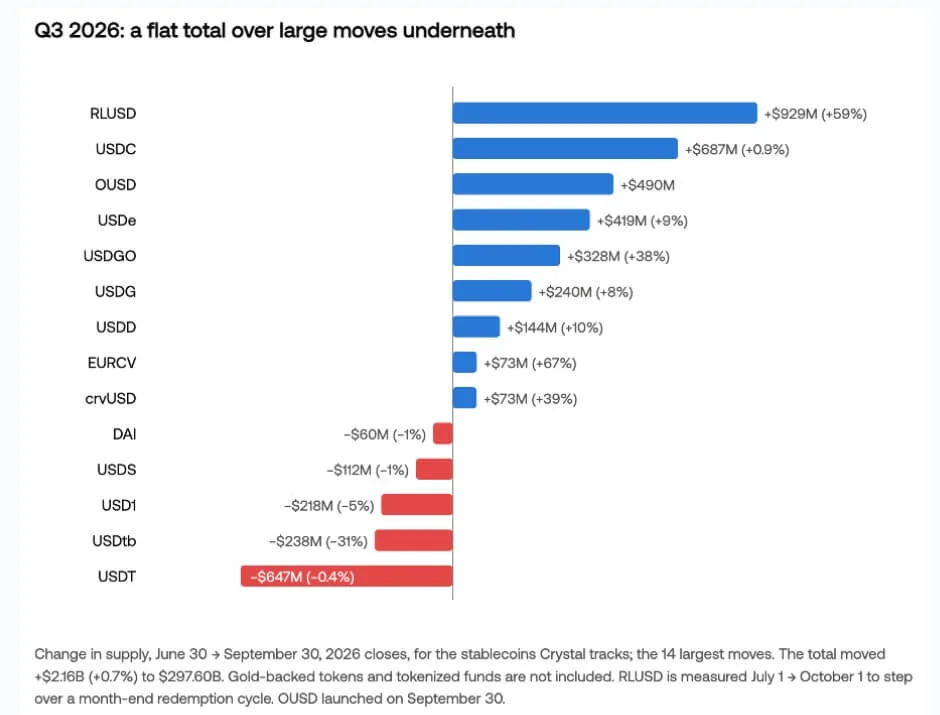

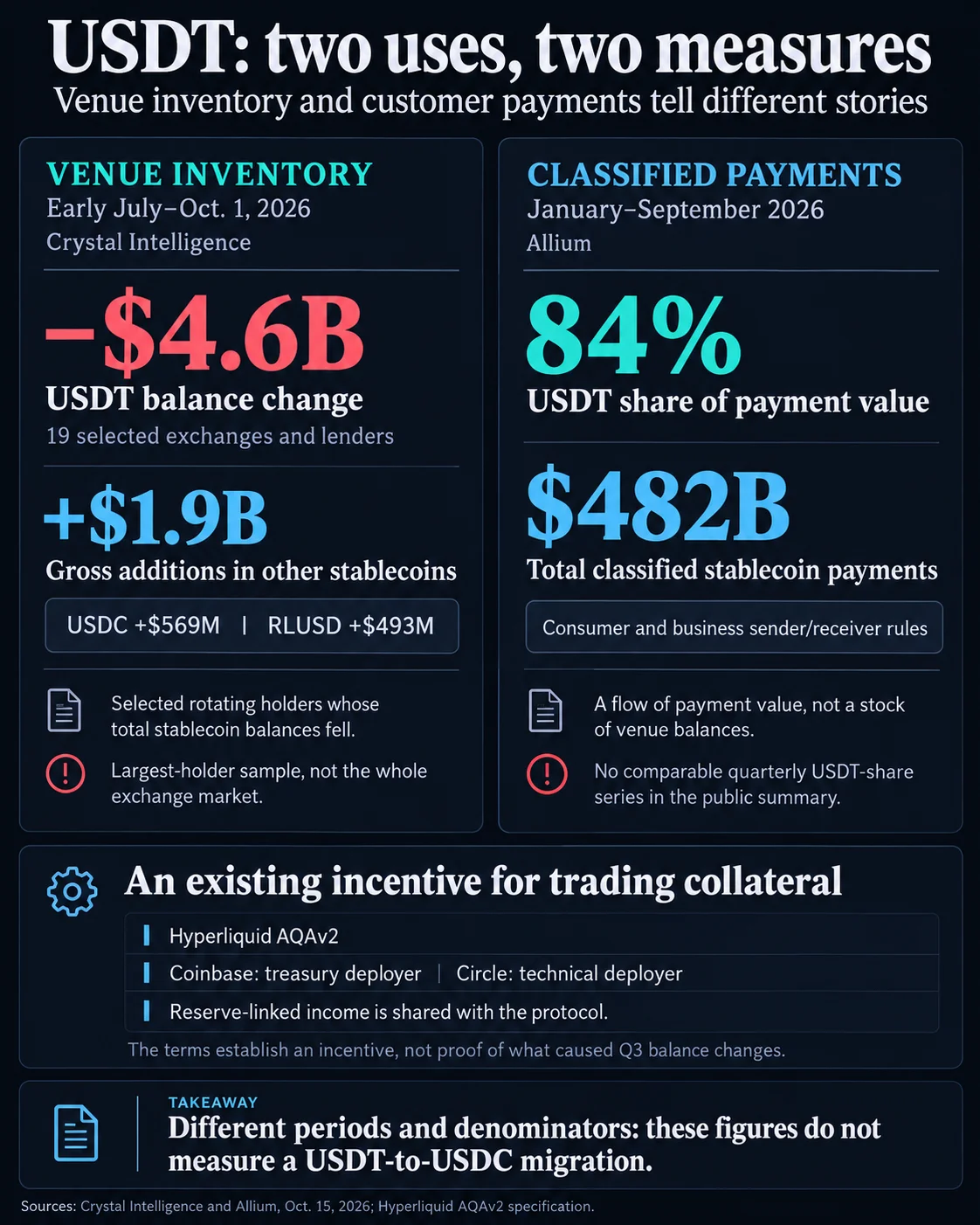
Tether's USDT supply across 19 major cryptocurrency exchanges and lenders fell $4.6 billion in the third quarter, while the same institutions added roughly $1.9 billion in rival stablecoins, including $569 million of Circle's USDC and $493 million of Ripple's RLUSD, according to a Crystal Intelligence report.
Bybit recorded the largest USDT reduction, shedding $1.66 billion while adding $315 million of RLUSD. Binance cut $987 million of USDT and acquired $223 million of USDC, and OKX trimmed $899 million of USDT while adding $273 million of USDC. Across the wider market, USDT's circulating supply slipped 0.4% to about $184 billion, while RLUSD jumped 59% to $2.5 billion.
Why it matters
The shifts reflect a market where stablecoin issuers now pay heavily for distribution. Hyperliquid added $1.5 billion of USDC under an arrangement with Coinbase and Circle that shares reserve income with the platform. Deribit rewards customers directly for holding USDC and expanded that program to roughly 70 more countries, while Bybit's RLUSD grew after a rewards campaign with Ripple.
The economics are steep. Circle generated about $1.4 billion of revenue in the first half of 2026 but spent $819 million, or 59%, on distribution costs, leaving just $103 million in net profit. Coinbase, its largest partner, held a record $20 billion of average USDC in Q2, and Circle has since signed a five-year deal with Binance that included a $100 million investment. PayPal's PYUSD offers a 4.5% incentive on up to $1 billion through USD.AI, and Stripe-owned Bridge launched Open USD returning most reserve income to partners.
Market impact
Despite losing exchange balances, Tether's dominance in payments is intact. Allium data shows stablecoins processed $482 billion in classified payments from January to September, with USDT carrying 84%, about $405 billion versus $77 billion for all rivals. Named exchanges still held roughly $85 billion in tracked stablecoins at the end of September, two-thirds of it in USDT, and Tron processed about two-thirds of payment value.



Frequently asked questions
-
How much USDT did exchanges shed in Q3?
USDT balances across 19 selected cryptocurrency exchanges and lenders fell $4.6 billion during the third quarter, per Crystal Intelligence, while the same institutions added about $1.9 billion in competing stablecoins.
-
Which exchanges cut Tether the most?
Bybit recorded the largest reduction, shedding $1.66 billion in USDT while adding $315 million of RLUSD. Binance cut $987 million of USDT and OKX trimmed $899 million.
-
Why are exchanges holding more USDC and RLUSD?
Issuers are sharing reserve income with distribution platforms. Hyperliquid receives income from USDC deployed via a Coinbase and Circle arrangement, Deribit pays customers to hold USDC, and Bybit ran a rewards campaign with Ripple for RLUSD.
-
Does Tether still dominate stablecoin payments?
Yes. Allium data shows USDT processed 84% of the $482 billion in classified stablecoin payments from January to September, roughly $405 billion, versus $77 billion for all competing stablecoins combined.
-
What does distribution competition cost issuers?
Circle generated about $1.4 billion of revenue in the first half of 2026 but spent $819 million, or 59%, on distribution and transaction costs, leaving roughly $103 million in net profit, about seven cents per revenue dollar.
 WatcherGuru
 TheBlock
 WuBlockchain
 CoinTelegraph
 CoinDesk