








 WuBlockchain
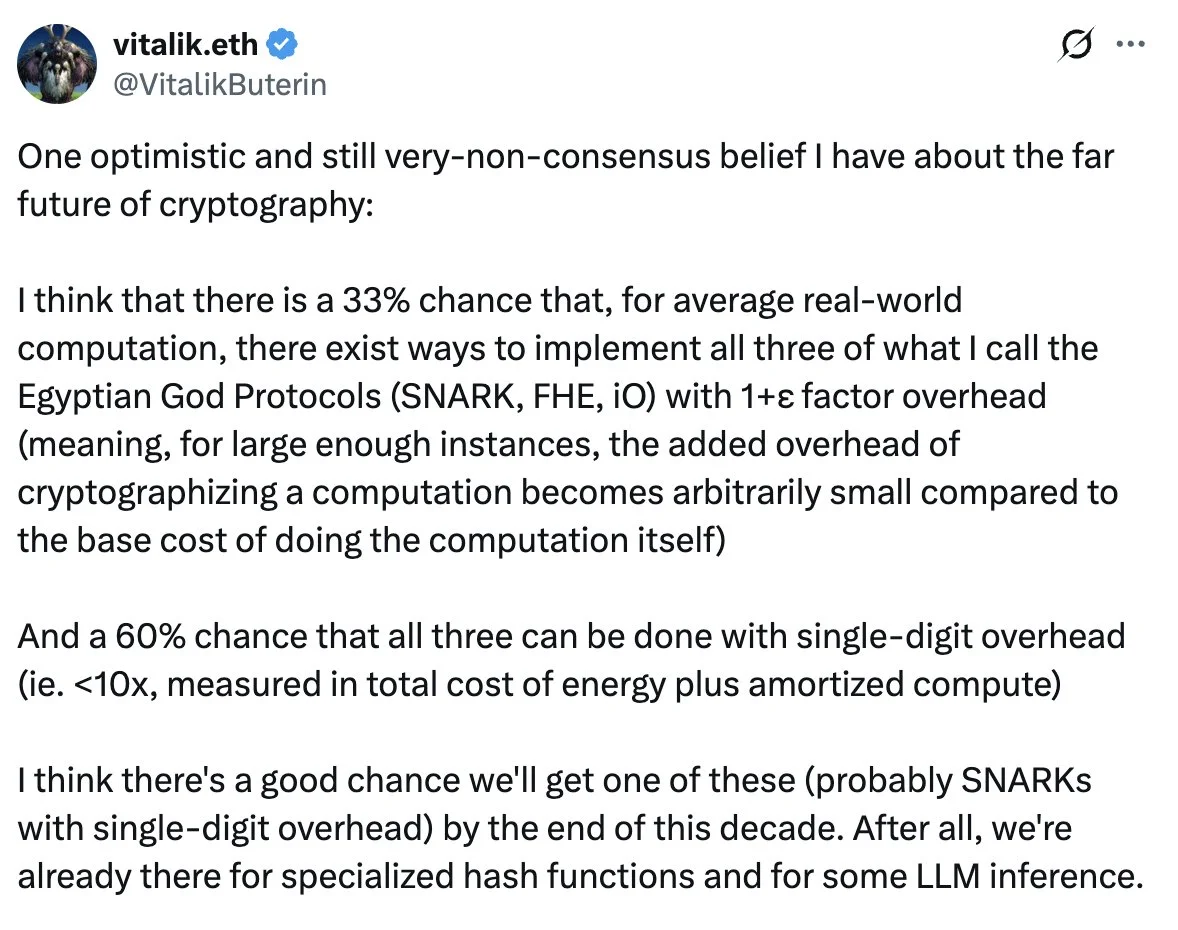

Vitalik Buterin puts the chance at 60% that SNARKs, fully homomorphic encryption and indistinguishability obfuscation can eventually reach single-digit computational overhead. He assigns a 33% chance that all three could approach near-zero additional overhead for large real-world workloads.
Why it matters
The forecast makes efficiency the key hurdle for deploying advanced cryptography beyond specialized settings. Buterin said at least one technology, most likely SNARKs, could reach sub-10x overhead by the end of this decade. Specialized hash functions and some LLM inference workloads are already approaching that level.
Market impact
For Ethereum-linked infrastructure, lower overhead would make these tools more practical at scale. The near-term signal is a technical milestone rather than a direct market catalyst: progress depends on moving SNARKs, FHE and iO from specialized workloads toward broad real-world use.

Frequently asked questions
-
What chance did Buterin give to all three technologies reaching near-zero overhead?
He assigned a 33% chance that SNARKs, FHE and iO could approach near-zero additional overhead for large real-world workloads.
-
Which technology did Buterin identify as likeliest to reach sub-10x overhead?
He identified SNARKs as the most likely of the three to reach sub-10x overhead by the end of this decade.
-
Why does computational overhead matter for these technologies?
Lower overhead would make these cryptographic tools more practical at scale and help them move beyond specialized workloads toward broad real-world use.
-
What workloads are already approaching the sub-10x level?
Specialized hash functions and some LLM inference workloads are already approaching that level.
-
What would show that SNARKs, FHE and iO are moving beyond specialized use?
The key sign would be SNARKs, FHE and iO moving from specialized workloads toward broad real-world use.
 CoinTelegraph
 CZ Binance
 CryptoSlate
 TheBlock
 CoinDesk