


 WuBlockchain

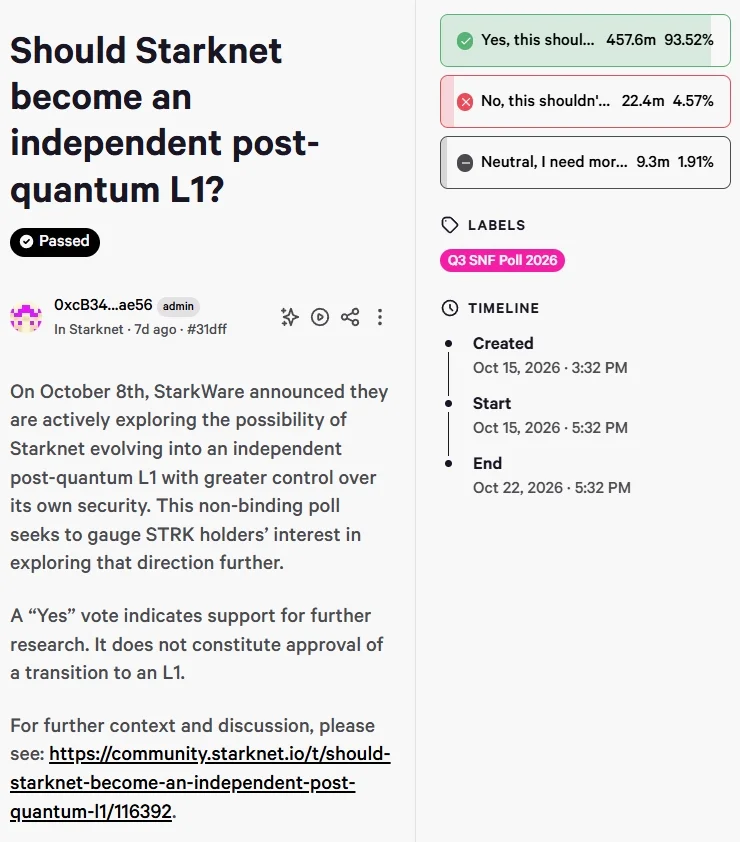
Starknet tokenholders have approved a governance proposal with 93.5% of voting power backing an exploration of transitioning the network from an Ethereum Layer 2 into an independent, quantum-resistant Layer 1. StarkWare confirmed it will release a draft whitepaper in November outlining the technical path forward.
The vote is strictly a mandate for preliminary research, not a formal approval of the transition itself. Any actual move to an independent L1 will require a dedicated governance vote further down the road.
Why it matters
The scale of the approval signals near-unanimous conviction among STRK holders that quantum resistance is worth pursuing at the architecture level, not just as a cryptographic patch. Ethereum's own roadmap includes post-quantum considerations, but Starknet breaking away to build a sovereign, quantum-resistant L1 would mark a significant divergence from the rollup-centric scaling thesis the ecosystem has operated under. It also raises structural questions about STRK's relationship with ETH security and settlement.
Market impact
The 93.5% supermajority removes near-term governance uncertainty around the research mandate. Attention now shifts to the November whitepaper, which will be the first concrete signal of how radical or incremental the proposed transition actually is. Holders and ecosystem developers will be watching closely for details on sequencer independence, data availability, and how any new L1 would handle settlement finality without Ethereum underneath it.

Frequently asked questions
-
What did the Starknet governance vote actually approve?
The vote authorized preliminary research into transitioning Starknet from an Ethereum Layer 2 to an independent, quantum-resistant Layer 1. It does not constitute formal approval of the transition, which will require a separate governance process.
-
When will StarkWare release more details on the proposed transition?
StarkWare plans to publish a draft whitepaper in November outlining the technical path forward for the potential transition to an independent quantum-resistant Layer 1.
-
How strong was the support among STRK tokenholders for this proposal?
Over 93.5% of Starknet voting power backed the research proposal, making it one of the most decisive governance votes in the network's history.
-
What would Starknet leaving Ethereum's Layer 2 ecosystem mean for ETH security?
An independent L1 would sever Starknet's reliance on Ethereum for settlement and security, raising structural questions about how STRK's value and finality guarantees would be maintained without Ethereum as the base layer.
-
Why is quantum resistance a priority for Starknet at the architecture level?
The proposal reflects a conviction among STRK holders that quantum resistance needs to be built into the network's core architecture rather than added as a cryptographic patch, given the long-term threat quantum computing poses to current elliptic-curve-based security models.
 CoinTelegraph
 CZ Binance
 Crypto News
 CryptoSlate
 TheBlock
 Benjamin Cowen
 WatcherGuru