








 CoinDesk
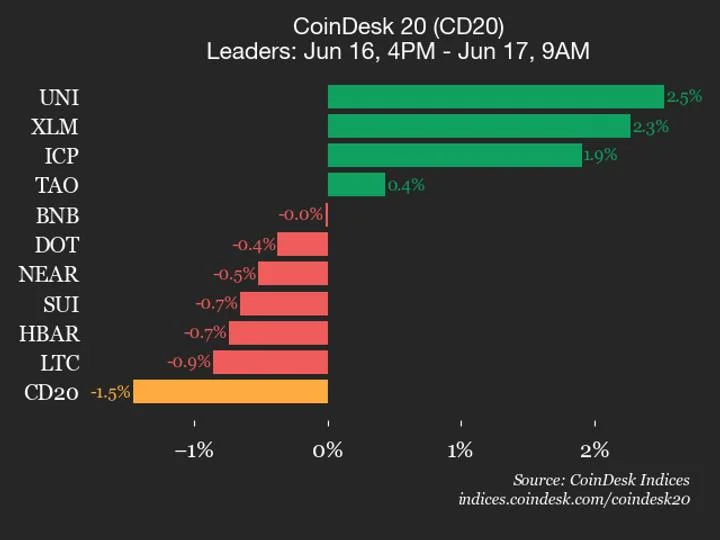
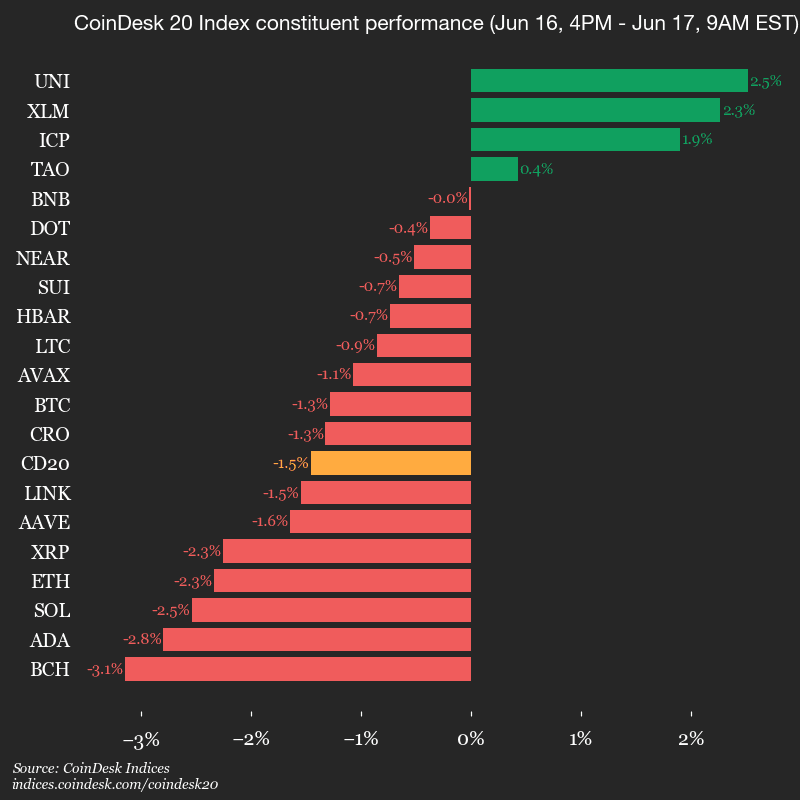


The CoinDesk 20 Index fell 1.5% to 1,774.43 in the latest session, with only four of twenty constituents trading higher. Bitcoin Cash (BCH) led the index lower at -3.1%, followed by Cardano (ADA) at -2.8%. On the other side of the tape, Uniswap (UNI) gained 2.5% and Stellar (XLM) added 2.3%.
Why it matters
The split tape — broad index red, a handful of mid-cap names green — is the kind of session that tells you more about rotation than direction. BCH and ADA together carry meaningful weight inside a broad-based index, and a synchronized drawdown of that size usually points to a single risk-off impulse dragging the high-beta tail rather than idiosyncratic single-name news.
Market impact
A second-order signal out of the same release: May combined exchange volumes fell 3.45% to $4.41 trillion, the weakest monthly print since September 2024. The counter-current is RWA perpetual futures, which posted a 10.4% monthly gain against the trend and hit a new all-time high — capital rotating into tokenized-real-asset perps while spot volumes cool.



Frequently asked questions
-
What is the CoinDesk 20 Index?
It is a broad-based market index tracking twenty major crypto assets, traded on multiple platforms in several regions globally. In the latest session it sat at 1,774.43, down 1.5%.
-
Which assets led the CoinDesk 20 lower in this update?
Bitcoin Cash (BCH) led the index down at -3.1%, followed by Cardano (ADA) at -2.8%. Only four of the twenty constituents traded higher on the day.
-
Which assets gained in the latest CoinDesk 20 session?
Uniswap (UNI) led gainers at +2.5%, with Stellar (XLM) close behind at +2.3%. The remaining two green names were not named in the release.
-
How did crypto exchange volumes perform in May?
Combined exchange volumes fell 3.45% to $4.41 trillion in May, the lowest monthly print since September 2024.
-
What counter-trend signal appeared in May volume data?
RWA perpetual futures volumes rose 10.4% in May against the broader decline, hitting a new all-time high and pointing to capital rotation into tokenized-real-asset derivatives.
 CryptoSlate
 Crypto News
 Glassnode
 Lookonchain
 WatcherGuru
 CoinTelegraph
 Crypto Rank News