








 CoinDesk

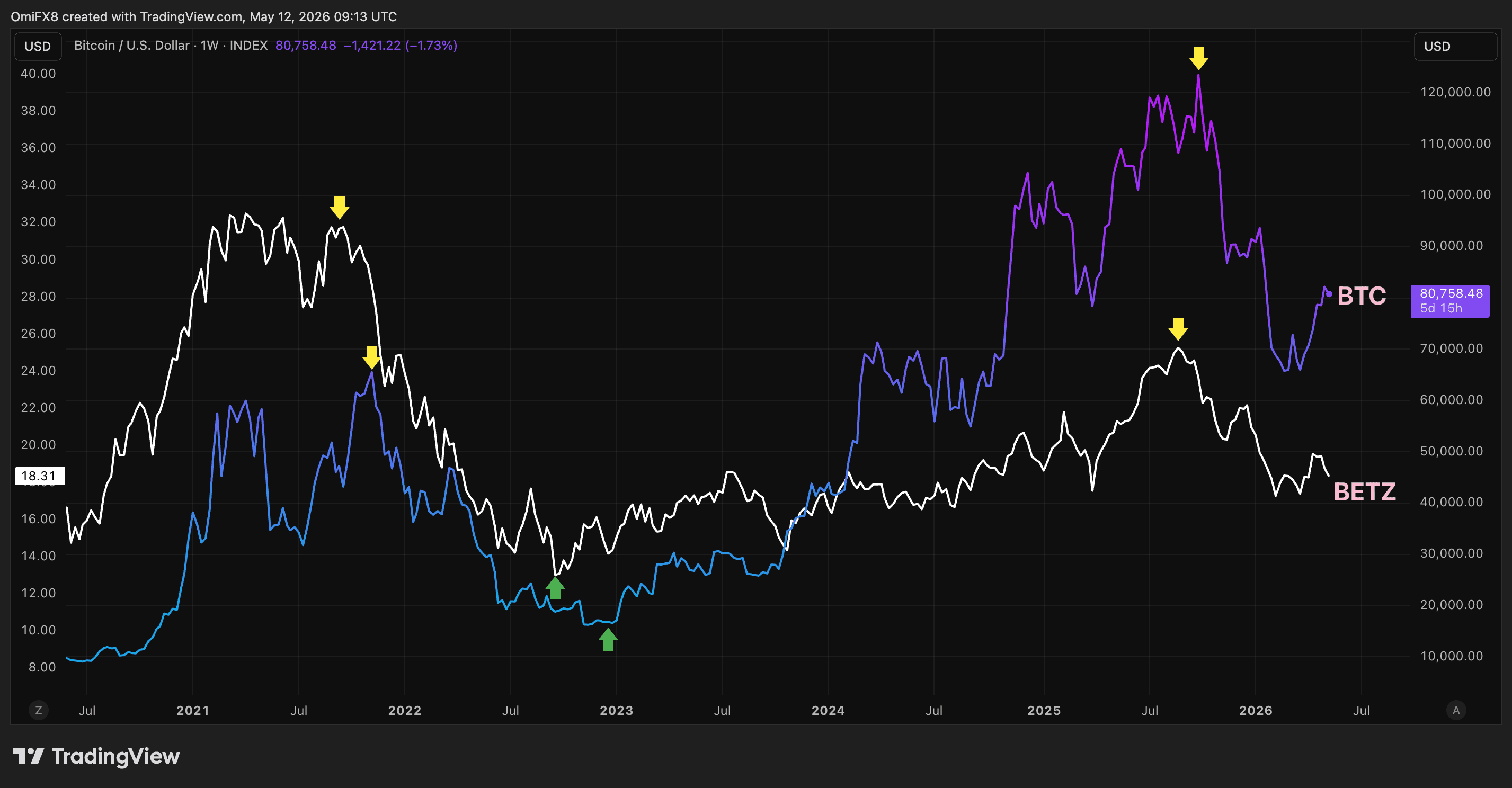


The Roundhill Sports Betting & iGaming ETF (BETZ) has moved in lockstep with bitcoin, posting a 365-day correlation coefficient of 0.91 and a 90-day reading of 0.73 against BTC, per TradingView data. That translates to an R² of roughly 0.83, meaning more than 80% of the variation in the two assets' price action is statistically linked. The NYSE-listed fund, which debuted in June 2020, holds only about $50 million in assets under management — a rounding error next to the billions sitting in BlackRock's IBIT — yet its price action has consistently front-run bitcoin at major cyclical turns.
Why it matters
BETZ peaked in September 2021, weeks before bitcoin topped in November, and bottomed in September 2022 — roughly three months ahead of BTC's eventual floor. The same lead showed up again in 2025, when the fund peaked in August, two months ahead of bitcoin. The consistency of the timing offset across multiple cycles is what gives the relationship weight, even if correlation is not causation. It also lines up with the argument from investors like Ray Dalio that bitcoin is behaving more like a risk-sensitive macro asset than a digital gold safe haven — a high-beta proxy for retail speculation and liquidity, not a hedge against it.
Market impact
The framing matters for anyone sizing BTC exposure: BETZ is effectively a sentiment and liquidity canary, and its recent decoupling from rising BTC prices is the kind of divergence traders tend to flag. The fund is too small to move bitcoin on its own, but as a coincident indicator of risk-on flows into speculative names, its lead time at prior cycle turns is hard to dismiss. Watch for BETZ to confirm or break the pattern — if it rolls over while bitcoin keeps climbing, the macro-asset read gets stronger; if it catches up, the correlation simply reasserts itself.

Frequently asked questions
-
What is the correlation between BETZ and bitcoin?
The 365-day correlation coefficient between the Roundhill Sports Betting & iGaming ETF (BETZ) and bitcoin stood at 0.91, with a 90-day reading of 0.73, per TradingView data. That implies an R² of roughly 0.83.
-
How has BETZ front-run bitcoin at past cycle turns?
BETZ peaked in September 2021, weeks before bitcoin topped in November 2021. It bottomed in September 2022, roughly three months ahead of bitcoin's eventual floor. A similar lead showed up in 2025, when BETZ peaked in August.
-
How large is the BETZ ETF compared to spot bitcoin ETFs?
BETZ held roughly $50 million in assets under management as of the article, far smaller than the billions of dollars parked in BlackRock's IBIT. The fund debuted in June 2020 and has attracted only about $98 million in net inflows since launch.
-
Does the BETZ-BTC correlation prove bitcoin is not a safe haven?
Correlation does not imply causation, but the consistency of the timing offset across multiple cycles supports the argument — echoed by Ray Dalio — that bitcoin behaves more like a risk-sensitive macro asset than a digital-gold safe haven.
-
Why would a sports-betting ETF track bitcoin so closely?
Both assets are high-beta proxies for retail speculation and risk-on liquidity. When risk appetite expands, money flows into both; when it contracts, both sell off. That shared exposure to speculative flows, rather than any fundamental link, is the likely driver of the 0.91 correlation.
 CoinTelegraph
 Crypto News
 TheBlock
 WuBlockchain
 Glassnode
 CryptoSlate