








 CoinDesk



U.S. spot Bitcoin ETFs lost another $228 million in net redemptions during the shortened trading week ending June 20, 2026, marking a sixth consecutive week of outflows and bringing the cumulative six-week drain to $5.94 billion, according to SoSoValue data. The bleed, however, is decelerating: weekly outflows have now fallen for a second straight session, down from $315.84 million the prior week and well below the four-week stretch where redemptions topped $1 billion each week and grew larger with every print.
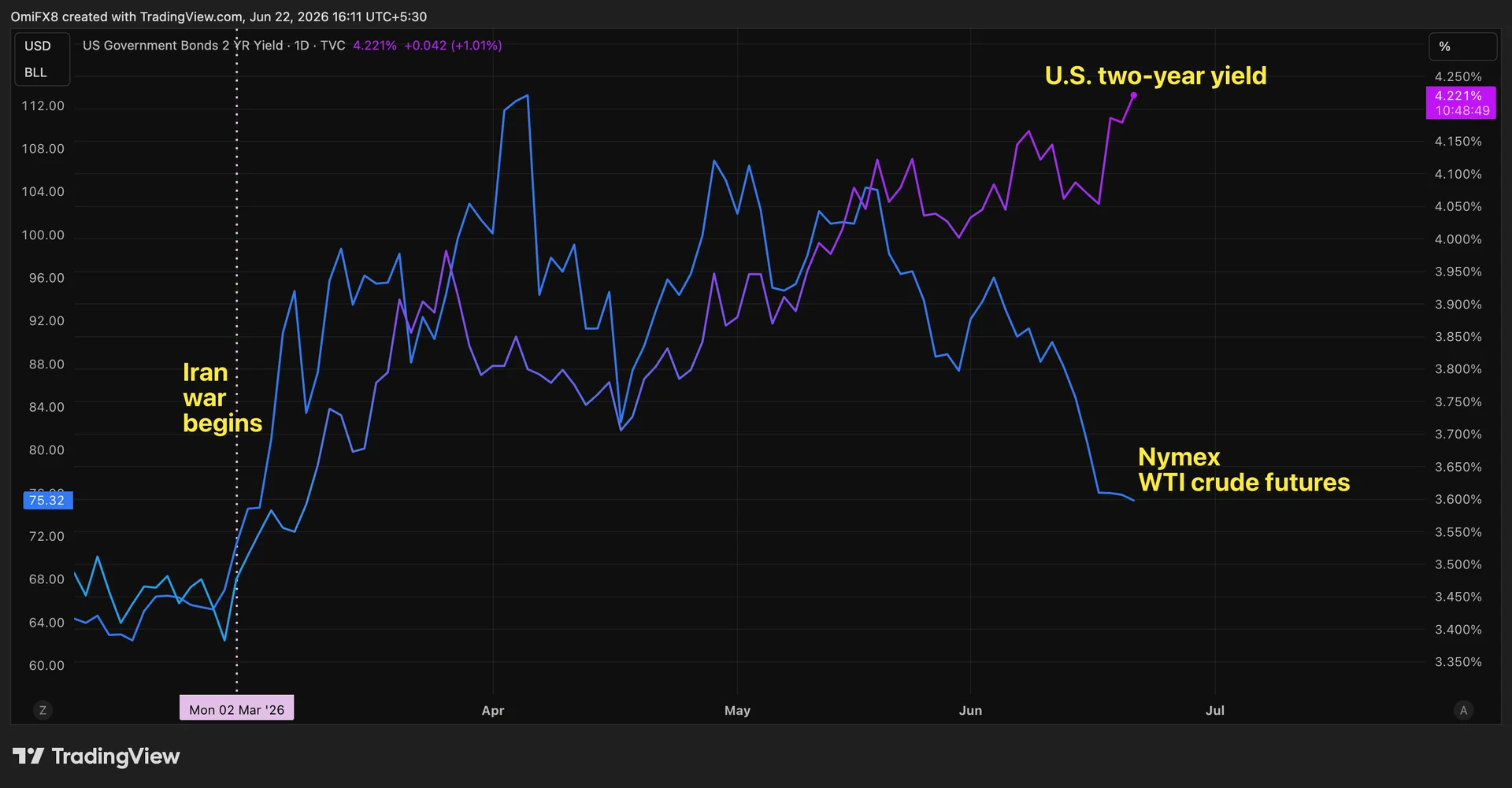
The second headwind is the more structural one. The U.S. two-year Treasury yield, the most Fed-sensitive point on the curve, has decoupled from collapsing WTI crude oil and is hovering at 4.21% — its highest level since February 2025. Oil is down roughly 20% from its post-Iran-war spike, yet the short end of the curve is still climbing, a divergence that markets are reading as a hawkish Fed repricing rather than an energy-driven risk-off signal.
Why it matters
For four months, oil and the two-year yield moved in lockstep as the Iran war choked supply through the Strait of Hormuz. That linkage is now breaking, and the curve is signaling that the second-order inflation impulse from the March oil spike is keeping the Federal Reserve on a tightening bias. Friday's core PCE print, forecast at +0.37% month-over-month and 3.4% year-over-year (the highest since May 2024 per FactSet consensus), would confirm that read. Tagus Capital framed the ETF flow picture as a stabilizing-but-fragile demand backdrop: institutions are no longer accelerating exits, but they are not yet returning as net buyers either.
Market impact
The combination matters for BTC because the previous risk-asset floor was geopolitical, not monetary. With energy pressure easing and rate-hike expectations replacing it, the macro headwind is shifting from a known quantity to a live repricing event. Tagus called the slower outflows a "potential floor to downside," but the bond market is sending the opposite message on duration.

Frequently asked questions
-
How much have U.S. spot Bitcoin ETFs lost over the past six weeks?
U.S. spot Bitcoin ETFs shed another $228 million in net redemptions during the shortened week ending June 20, 2026, extending a six-week losing streak to a cumulative $5.94 billion in outflows, according to SoSoValue data.
-
Is the pace of Bitcoin ETF outflows actually slowing?
Yes. Weekly outflows fell for a second consecutive week, dropping from $315.84 million the prior week and well below the four-week run where redemptions topped $1 billion each session and grew larger every week. Tagus Capital called the shift a stabilizing but still fragile demand backdrop.
-
Why are the U.S. two-year Treasury yields rising while oil prices fall?
The two-year yield has decoupled from collapsing WTI crude and is now sitting at 4.21%, its highest level since February 2025. Markets are reading the divergence as a hawkish Federal Reserve repricing driven by the second-order inflation impulse from the March oil spike, rather than an energy-driven risk-off move.
-
What does Friday's core PCE print mean for Bitcoin's near-term outlook?
Consensus forecasts from FactSet have core PCE rising 0.37% month-over-month and 3.4% year-over-year, which would be the highest annual rate since May 2024. A confirming print would cement the Fed-tightening narrative and weigh on BTC's recovery odds in the short term.
-
What is Tagus Capital saying about the current Bitcoin ETF demand backdrop?
Tagus Capital described the setup as "stabilizing but still fragile." Institutions are no longer accelerating exits, but they have not returned as net buyers, with flows shifting toward more selective and balanced positioning that could provide a potential floor to downside.
 CoinTelegraph
 Crypto News
 TheBlock
 WuBlockchain
 WatcherGuru