








 CoinDesk
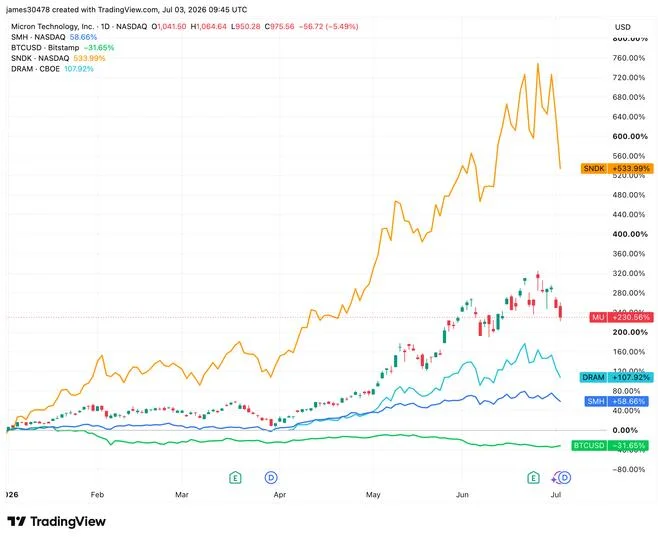



Memory and semiconductor stocks that dominated the first half of 2026 are losing momentum at the same moment bitcoin is rebounding off a two-year low, raising the question of whether capital is starting to rotate back into digital assets.
Sandisk (SNDK) and Micron (MU) had been the standout equity winners of the year, up more than 530% and 230% respectively on demand for NAND flash and high-bandwidth memory used in AI infrastructure. The Roundhill Memory ETF (DRAM) more than doubled in the first half and the VanEck Semiconductor ETF (SMH) climbed about 60%. BlackRock's iShares Bitcoin Trust (IBIT), by contrast, dropped roughly 30% in line with bitcoin itself.
The setup shifted late last week. The Roundhill Memory ETF has now fallen about 25% from its June 22 record high, while SMH is down around 12%. Bitcoin, which dipped below $58,000 on July 1, is back trading above $61,000. The selling pressure in AI-linked names accelerated after Bloomberg reported Meta Platforms (META) is building a unit called Meta Compute to sell excess GPU capacity to third parties, a development that rattled the "neocloud" providers, including the former bitcoin miners IREN, Cipher Digital (CIFR) and TerraWulf (WULF), each down at least 20% from all-time highs.
Why it matters
For most of 2026 the AI trade and the crypto trade looked like competing magnets for the same risk capital. Investors who wanted exposure to compute demand bought memory and semis instead of bitcoin, and the rotation showed up cleanly in the ETF tape: DRAM and SMH ripping higher while IBIT gave back a third of its value alongside its underlying asset. The synchronous pullback in chip leaders and bounce in bitcoin is the first move in months that points the other way.
Meta's reported push to monetise excess GPU capacity is the proximate trigger for the AI side. If the hyperscalers themselves start selling compute, the third-party neocloud thesis, including the ex-miner pivots, becomes harder to defend, and a chunk of capital that lived in those names has to find a new home.

Frequently asked questions
-
Why are memory and semiconductor stocks pulling back while bitcoin rebounds?
The Roundhill Memory ETF (DRAM) is down about 25% from its June 22 record and the VanEck Semiconductor ETF (SMH) is off 12%, while bitcoin has climbed back above $61,000 from a sub-$58,000 low on July 1. The trigger was Bloomberg's report on Meta's Meta Compute GPU-leasing push, which hit the neocloud cohort hardest.
-
How much have AI chip stocks gained in 2026 before the recent pullback?
Sandisk (SNDK) is up more than 530% year to date and Micron (MU) more than 230%. The Roundhill Memory ETF (DRAM) more than doubled in the first half and the VanEck Semiconductor ETF (SMH) climbed about 60%, while BlackRock's IBIT fell roughly 30% over the same window.
-
What is the Meta Compute unit and why did it move markets?
Meta Platforms is building a unit called Meta Compute to sell excess GPU computing capacity to third parties, according to Bloomberg. The news undercut the thesis behind third-party neocloud providers, particularly the former bitcoin miners IREN, Cipher Digital and TerraWulf, each of which is down at least 20% from…
-
Is this the start of a sustained rotation from AI stocks into bitcoin?
It is too early to declare a rotation. But the synchronous move, with AI-infrastructure leaders pulling back the same week bitcoin rebounded from a two-year low, is the first cross-asset signal in months that capital may be rebalancing back toward digital assets.
-
What should investors watch to confirm a real rotation into crypto?
Watch whether IBIT flows turn net positive, whether DRAM and SMH reclaim their June highs, and whether the neocloud cohort (IREN, CIFR, WULF) stabilises. A genuine rotation typically shows up in cross-asset correlation before it appears in fund-flow data.
 Glassnode
 WatcherGuru
 Whale Alert
 Crypto Rank News
 CryptoSlate
 CoinTelegraph