








 CoinDesk
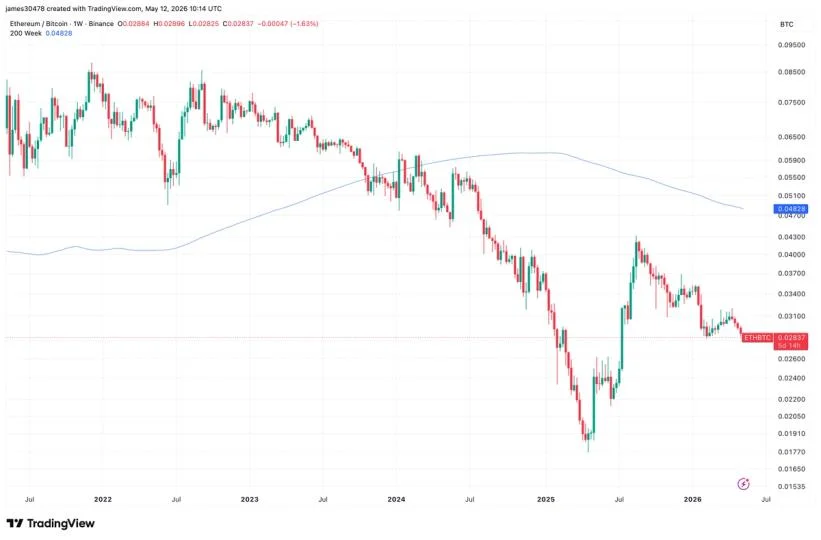



The ETH/BTC ratio dropped to 0.02835 on Tuesday, its weakest reading since July 2025 and a fresh 10-month low. Ether slipped more than 2% on the day while bitcoin held to a decline of just over 1%, widening the performance gap that has defined the pair for most of the past year. From its August peak of 0.04324, the ratio is now down more than 35%.
Why it matters
The ETH/BTC ratio is the most-watched gauge of relative risk appetite across crypto: a rising ratio signals capital rotating into ether and higher-beta assets, while a falling one means traders are parking exposure in bitcoin's perceived defensiveness. The pair peaked above 0.08 in December 2021 and bottomed at 0.01770 in April 2025 during the market turmoil around President Trump's "Liberation Day" tariff announcements — a stress-test low that the market has spent the year since trying to climb out of. The August rebound briefly delivered a 135% rally off that April floor, but the subsequent 35% retracement has now erased most of the recovery.
More structurally, the ratio trades well below its 200-week moving average of 0.04828. That gap reinforces the long-running view that ether remains in a multi-year bear market relative to bitcoin, with spot bitcoin ETFs — launched in January 2024 — continuing to absorb institutional flows that have not rotated meaningfully into ether products.
Market impact
The divergence shows up in flows, not just price. Bitcoin ETF launches in January 2024 unlocked a wave of institutional inflows that ether has not matched at the product level, and the ratio's persistence below its 200-week MA suggests that capital preference has not yet reversed. For traders, the technical setup is decisive: until ETH/BTC reclaims the 0.048 area on a sustained basis, the relative-trade base case stays bitcoin-heavy, with ether underperformance as the dominant cross-asset signal through the pair.


Frequently asked questions
-
What is the ETH/BTC ratio and why does it matter?
The ETH/BTC ratio measures ether's price relative to bitcoin's. A rising ratio signals capital rotating into ether and higher-risk crypto assets; a falling ratio means investors are favoring bitcoin's relative stability. It is widely treated as a gauge of crypto market risk appetite.
-
How low did the ETH/BTC ratio fall and when was the last time it was this weak?
The ratio dropped to 0.02835 on Tuesday, its weakest reading since July 2025. It is now down more than 35% from its August peak of 0.04324 and sits well below its 200-week moving average of 0.04828.
-
Why has ether been underperforming bitcoin?
The underperformance is largely structural. Spot bitcoin ETFs launched in January 2024 attracted significant institutional inflows that have not rotated meaningfully into ether products, keeping bitcoin's relative bid firm while ether has lagged. The ratio's persistence below its 200-week moving average reinforces…
-
What was the ETH/BTC ratio's all-time high and recent low?
The pair peaked above 0.08 in December 2021 before entering a prolonged multi-year downtrend. It bottomed at 0.01770 in April 2025 during market turmoil surrounding President Trump's "Liberation Day" tariff announcements, then rebounded roughly 135% through August 2025 before reversing course.
-
What level would ether need to reclaim against bitcoin to break the trend?
Technically, the ETH/BTC ratio would need to reclaim its 200-week moving average at 0.04828 on a sustained basis to signal a reversal of the long-term relative downtrend. Until then, bitcoin-heavy positioning is likely to remain the dominant cross-asset signal through the pair.
 WuBlockchain
 Lookonchain
 CoinTelegraph
 CryptoSlate
 Crypto Rank News
 TheBlock
 Glassnode
 Crypto News