








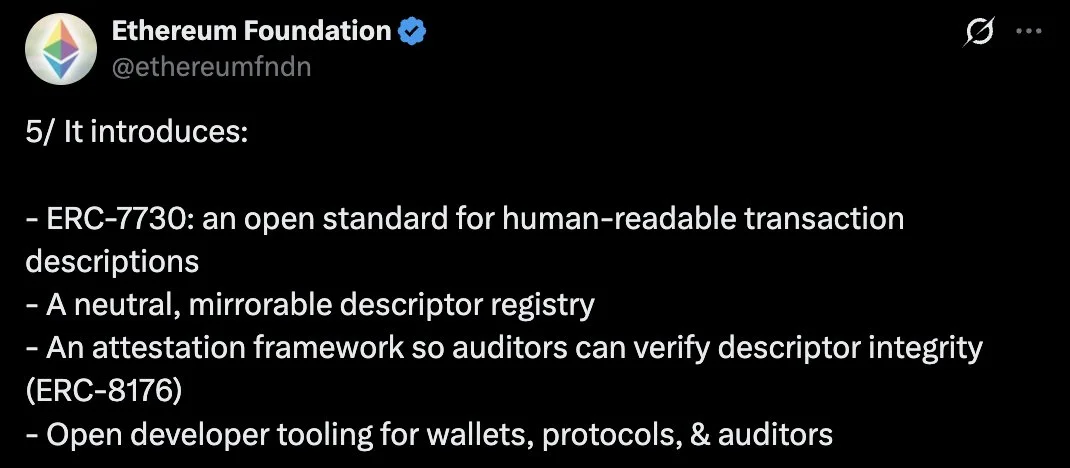

The Ethereum Foundation launched the "Clear Signing" open standard on Monday, aimed at replacing the unreadable hexadecimal data users see during transaction approvals with human-readable descriptions of what they're actually signing.
The initiative has drawn in Ledger, Trezor, MetaMask, WalletConnect, and Fireblocks as contributors, with the Ethereum Foundation coordinating the effort across hardware wallets, browser extensions, mobile wallets, and institutional custody platforms.
Why it matters
Blind signing — where users approve transactions without being able to verify the underlying action — has been one of the largest unsolved attack surfaces in self-custody. Phishing kits that spoof contract methods and wallet drainers that trick users into signing malicious approvals both exploit the same gap: a hex string the user can't read. A shared standard that pushes method names, token amounts, and recipient addresses into plain text across the major wallet vendors closes that gap at the wallet layer rather than relying on each user to decode calldata.
Market impact
The contributor list is the substance of the announcement. Ledger and Trezor cover the hardware-wallet majority; MetaMask and WalletConnect dominate the browser and mobile entry points; Fireblocks brings institutional custody. A signing standard that lands in all five at once is not an incremental UX improvement — it sets a baseline the rest of the wallet ecosystem will be measured against, and gives enterprise compliance teams a citable spec when reviewing institutional self-custody workflows.

Frequently asked questions
-
What is the Ethereum Clear Signing standard?
It's an open standard coordinated by the Ethereum Foundation that requires wallets to display transaction details in human-readable text — method names, amounts, recipients — instead of raw hexadecimal calldata during approval prompts.
-
Which wallets and custody platforms support Clear Signing?
The contributor group includes hardware wallet makers Ledger and Trezor, browser and mobile wallet MetaMask, the connection protocol WalletConnect, and institutional custody provider Fireblocks, with the Ethereum Foundation acting as coordinator.
-
Why is blind signing a security risk?
Blind signing forces users to approve transactions they cannot read. Phishing kits and wallet drainers exploit this by tricking users into signing malicious approvals or transfers disguised as hex strings the victim has no way to interpret.
-
How does Clear Signing reduce blind signing risks?
By pushing structured transaction details — what the call does, what asset moves, where it goes — into plain text on the signing prompt, Clear Signing lets users verify intent before they approve, rather than trusting an opaque data blob.
-
Does Clear Signing require a hard fork or protocol change on Ethereum?
No. It's a wallet-layer standard, not a consensus-layer change. Adoption is driven by wallet vendors integrating the spec into their signing interfaces, which is why the cross-vendor contributor list is the substance of the announcement.

 CryptoSlate
 WatcherGuru
 Crypto Capital Venture
 CoinTelegraph
 CoinDesk
 Crypto News
 TheBlock