


 CryptoSlate



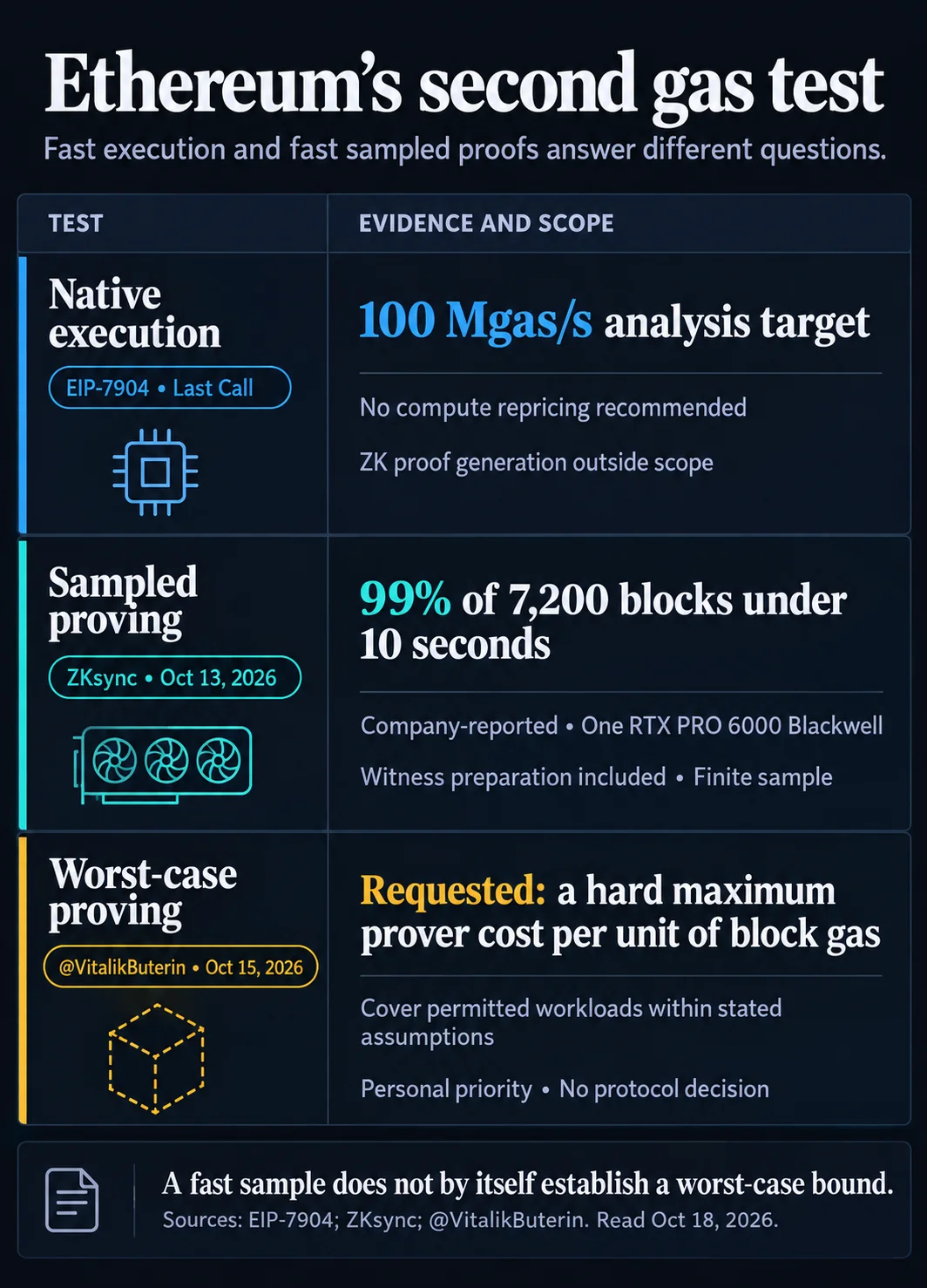
Vitalik Buterin has called for a hard limit on Ethereum proving costs per unit of block gas, adding a resource-accounting requirement to the race for faster zero-knowledge proofs. In an October 15 post, he congratulated ZKsync's Airbender team and laid out three priorities: matching execution's mathematical representation to Ethereum's specification, bounding prover cost relative to block gas, and securing the proof system itself.
The proving side is moving fast. ZKsync reported on October 13 that a single NVIDIA RTX PRO 6000 Blackwell GPU proved 99% of 7,200 consecutive Ethereum mainnet blocks in under 10 seconds each, with every sampled block finishing under 12 seconds. But sample performance is not a guarantee: a cost bound must cover deliberately expensive blocks, not typical ones.
Why it matters
Gas exists to cap a block's resource consumption, and Buterin's argument is that the allowance should translate into a dependable limit on proving resources too. EIP-7904, currently Informational in Last Call with a November 1 deadline, recommends no compute repricing, but its analysis covers only bare-CPU execution at 100 million gas per second and expressly does not address ZK-SNARK proof generation.
Nethermind Research's January measurements found that cryptographic precompiles and modular arithmetic or division operations cost disproportionately more to prove per gas, with results varying by prover. For an operator budgeting hardware, the hardest legal workload, not the average block, determines the reserve capacity needed.
Market impact
The likely responses include weighted ZK-gas metering with a per-block ceiling, as outlined by Nethermind, or opcode repricing through the existing gas allowance, which would raise costs for applications using proof-heavy operations. EIP-7999's multidimensional fee market remains Draft, and EIP-8025's optional execution-proof proposal provides no prover incentives. Until a bound tied to explicit workloads, hardware and security assumptions lands, higher execution capacity carries an unpredictable proving bill for independent provers.

Frequently asked questions
-
What did Vitalik Buterin propose for Ethereum proving costs?
In an October 15 post, he called for a hard limit on proving cost per unit of block gas, alongside formal-verification priorities covering execution-to-spec matching and proof system security.
-
How fast are ZKsync's current Ethereum proofs?
ZKsync reported that one NVIDIA RTX PRO 6000 Blackwell GPU proved 99% of 7,200 consecutive mainnet blocks in under 10 seconds each, with every sampled block under 12 seconds.
-
Why doesn't EIP-7904 cover proof generation?
EIP-7904 recommends no compute repricing based on bare-CPU execution analysis at 100 million gas per second, and it expressly states it does not address ZK-SNARK proof generation, which imposes different workloads.
-
Which operations are most expensive to prove on Ethereum?
Nethermind Research's measurements found cryptographic precompiles and several modular arithmetic or division operations cost relatively more to prove per gas, with costs varying across provers like SP1 and RISC0.
-
How could Ethereum enforce a proving cost limit?
Options include weighted ZK-gas metering with a per-block ceiling, as outlined by Nethermind, or repricing opcodes through the existing gas allowance so proof-heavy operations consume more of a block's capacity.
 CoinDesk
 CoinTelegraph
 WuBlockchain
 CZ Binance
 TheBlock