


 CryptoSlate

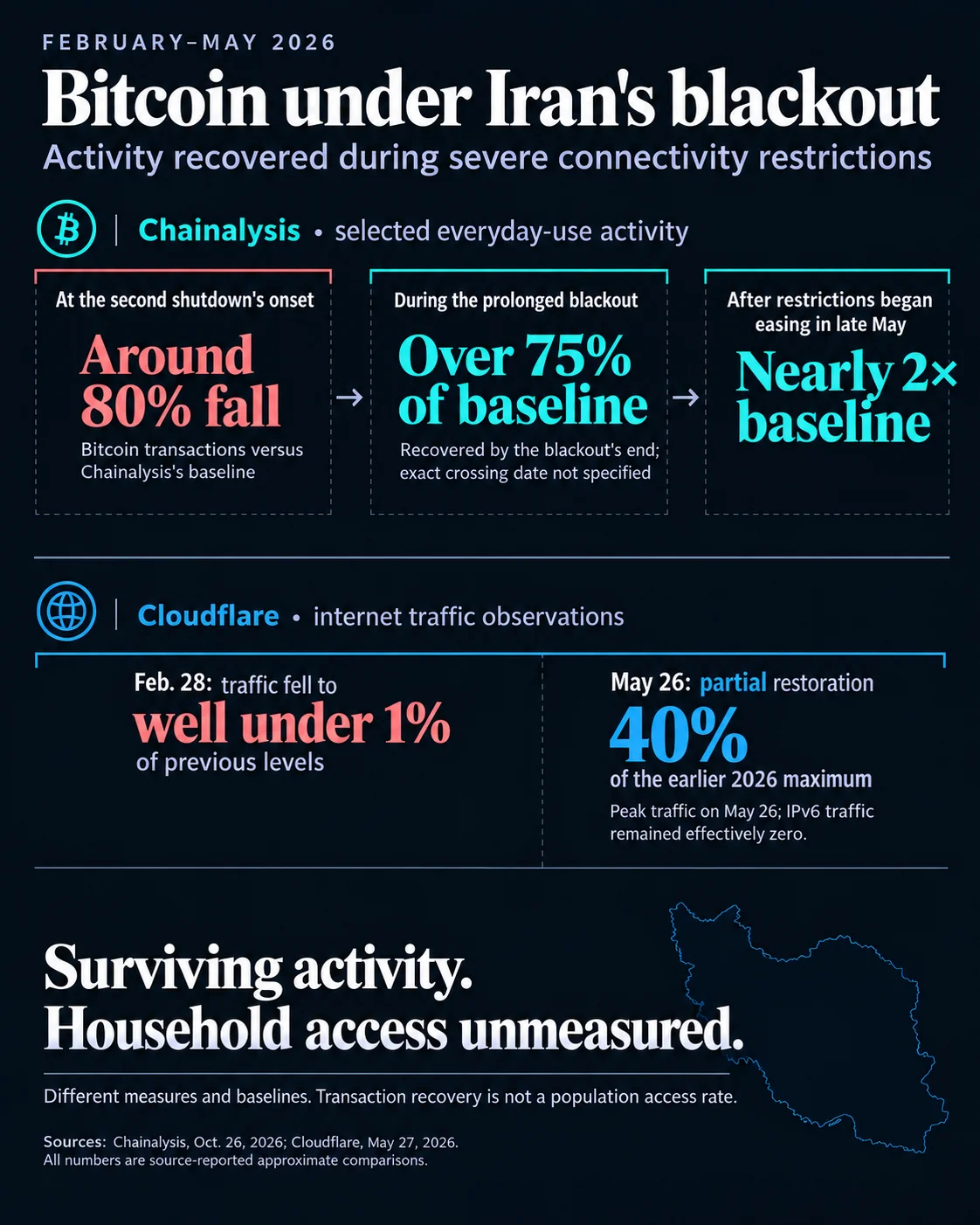

Chainalysis found that Bitcoin transaction activity linked to Iran initially fell about 80% during the country’s prolonged February-to-May 2026 internet shutdown. The selected everyday-use series later recovered to more than 75% of baseline before the blackout ended, then rose to nearly twice baseline as restrictions eased.
Why it matters
The rebound developed while severe connectivity restrictions were still in place. Cloudflare recorded Iranian traffic falling to well under 1% of previous levels and later observed a partial restoration on May 26, when traffic reached only 40% of its earlier 2026 peak. IPv6 traffic remained effectively zero.
The two data sets measure different things. Chainalysis tracks Bitcoin activity against its own baseline, while Cloudflare measures traffic and DNS activity across its network. Their figures cannot show how many households had access, whether activity became concentrated among a smaller group of users, or which bypass routes were used.
Market impact
The findings strengthen Bitcoin’s censorship-resistance narrative, but they do not mean holders could freely use their funds. Private keys can remain offline and transactions can be signed without a direct internet connection, yet a signed transaction still needs a route to reach the network. Receiving Bitcoin can occur while the recipient is offline, although checking the payment and later spending it require network access.
Country attribution also has limits. An Iran-linked wallet does not necessarily prove where its operator was when a transaction reached the network. The clearest signal is narrower but still significant: severe national restrictions coexisted with a substantial recovery in Iran-linked Bitcoin activity, showing that partial connectivity can preserve access to an open monetary network.

Frequently asked questions
-
How far did Iran-linked Bitcoin activity fall during the blackout?
Chainalysis reported an initial decline of about 80% in its selected Iran-linked Bitcoin activity series.
-
How much did the Bitcoin activity recover before the blackout ended?
The series recovered to more than 75% of its baseline by the end of the prolonged blackout.
-
How did Iran’s internet traffic compare with its Bitcoin activity?
Cloudflare observed Iranian traffic fall to well under 1% of previous levels, while Chainalysis recorded Bitcoin activity recovering above 75% of its own baseline.
-
Can Bitcoin be used during an internet shutdown?
Keys can remain offline and transactions can be signed without a direct internet connection, but a signed transaction still needs a route to the Bitcoin network for broadcasting.
-
Does an Iran-linked wallet prove the user was in Iran?
No. Chainalysis country attribution uses behavioral indicators, so an Iran-linked wallet does not directly establish where its operator was when the transaction reached the network.
 Glassnode
 Crypto News
 TheBlock
 WatcherGuru
 WuBlockchain
 CoinDesk