


 CryptoSlate

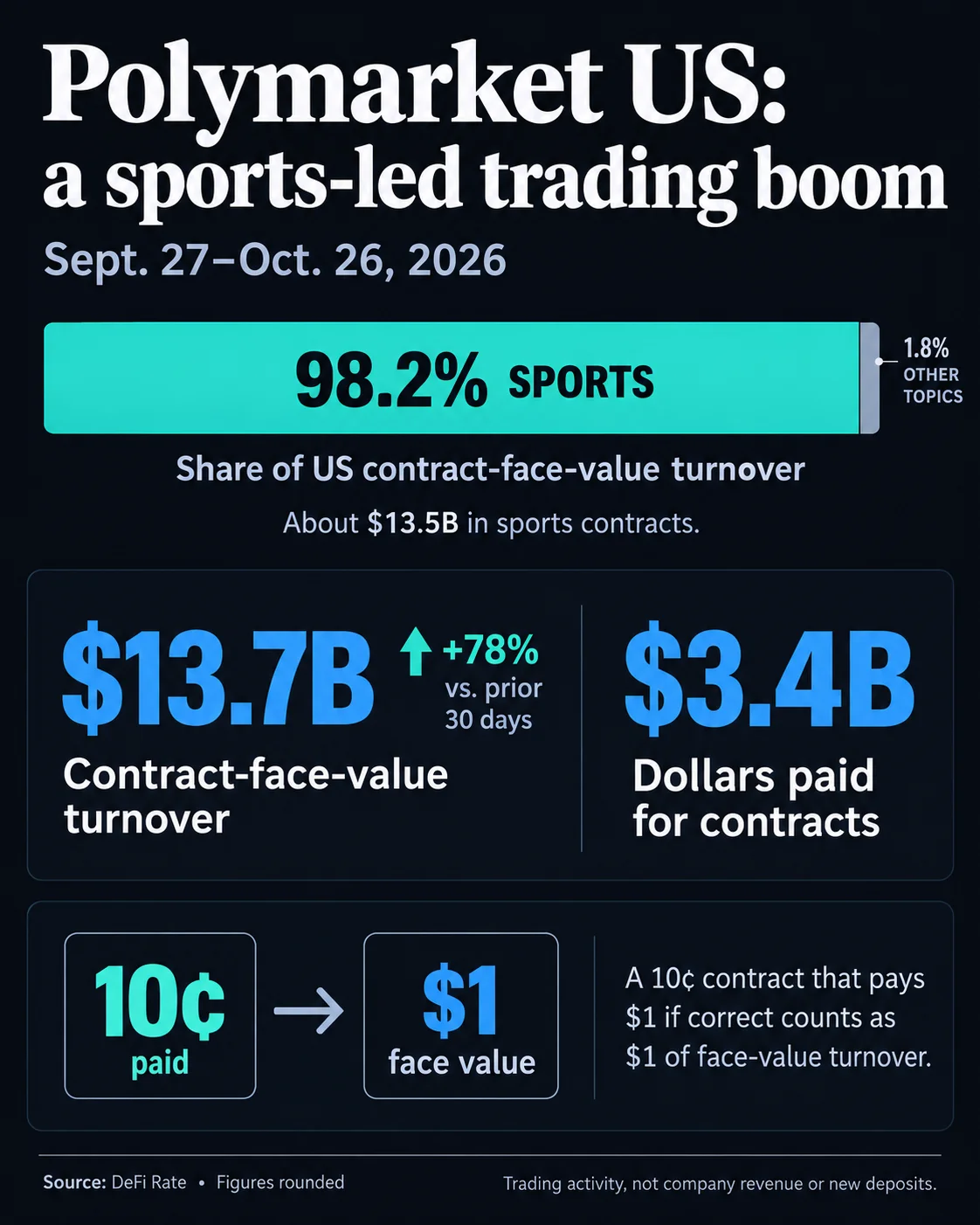

Polymarket US recorded about $13.7 billion in contract-face-value turnover in the 30 days through Oct. 26, with sports accounting for 98.2%, according to DeFi Rate. The figure was up 78% from the preceding 30 days. Measured by dollars traders paid for contracts, the same US activity totaled $3.4 billion.
The distinction changes the scale comparison. Polymarket's international venue recorded $4.8 billion in face-value turnover and $2.4 billion in dollars paid over the same period. The US venue represented about 74% of the two venues' combined face-value turnover, but about 59% of dollars paid.
Why it matters
The sports concentration puts Polymarket US's expansion close to the center of a regulatory dispute: whether sports event contracts belong under federal derivatives oversight or state gambling laws. Reuters reported that the CFTC is again examining compliance with Polymarket's 2022 settlement restricting US access to its offshore platform. The reported inquiry includes location controls and US advertising, while separate scrutiny has examined onboarding and customer protections at the newer US exchange.
The CFTC's Oct. 27 lawsuit against Utah adds to proceedings involving nine other states. The Utah case targets Kalshi, not Polymarket, and its implications for Polymarket depend on how courts resolve the federal-state jurisdictional question. The CFTC asserts exclusive federal jurisdiction over registered prediction markets; Utah alleges Kalshi's event contracts violate state gambling laws.
Market impact
If broad restrictions on sports contracts persist as a possibility, Polymarket US's current mix leaves most recent face-value turnover exposed. The actual effect would depend on which contracts and jurisdictions are covered, and whether the sports share changes. Face-value turnover should not be confused with money paid: a contract counted at $1 face value can have been purchased for a fraction of that amount.
The NBA named Polymarket and Kalshi preferred prediction market exchanges on Oct. 26, and the league and CFTC also announced an information-sharing memorandum focused on basketball-market integrity.
Frequently asked questions
-
How much did traders pay for Polymarket US contracts?
Polymarket US recorded $13.7 billion in contract-face-value turnover, while traders paid $3.4 billion for those contracts in the 30 days through Oct. 26.
-
Why is Polymarket's face-value turnover higher than dollars paid?
Face-value turnover counts each contract at its $1 face value, regardless of its purchase price. A contract bought for 10 cents contributes $1 to face-value turnover but 10 cents to dollars paid.
-
What is the CFTC examining regarding Polymarket?
Reuters reported that the CFTC is again examining compliance with Polymarket's 2022 settlement restricting US access to its offshore platform, including location controls and US advertising.
-
Does Utah's lawsuit directly target Polymarket?
No. Utah's enforcement case targets Kalshi. Its significance for Polymarket depends on how courts resolve the dispute over federal and state authority.
-
What could expose Polymarket US's recent trading activity to restrictions?
Sports accounted for 98.2% of recent face-value turnover. Broad restrictions on sports event contracts could affect most of that activity, depending on the contracts and jurisdictions covered.
 Crypto Rank News
 TheBlock
 Glassnode
 WatcherGuru
 CoinDesk
 Lookonchain