








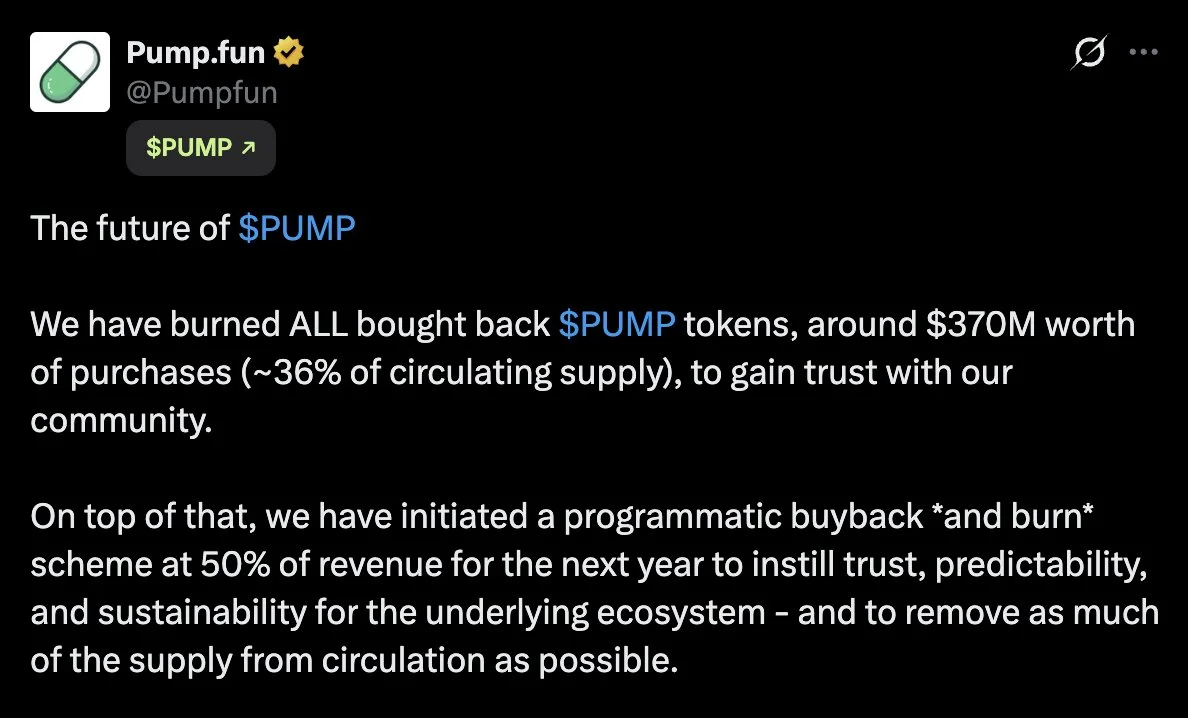
PumpFun has burned all previously repurchased PUMP tokens, retiring roughly $370 million worth of supply — about 36% of the circulating float — and committed to allocating 50% of platform revenue over the next 12 months to a programmatic buyback-and-burn mechanism.
The one-time burn closes the loop on tokens the team had been accumulating in a discretionary buyback program — a setup that had drawn repeated criticism from tokenholders who wanted to know whether those repurchases would ever hit the burn address. The $370M figure answers that question directly: yes, and at scale.
Why it matters
The 50% revenue commitment matters more than the headline number. A one-off burn of $370M is a marketing event; a recurring mechanism tied to platform revenue is a structural supply sink. It turns the buyback from something the team could pause into something the market can model — PUMP holders can now underwrite a baseline buyback cadence off top-line growth, the way equity investors underwrite a buyback program off earnings.
It also recalibrates the token's scarcity narrative. With roughly 36% of the original circulating float now permanently removed, the marginal supply curve going forward depends almost entirely on emissions, unlocks, and the new buyback flow — and the buyback is now committed to scale with the platform's success rather than a treasury vote.
Market impact
The mechanism is dollar-cost-averaged by design: revenue-based, programmatic, and predictable. That gives PUMP a reflexive bid that strengthens as platform revenue grows — the kind of structural floor the token previously lacked. Watch the platform's weekly revenue prints; the buyback rate is now a first-class metric for the asset.

Frequently asked questions
-
How much PUMP did PumpFun burn in the one-time burn?
PumpFun burned all previously repurchased PUMP tokens — roughly $370 million worth, equal to about 36% of the token's circulating supply at the time of the announcement.
-
What is the 50% revenue commitment?
PumpFun has committed to allocating 50% of its platform revenue over the next 12 months to a programmatic buyback-and-burn mechanism, retiring PUMP tokens on a recurring basis rather than at treasury discretion.
-
Why did PumpFun announce this buyback-and-burn?
The platform said the move responds to tokenholder concerns about the use and certainty of prior buybacks. Burning the previously repurchased tokens removed any ambiguity about their final disposition.
-
What percentage of PUMP's circulating supply was burned?
Roughly 36% of the original circulating supply was retired in the one-time burn, permanently removing that supply from the market.
-
How does the new buyback mechanism differ from the old one?
The new mechanism is programmatic and revenue-linked: 50% of platform revenue over the next year is automatically directed to buyback-and-burn, replacing the prior discretionary buyback with a predictable, modelable supply sink.

 CryptoSlate
 Crypto Rank News
 CoinDesk
 TheBlock
 Crypto News
 CoinTelegraph
 Lookonchain