








Trader @Eveningtraders published a watchlist of tokens it says carry elevated supply-control risk, warning that deep holder concentration layered on top of sharp, two-directional price swings has become a reliable setup for liquidating retail longs and shorts while amplifying abnormal volatility.
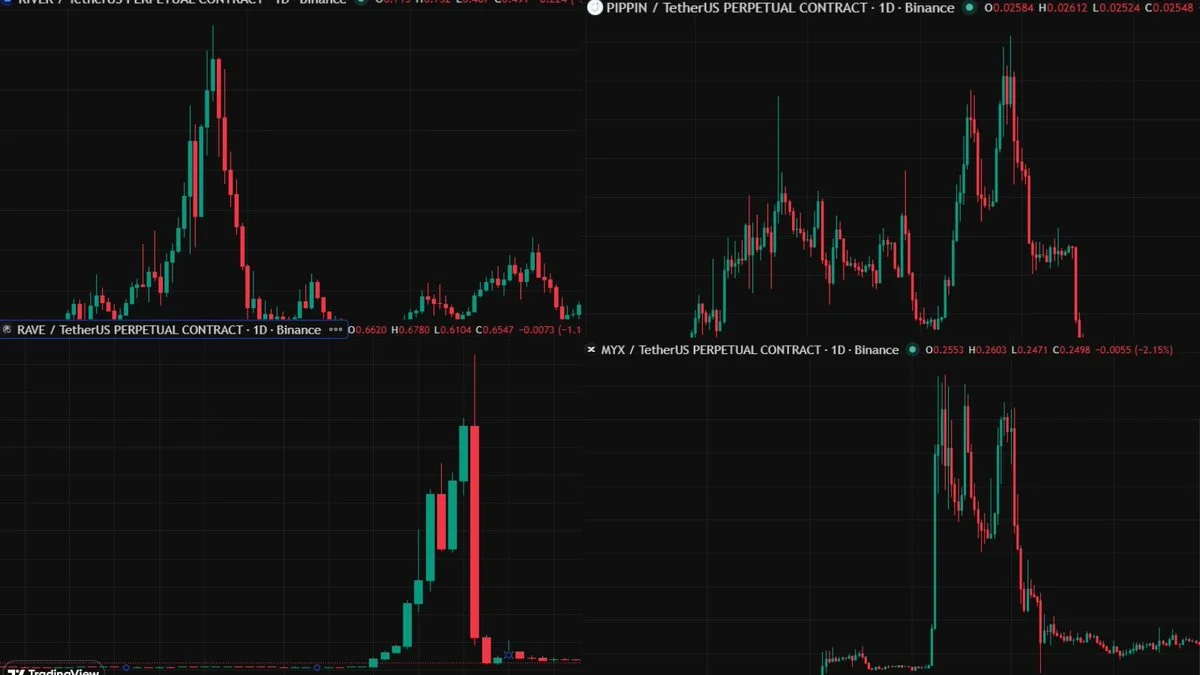
The flagged names span AI-themed memecoins ($SKYAI, $GENIUS, $UAI), DeFi tokens ($DEXE), and smaller-caps $H, $M, and $ZKP, alongside a cluster of sports fan tokens — $LAZIO, $CHZ, $SANTOS, $PORTO, and $ALPINE. The post cites past episodes in $RIVER, $COAI, $MYX, $PIPPIN, and $RAVE as prior instances of the same pattern, where concentrated supply and engineered squeezes preceded forced retail liquidations.
Why it matters
Supply concentration on its own is a known risk; the trader is flagging it as a market-structure vulnerability when paired with deliberate short-squeeze and bear-trap choreography. In tokens where a small number of wallets control a disproportionate share of supply, price can be moved with relatively thin order-book depth, and the resulting volatility tends to attract late retail flow on both sides — flow that the concentrated holders can systematically clear out.
Market impact
Names on the list already trade on thin liquidity and high beta, which is precisely the surface area the warning is describing. Traders running leveraged books in any of the named tickers should assume asymmetric tail risk into any sharp directional move, since the same setup that produces the squeeze also produces the snap-back that liquidates the chasing side.





Frequently asked questions
-
Which tokens did @Eveningtraders flag for supply-control risk?
The watchlist includes $SKYAI, $GENIUS, $DEXE, $H, $M, $UAI, and $ZKP, plus sports fan tokens $LAZIO, $CHZ, $SANTOS, $PORTO, and $ALPINE.
-
What pattern is the trader warning about?
Heavy holder concentration combined with sharp, two-directional price action — used to engineer short squeezes and bear traps that liquidate retail on both sides while amplifying abnormal volatility.
-
What past examples does the post cite as prior instances of this pattern?
The post points to $RIVER, $COAI, $MYX, $PIPPIN, and $RAVE as earlier episodes where concentrated supply and engineered squeezes preceded forced retail liquidations.
-
Why is supply concentration itself a risk in these tokens?
When a small number of wallets control a disproportionate share of supply, price can be moved against thin order-book depth, and the resulting volatility tends to attract late retail flow that concentrated holders can systematically clear out.
-
What should traders using leverage in these names watch for?
Sharp directional moves in either direction carry asymmetric tail risk, since the same setup that produces a squeeze also produces the snap-back that liquidates the chasing side of the book.

 Whale Alert
 CoinDesk
 Glassnode
 CryptoSlate
 Altcoin Daily
 WatcherGuru
 Lookonchain