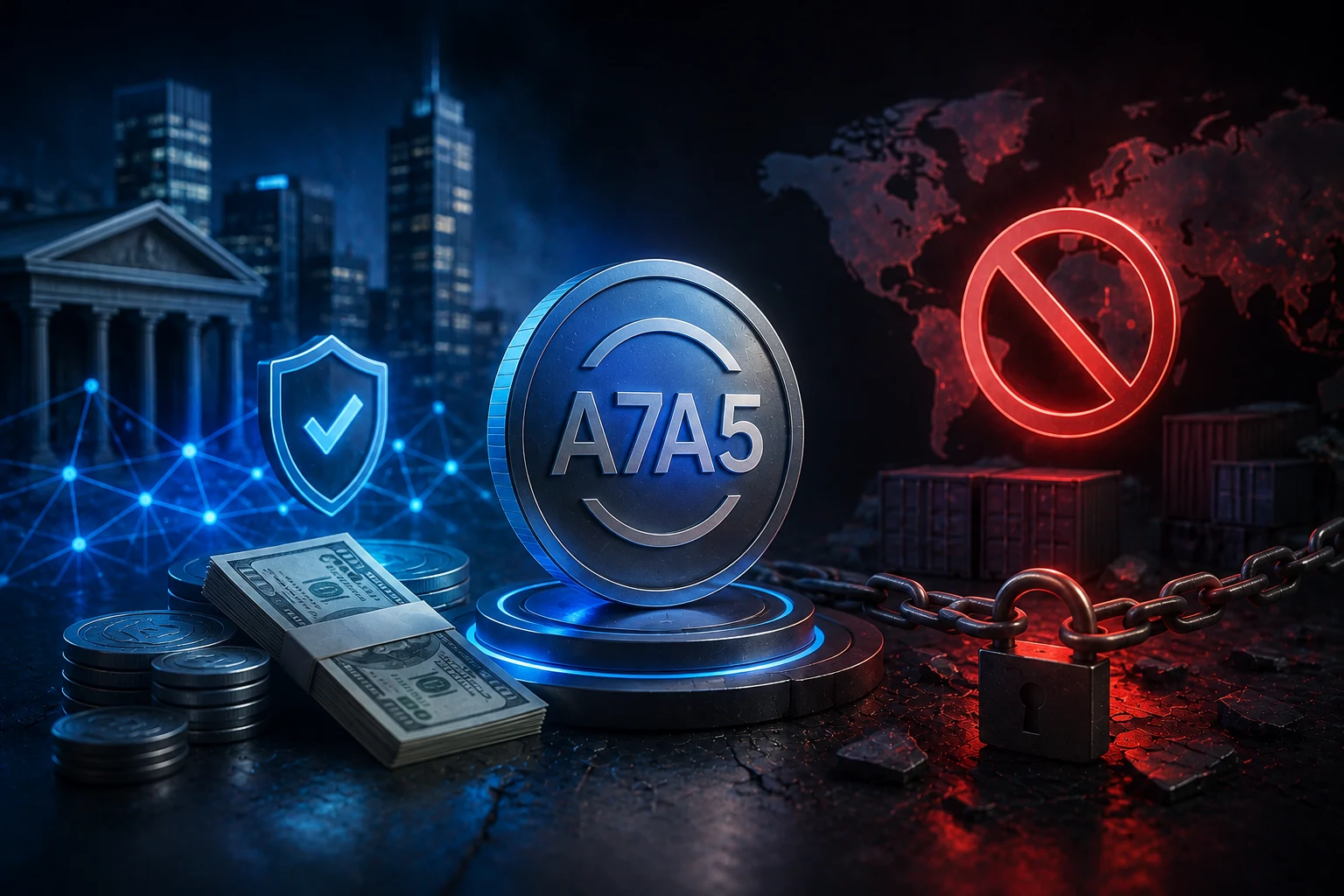
What is A7A5 and why was it created?
A7A5 is a stablecoin pegged one to one to the Russian ruble. It was launched in early 2025 by a firm called A7, also reported under the name Old Vector, registered in Kyrgyzstan. Like other stablecoins, A7A5 runs on a public blockchain, primarily Ethereum as an ERC-20 token, with additional issuance on Tron to take advantage of lower transaction fees and the deep liquidity stablecoins already have there.
The token did not appear in a vacuum. By late 2024, a number of Russian banks, energy traders, and commodity exporters had been cut off from the SWIFT messaging system or placed under blocking sanctions by the United States, the European Union, the United Kingdom, and a growing list of other jurisdictions. That left a specific gap: how do counterparties in friendly jurisdictions settle invoices in rubles without touching sanctioned intermediaries? Cash couriers and informal hawala-style networks can absorb some of that volume, but they cannot scale to the size of Russian cross-border trade.
A7A5 was built to fill that gap. Marketing materials and interviews with the issuer described it as a tool for legitimate cross-border settlements, including trade between Russian firms and partners in Central Asia, the Middle East, and parts of Asia. The token was designed to move value at the speed of an internet connection while nominally preserving the auditability of a bank wire. That combination, a public ledger plus a stated KYC posture, became the central selling point for a token that would otherwise look identical to any other sanctions-era workaround.
From the first weeks of issuance, blockchain analytics firms flagged unusual patterns. By mid-2025, on-chain volumes attributed to A7A5 had crossed into the billions of dollars, a figure that is small compared with USDT's daily turnover but enormous for a single-purpose, single-currency token launched in a niche corridor. That scale is the reason A7A5 ended up on the agenda of the U.S. Treasury, not just crypto-native observers.
Sanctions exposure and OFAC risk
The single most important fact about A7A5, from the perspective of anyone reading this article, is that the token and its issuer were designated by the U.S. Treasury's Office of Foreign Assets Control in 2025. Once a token is on the OFAC list, transactions by U.S. persons become a matter of federal enforcement, not platform policy.
OFAC operates under authorities granted by the International Emergency Economic Powers Act, the Trading with the Enemy Act, and various country-specific statutes. The agency's Specially Designated Nationals (SDN) list freezes the property of named individuals and entities subject to U.S. jurisdiction. When OFAC adds a digital asset issuer and the token itself to that list, the practical effect is broad.
- U.S. persons, including citizens, residents, green-card holders, and U.S.-domiciled companies, are prohibited from making any transaction with the listed property, including holding, transferring, exchanging, or providing software services that facilitate transactions.
- Non-U.S. persons can be exposed to secondary sanctions, meaning penalties for knowingly facilitating significant transactions on behalf of listed persons, even if the non-U.S. person has no direct U.S. nexus.
- Financial institutions and money services businesses are expected to block, reject, and report any incoming A7A5 transactions, mirroring how they handle sanctioned fiat wires.
Civil penalties under IEEPA can reach the greater of roughly $360,000 per violation (inflation-adjusted) or twice the value of the transaction. Criminal penalties, where willful conduct is established, can reach up to 20 years of imprisonment and $1 million per violation for individuals. These numbers are not theoretical: OFAC has settled enforcement actions with crypto exchanges, mixers, and individuals for seven- and eight-figure sums in recent years.
The 50 percent rule applies even to entities not explicitly named. If a non-listed entity is owned 50 percent or more, in the aggregate, by one or more SDNs, that entity is treated as blocked by default. For A7A5 counterparties, this means an apparently unrelated Russian trading firm can be in legal jeopardy simply because of its ownership structure. Compliance teams must map beneficial ownership before touching any counterparty that has handled A7A5.
Outside the United States, the European Union, the United Kingdom, Canada, Australia, and Japan operate their own sanctions programs with overlapping designations. A user in a non-aligned jurisdiction may not face OFAC enforcement directly, but their bank, payment processor, or crypto exchange almost certainly complies with one of these regimes, and many centralized exchanges have delisted A7A5 or refuse to onboard users who can show a history of A7A5 flows. The practical effect is that A7A5 liquidity has migrated to informal OTC desks, peer-to-peer networks, and a small number of non-compliant venues, which is itself a red flag for anyone considering involvement.
Who issues A7A5 and what backs it?
A7A5 is issued by A7 LLC, also reported under the corporate name Old Vector LLC. The company is registered in Kyrgyzstan, a jurisdiction chosen in part for its light-touch regulatory environment and its geographic proximity to Russia. Public reporting has linked the principal behind A7 to a network of Moldovan and Russian intermediaries, though those relationships remain partially opaque. The issuer has positioned itself as a payments-infrastructure provider for sanctioned and partially-sanctioned trade, not as a consumer-facing crypto product.
The stated backing mechanism is straightforward on paper. A7A5 claims to maintain a one-to-one reserve in Russian rubles held at commercial banks, and the issuer describes a redemption process in which holders can redeem tokens for rubles at par. In promotional materials, A7 emphasized that A7A5 is fully reserved and that every token is matched by an equivalent ruble deposit. That claim is the foundation of its pitch to importers and exporters who would otherwise have no way to settle in rubles outside the formal banking system.
Verification of the redemption claim is the weak point. Unlike major stablecoin issuers such as Tether, Circle, or the issuers of regulated euro and pound stablecoins, A7 has not published attestations from a top-tier audit firm. There is no monthly reserve report, no breakdown of which bank holds the reserves, and no segregation language that would protect token holders if the issuer is dissolved. Holders are therefore relying on a corporate representation from a Kyrgyzstan-registered entity with limited public accountability.
Redemption is also subject to political risk. If the issuing bank comes under sanctions, or if the Kyrgyz government changes policy under pressure from Washington, Brussels, or Moscow, the redemption pipeline can close overnight. Holders who cannot redeem can only sell at the secondary market price, which can gap sharply downward when news breaks. This is the classic stablecoin run risk, and it is sharper for A7A5 than for USDT or USDC because the issuer has no fallback banking relationships outside the sanctioned ecosystem.
For these reasons, treat the one-to-one backing claim as a corporate assertion, not an audited fact. Treat redemption as a function of the issuer's continued ability to operate, not a contractual right enforceable in a major jurisdiction.
How A7A5 works on chain
A7A5 is, technically, a routine ERC-20 token. The issuer deploys a smart contract on Ethereum that issues, burns, and transfers balances, with a parallel deployment on Tron for cheaper settlement. The token has standard transfer, approve, and transferFrom functions, and it shows up in ordinary wallet software like MetaMask, Trust Wallet, or TronLink without modification. From a developer perspective, there is nothing exotic about integrating A7A5.
What makes A7A5 distinctive is the marketing layer built around the token. The issuer promotes A7A5 as KYC-attached, meaning that wallet addresses are tied to verified real-world identities at the time of issuance or redemption. The pitch is that A7A5 combines the speed of a blockchain transfer with the traceability of a bank wire. This is a deliberate inversion of the original crypto thesis, which treated traceability as a weakness rather than a feature, and it is one of the reasons A7A5 has been treated differently from privacy coins like Monero or older mixers.
In practice, the KYC layer is partial and the on-chain layer is fully public. Every A7A5 transaction is visible on the relevant block explorer from the moment it is mined. The issuer can, in principle, map wallet addresses to verified customers using its internal records, but those records are not published. This means the public sees a complete graph of A7A5 flows, while the issuer sits on the identity layer that would tie addresses to people.
That asymmetry has played out in coverage from blockchain analytics firms. Elliptic, Chainalysis, and TRM Labs have each published reports tracing A7A5 volume to specific exchanges, OTC desks, and on-chain services. The public ledger made it possible for these firms to identify that a large share of A7A5 redemption and issuance activity passed through counterparties already on sanctions lists, including successor entities to sanctioned Russian exchanges. The traceability claim is therefore true in the narrow technical sense, but the conclusion drawn by U.S. and EU authorities is the opposite of what the issuer intended: the transparency is what got A7A5 on the SDN list.
For a user holding A7A5, the practical consequence is that balances are not anonymous. If a user sends A7A5 to a centralized exchange that complies with U.S. or EU sanctions, that exchange can and likely will freeze the funds and report the activity to the relevant authority. Even moving A7A5 between personal wallets leaves a permanent record that can be reconstructed years later by any analytics firm given a starting clue.
There is also a technical wrinkle that deserves attention. A7A5 has been bridged and wrapped into other forms on different chains to extend its reach. A user who receives a wrapped variant, such as an A7A5 token on a chain where it was not natively issued, may not realize they are receiving a sanctioned asset at all. Compliance teams have to screen for the underlying token, not just the chain of custody, and they have to unwrap bridges before ruling on a deposit. This is one reason why the OFAC designation was written at the level of the token contract itself rather than at the level of any specific venue.
A7A5 versus USDT ruble flows
To understand why A7A5 matters, it helps to compare it with how ruble flows have historically moved on chain. Until 2022, USDT on Tron functioned as a de facto ruble rail in several corridors. Russian importers and exporters, as well as individuals moving value across borders, settled in USDT because it is liquid, cheap to transact, and accepted by counterparties worldwide. Tether, the issuer of USDT, has historically cooperated with law enforcement requests and has frozen specific wallet addresses tied to sanctioned entities, including addresses linked to Garantex and other sanctioned Russian exchanges.
That cooperation created friction for users who did not want their wallets frozen. Each new wave of OFAC enforcement against Russian counterparties narrowed the universe of usable USDT addresses, and Tether's compliance posture became more visible. By 2024, several large Russian and CIS-nexus OTC desks had moved away from USDT in favor of alternative rails, including ruble-denominated tokens like A7A5.
A7A5 differs from USDT ruble flows in three practical ways. First, the unit of account is the ruble, not the dollar, which removes one step of currency conversion and removes the need to take USDT price risk during settlement. Second, the issuer marketed KYC, offering a layer of regulatory comfort to counterparties in jurisdictions where regulators do not want to be seen touching dollar stablecoins tied to sanctioned parties. Third, A7A5 issuance and redemption were deliberately routed through counterparties that had already been cut off from mainstream stablecoin issuers, which meant A7A5 inherited the sanctions risk rather than avoided it.
The volume comparison is instructive. USDT still handles the overwhelming majority of ruble-adjacent crypto flow, simply because of its liquidity depth. A7A5's volume is a fraction of USDT's, but the concentration is striking. A small number of OTC desks and on-chain services accounted for most of A7A5's issuance and redemption, and many of those entities had prior OFAC exposure. From a sanctions analyst's perspective, A7A5 is not a parallel payment system so much as a substitute rail for flows that mainstream stablecoin issuers had already refused.
For users, the difference matters at the wallet level. A user receiving USDT from a sanctioned address can have those specific tokens frozen at the receiving exchange, but other USDT in the same wallet remains usable. A user holding A7A5, by contrast, holds a token that is itself sanctioned, which means the entire balance is suspect at any compliant venue. That is a meaningfully different risk profile, and it is one of the reasons retail-facing exchanges have moved quickly to delist A7A5 rather than just freezing individual deposits.
What A7A5 means for users, exchanges, and compliance teams
For retail users, the practical guidance is simple: do not hold, receive, or transmit A7A5. Even an accidental receipt, such as being paid in A7A5 by a counterparty who did not disclose the asset, can create a sanctions problem at the next touchpoint with a compliant venue. Users who discover A7A5 in their wallet should treat the balance as impaired, contact the receiving exchange or service about disposal options, and document the origin so they can demonstrate they did not knowingly transact with a sanctioned entity.
For centralized exchanges and custodians, A7A5 requires the same treatment as any other sanctioned asset: block the asset at the deposit layer, refuse to credit balances, delist trading pairs, and report attempted deposits to the relevant Financial Intelligence Unit. Several major exchanges have already taken these steps. The operational challenge is that A7A5 can arrive wrapped or routed through bridges and DEXs, so screening must extend beyond the direct token contract to bridged and synthetic variants.
For payment firms and money services businesses, A7A5 is a useful case study in why sanctions screening must extend beyond direct counterparty checks. A payment firm that screens for sanctioned individuals and entities but does not screen the specific crypto asset being transferred can still process an A7A5 transaction, which is itself a violation. Best practice is to maintain a list of sanctioned tokens, including A7A5 and any other OFAC-listed assets, and to block deposits of those tokens at the wallet or payment-processor layer.
For compliance teams at decentralized finance protocols, the picture is more complex. OFAC has historically taken the position that even protocol developers and governance token holders can face exposure if they knowingly facilitate sanctioned transactions. The Treasury's 2022 sanctioning of the Tornado Cash smart contract and the subsequent enforcement actions against Tornado Cash users set the precedent. A7A5 is a more targeted designation, but the same principle applies: routing sanctioned assets through a DEX or relayer, even without taking custody, can draw enforcement attention.
For everyone in this ecosystem, the A7A5 case underscores a recurring lesson. Tokens that appear to be transparent and KYC-friendly are not automatically safe from sanctions. Sanctions exposure flows from the identity of the issuer, the identity of the counterparties, and the underlying policy posture of the jurisdiction that controls the banking rails. A KYC-attached token issued by a sanctioned entity, backed by a sanctioned banking system, is a sanctioned asset regardless of how clean the on-chain trail looks.
For legal and compliance professionals, A7A5 also illustrates how quickly the regulatory perimeter around stablecoins can shift. Tokens that were unremarkable at launch can become unsellable within months, and the burden falls on intermediaries to detect the change. Documentation, ongoing sanctions-list monitoring, and clear escalation paths for unexpected deposits are no longer optional for any crypto business with a U.S. nexus, and arguably for any crypto business with correspondent banking through a U.S. bank.
Read A7A5 coverage critically
A7A5 sits inside a fast-shifting intersection of payments, geopolitics, and sanctions policy. Coverage ranges from chain-analysis deep dives to industry press releases and policy briefs, and the framing depends heavily on the outlet's audience. Tracking A7A5 manually, especially across sanctions updates, exchange delistings, and on-chain volume shifts, is a losing game for most users and even for many compliance teams.
Zippfeed surfaces A7A5 headlines with sentiment scoring, marking each item as bullish, neutral, or bearish for the token and its issuer, and an importance rating that weights policy moves above routine volume updates. That lets you separate signal from noise: when OFAC updates a designation, when a major exchange delists, or when a blockchain analytics firm publishes new tracing, those items rise to the top instead of getting buried under promotional coverage.

 CryptoSlate
 CoinDesk