Why cross-chain messaging is harder than it looks
Moving a token from Ethereum to Solana, or from a Cosmos app-chain to a rollup, looks like a simple transfer on the surface. Under the hood, the destination chain has to take the word of a foreign system that a deposit, a burn, or a vote really happened. That word is a message, and the way it gets verified is the entire security model of the bridge.
The naive approach is to hand the job to a multisig wallet. A group of well-known validators signs the message, and the destination chain accepts it once a threshold of signatures shows up. This is fast, flexible, and it is also the design pattern behind most of the largest bridge exploits in crypto history. When a multisig is the trust root, the bridge is only as safe as the smallest number of compromised keys it tolerates.
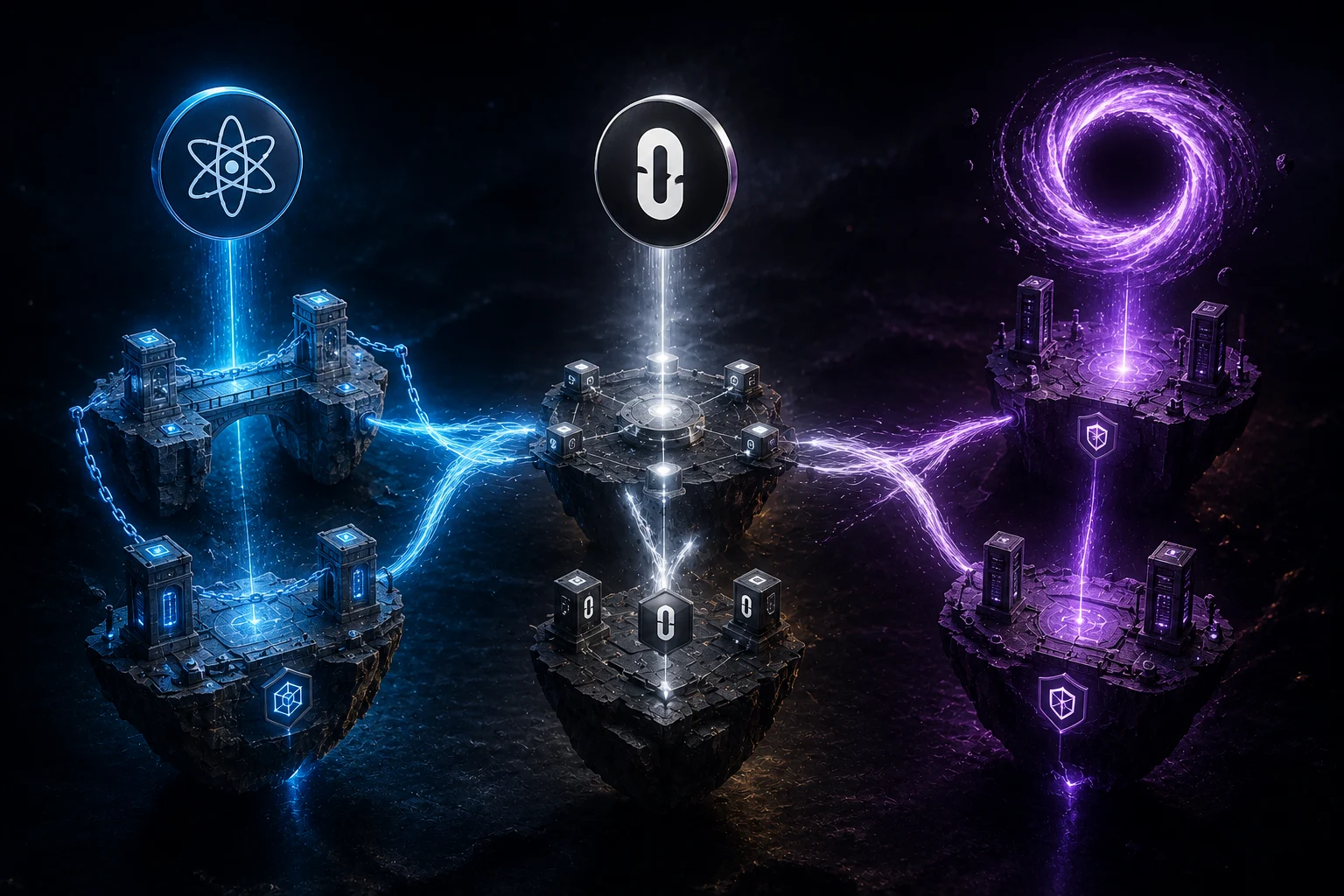
The deeper approach is to make the destination chain verify the source chain directly, the way a person verifies a passport by reading the issuing country's stamp rather than trusting a third party's word. That is what a light client does. It is also expensive, slow to ship, and limited to chains that can run each other's verification logic. The three stacks in this article sit on a spectrum between these two extremes, and the differences matter more than the marketing pages suggest.
Risks every cross-chain user should accept first
Before comparing features, the honest framing is that every cross-chain message carries risk the underlying chains do not. A token bridged from Ethereum to another network is, in a strict sense, no longer the Ethereum token. It is a wrapped or minted IOU that the destination chain can honour only if the bridge's security model holds. Bridges have been the single largest source of crypto loss by category for three years running.
The historical record is sobering. The Ronin bridge lost roughly 625 million dollars in 2022 after five of nine validator keys were compromised. The Wormhole bridge lost about 320 million dollars in 2022 when an attacker bypassed signature verification on Solana. The Harmony Horizon bridge lost around 100 million dollars in 2022. The Nomad bridge lost close to 190 million dollars in early 2023. In total, cross-chain bridges have accounted for more than two billion dollars in documented losses, and that number understates the picture because some incidents are absorbed quietly.
For users, the practical risks fall into a few buckets. Smart contract risk on the destination chain can let an attacker mint unbacked assets. Validator compromise on the source side can let a thief approve a fake deposit. Replay or finality issues can let a message get accepted before the source chain has truly settled. Governance capture can change the rules after the fact. None of these are theoretical. They have all happened, and they are why a trust model comparison is more useful than a feature checklist.
Cosmos IBC and the light-client trust model
IBC, the Inter-Blockchain Communication protocol, is the closest thing the industry has to a cryptographically native cross-chain standard. It was specified by the Interchain Foundation and shipped inside the Cosmos SDK, and it has been live carrying real assets and messages between independent app-chains since 2021. ATOM, the native token of the Cosmos Hub, plays a coordinating role in that ecosystem, though many IBC-enabled chains have little to no direct ATOM exposure.
The defining idea behind IBC is that the destination chain runs a light client of the source chain, and the source chain runs a light client of the destination chain. A light client is a small piece of code that verifies block headers from another chain using only that chain's consensus rules. When chain A wants to send a packet to chain B, it commits the packet to its own merkle tree, then chain B verifies that commitment by checking the header chain A sent, signed by A's validator set. There is no external multisig, no oracle, and no third-party relayer with the power to forge a message. The security of the bridge is the security of the two chains involved.
This model has real consequences. A Cosmos app-chain and another Cosmos app-chain that both run Tendermint-style consensus can connect with a few lines of configuration and inherit very strong guarantees. Connecting to a chain with a different consensus algorithm, like Ethereum, requires writing a custom light client in Solidity and a relayer that can pay gas on both sides. That work has been done for Ethereum, and the resulting ICS-27 Neutron-style connections are usable, but it is a heavier lift than the other stacks in this article.
The narrow reach is the trade-off. IBC does not magically secure arbitrary rollups and alt-L1s. Each connection is bespoke, and every connected chain becomes part of the trust surface. That is a feature from a security standpoint, because it keeps the trust model local, and a limitation from an ecosystem standpoint, because it does not scale as easily as a permissioned message bus.
Shared security and the app-chain angle
The app-chain thesis behind Cosmos is that serious applications deserve their own blockchain, with their own validator set and their own fee token. IBC is the connective tissue that makes that thesis workable, because it lets many sovereign chains interoperate without surrendering sovereignty. Replicated security, and its successor interchain security, let smaller app-chains rent the Cosmos Hub validator set, which improves their security while keeping IBC as the cross-chain layer. The result is a model where the trust assumptions for a cross-chain message are explicit, local, and auditable, but the cost is fragmentation across many chains with varying levels of validator quality.
LayerZero and the configurable DVN stack
LayerZero takes a different design path. Instead of running full light clients on each chain, it runs an Ultra Light Node, which is a minimalist endpoint that stores block headers only when needed and otherwise relies on an off-chain relayer plus a separate stack of Decentralized Verifier Networks, called DVNs, to attest to a message. The destination chain accepts a message when the configured DVNs agree that the source chain's transaction is valid.
This is a trust-minimized architecture in the sense that no single party controls message delivery, but it is also a configurable one. The application that deploys a LayerZero endpoint gets to pick which DVNs verify its messages. The default configuration uses a specific set, but a developer can swap in a different DVN stack to change the security profile of a particular bridge. Some teams have shipped with a single DVN, which is closer to a multisig in practice, while others use multiple DVNs from independent operators.
Critics of LayerZero have argued that this flexibility is itself a risk. If an application deploys with weak DVNs to save on cost or latency, the security of that bridge is weak by construction. The LayerZero team has responded by expanding the DVN marketplace and pushing for default configurations that use independent verifiers, and the V2 redesign of the protocol leans harder on explicit DVN composition. Still, the responsibility for choosing the verifier stack ultimately falls on the application team, which means a user transacting across a LayerZero bridge has to trust both the protocol and the choices that team made.
The reach of LayerZero is broad. It is live on most major EVM chains, on Solana, and on several non-EVM networks, and it has been used by large applications including Stargate, a cross-chain liquidity router, and several stablecoin issuers. That reach is a real advantage, but it comes with a more complex mental model: the security of a specific bridge depends on the DVNs selected, the application contract that enforces verification, and the on-chain endpoint version in use.
How DVNs change the trust math
The simplest way to think about a DVN stack is as a pluggable signature scheme. Each DVN can be a zk-proof system, a restaking-based verifier, a centralized attestation service, or a multisig run by a known operator. Stacking independent DVNs with different trust roots is a reasonable defense, because an attacker would have to compromise more than one verifier at once. Stacking correlated DVNs that share infrastructure or governance is closer to having a single point of failure dressed up as many. Application teams that ship with cheap, correlated DVNs get the marketing of decentralization and the risk profile of a multisig.
Wormhole and the guardian multisig
Wormhole, originally developed by Certus One and now stewarded by the Wormhole Foundation, is the third major stack. It connects Ethereum, Solana, BNB Chain, Aptos, Sui, and a long tail of other networks, and it has historically been one of the highest-TVL bridge designs in the industry. Its design is also the simplest to describe, and the most controversial from a security standpoint.
Messages on Wormhole are attested to by a permissioned set of 19 guardians, each of which runs a node that observes the source chain and signs observed events. When 13 of 19 guardians sign the same message, it is accepted on the destination chain. The guardians are well-known operators drawn from across the industry, and the set is governance-controlled, meaning new guardians can be added or removed by the Wormhole DAO.
The trust model is a multisig with a high threshold. If 7 of 19 guardians collude, or if 7 guardians' keys are compromised, the bridge is fully compromised. That is a meaningful centralization point, and the 2022 exploit made the consequences concrete. An attacker found a way to forge a signature check on the Solana side of Wormhole, allowing them to mint 120,000 wrapped ETH that was not backed by deposits on Ethereum. The loss was about 320 million dollars at the time, and it was backstopped by Jump Crypto, which had been a guardian operator and stepped in to recapitalize the bridge.
Wormhole has since added a guardian firewall, tightened its on-chain verification logic, and pushed for additional security reviews. None of that changes the underlying trust assumption, which is that a permissioned multisig with a 13-of-19 threshold is the root of cross-chain safety. For users, the practical question is whether the guardian set is decentralized enough, whether the guardians' incentives align with honest operation, and whether the application on the destination chain enforces the verification path correctly.
Why the TVL ranking is misleading
Wormhole's TVL has often been used as a proxy for its safety, on the implicit logic that more money trusting a bridge means the bridge is more trustworthy. The historical record argues the other direction. Bridges with the highest TVL are the most attractive targets, and Wormhole's position near the top of that list is the reason its exploits have been so large. A user looking at total deposits is not seeing the security model, only the prize available to an attacker.
How IBC, LayerZero, and Wormhole compare on the dimensions that matter
Trust model is the primary dimension, and on that axis IBC is the most secure by design, because each chain verifies the other through consensus. LayerZero is second, because the DVN stack can be configured to be cryptographically robust, but only if the application picks verifiers that actually are. Wormhole is third, because the trust root is a permissioned guardian multisig that has already been compromised once and that improves only as fast as the guardian set is decentralized and rotated.
Reach and connectivity favor Wormhole and LayerZero. Both ship on dozens of chains out of the box, and a developer can deploy a cross-chain application on either without writing a custom light client. IBC, by contrast, requires a per-connection setup, and a connection to a chain with unfamiliar consensus is a serious engineering project. For an application that needs to touch every major network quickly, that is a real cost.
Developer experience is roughly even between LayerZero and Wormhole today, with each offering a relatively straightforward endpoint and well-trodden deployment paths. IBC tooling has improved a lot, with libraries like ibc-go and Hermes relayers, but the on-chain footprint on the Ethereum side is heavier and the EVM tooling is less mature than the alternatives.
Latency and cost are hard to generalize. IBC connections between Tendermint chains are fast and cheap because the relayer just submits existing headers. LayerZero's latency depends on DVN configuration and on how often the Ultra Light Node needs to refresh state. Wormhole's latency depends on guardian signature aggregation. For retail-sized transfers, all three are competitive; for high-frequency cross-chain arbitrage, the differences in finality and gas can matter.
Governance and upgrade paths are an underrated risk surface. IBC upgrades happen at the protocol level and require coordination between connected chains. LayerZero has been actively iterated, with V2 reshaping the trust model toward more explicit DVN composition. Wormhole governance sits with the Wormhole Foundation and the guardian set, with the 2022 incident prompting a more visible security roadmap. None of these governance paths is fully trustless, and a user should be aware of who can change the rules.
Practical implications for builders and DeFi users
For builders, the honest takeaway is that the choice of cross-chain stack is the choice of a trust root, and that decision should be made before a single line of business logic is written. An application that needs the strongest possible guarantees and is happy to live inside a Cosmos-style environment will find IBC hard to beat. An application that needs broad reach and is willing to manage DVN composition carefully will find LayerZero flexible. An application that prioritizes time-to-market and is comfortable with a permissioned guardian set will find Wormhole fast to ship, with the understanding that the trust model is the one the marketing page tends to leave out.
For DeFi users, the practical checklist is short. Find out which bridge a token uses to move between the chains you care about. Read how that bridge verifies messages. If the answer is a multisig, ask how many signers are required, who they are, and how they are governed. If the answer is a light client, ask whether the destination chain actually runs that client and how often it is updated. If the answer is a DVN stack, ask which DVNs are in the stack and whether they are independent. A wrapped or bridged asset is only as safe as the weakest part of that answer, and the bridged token is rarely the same risk profile as the underlying asset on its home chain.
It is also worth remembering that cross-chain risk is not static. The guardian set of a bridge today may not be the guardian set tomorrow. The DVN composition of a LayerZero application today can be reconfigured tomorrow. The light clients of an IBC connection today depend on validator sets that can change through governance. Trust assumptions are living things, and an honest comparison is one that says so out loud.
How to track cross-chain risk the smart way
Cross-chain infrastructure moves fast, and so does the news around its security. Tracking bridge audits, guardian rotations, DVN changes, and exploit disclosures manually is a losing game. Zippfeed surfaces cross-chain headlines with sentiment scoring, bullish, neutral, or bearish, and an importance rating, so you can see which bridge events actually moved markets and which were noise. Pair that with a habit of asking, every time, which validator set you are trusting with the message, and you will be ahead of most retail users still treating bridges as routine infrastructure.

 CryptoSlate