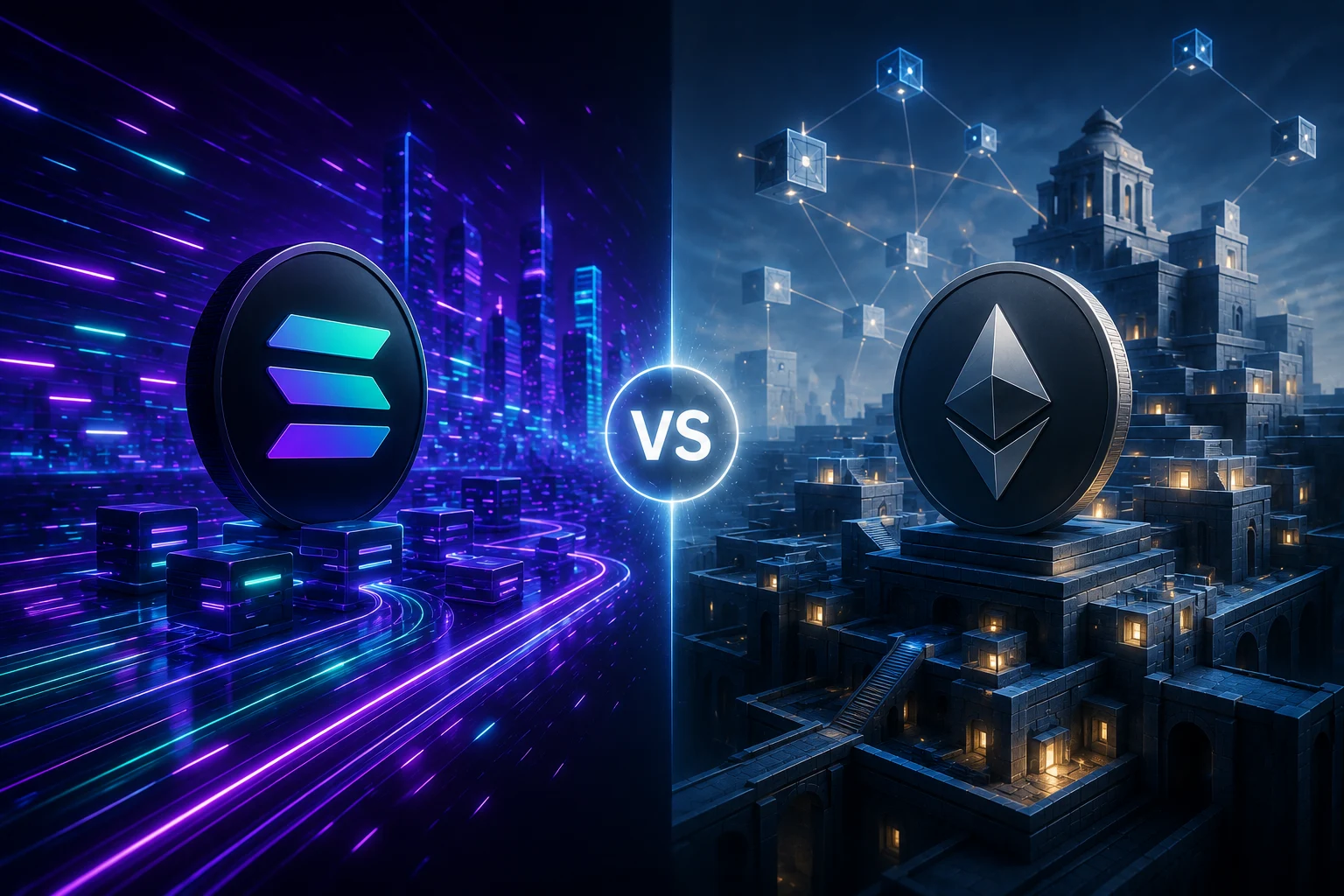
What "Solana DeFi vs Ethereum DeFi" actually means
When people compare Solana and Ethereum DeFi, they usually start at gas fees and transaction speed, then stop. That comparison misses what is structurally different. Solana and Ethereum are not two cars with different horsepower running the same highway. They are two roads built on different ideas about what a blockchain is for.
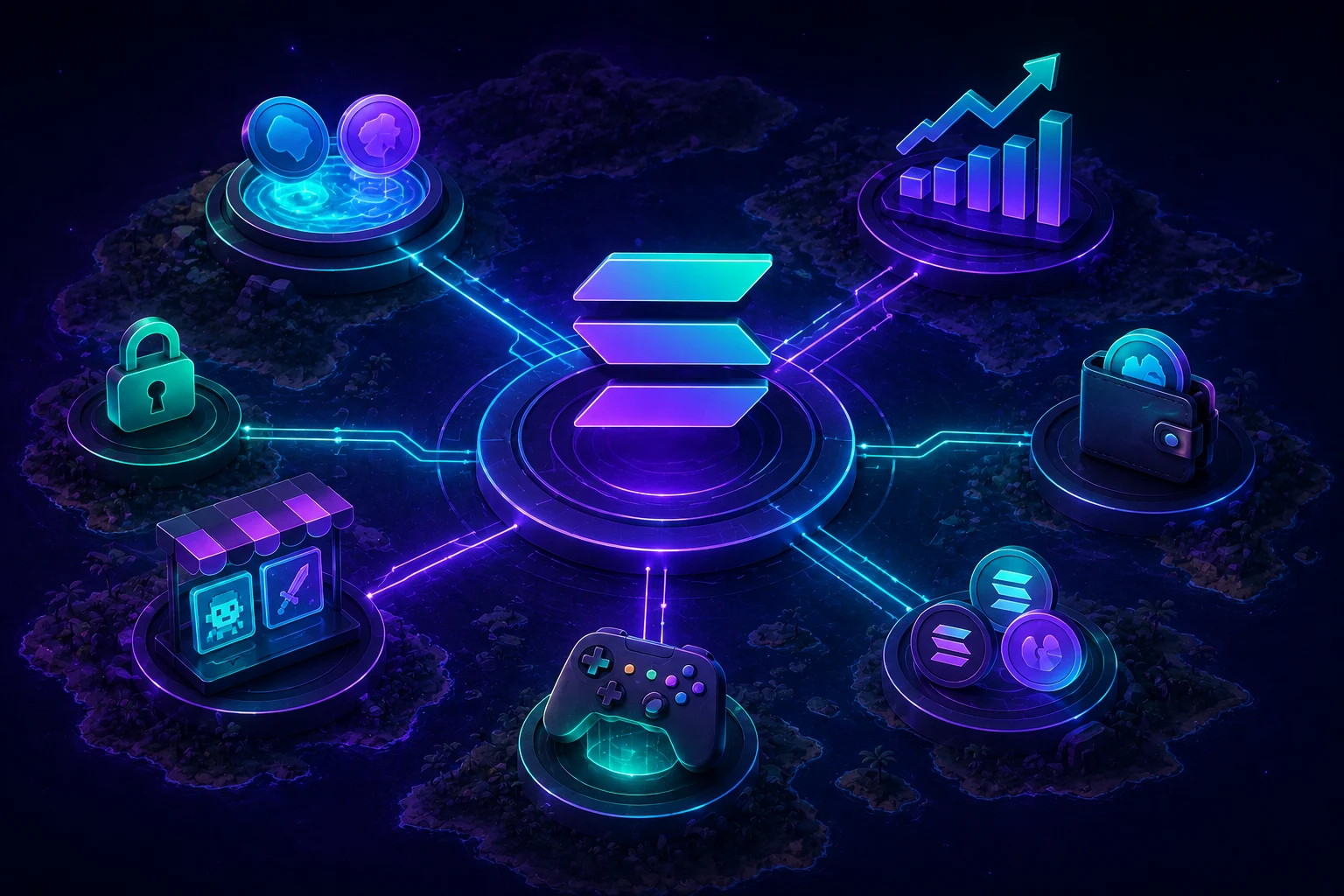
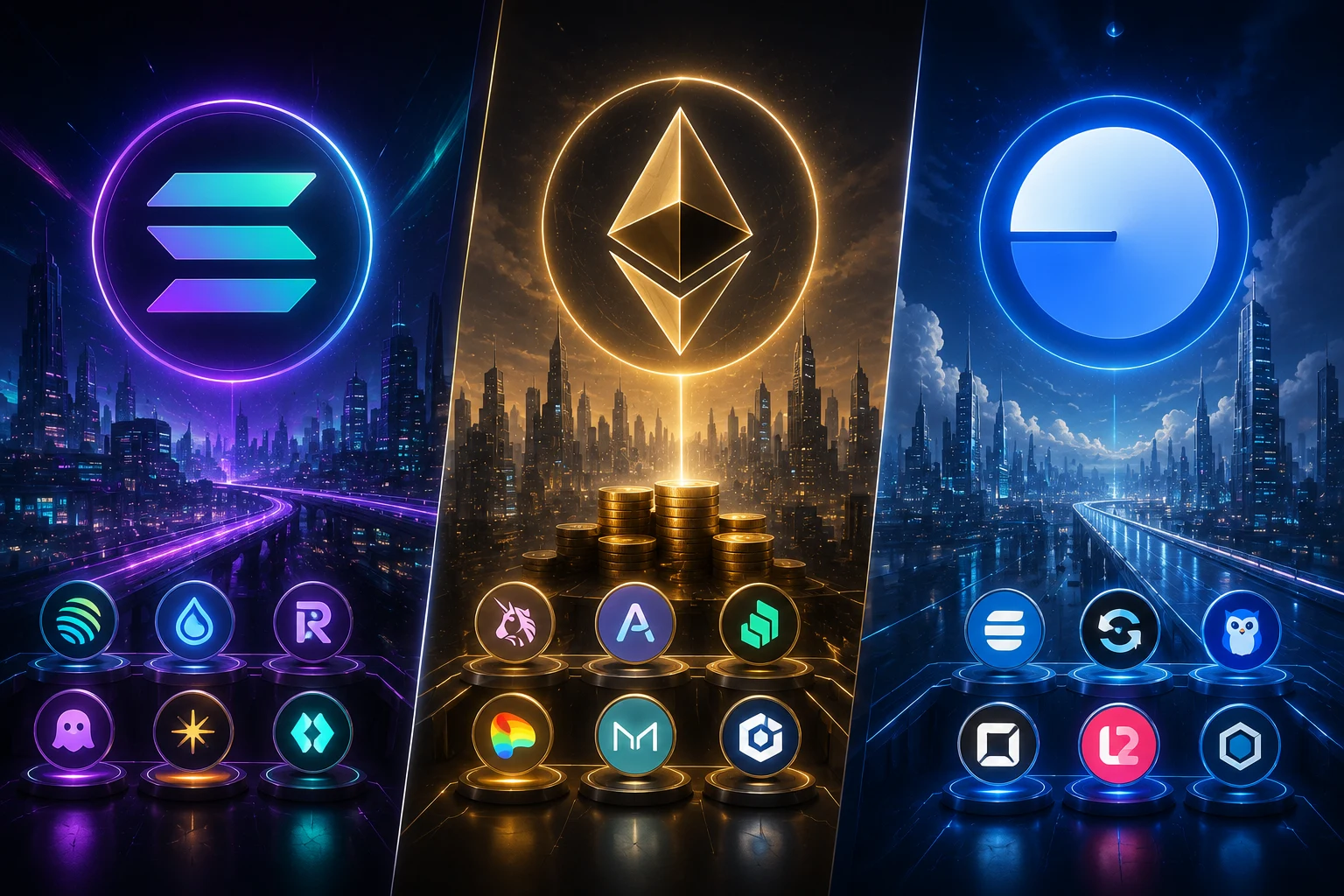
Solana was designed around a single, monolithic chain that tries to handle execution, consensus, and data availability on one tightly optimized layer. Most DeFi activity, meaning swaps, lending, liquid staking, perpetuals, lives directly on that base layer. Jupiter aggregates that activity; Jito handles staking and a large share of MEV extraction; token standards like token-2022 add features such as transfer hooks, confidential transfers, and custom fees at the protocol level.
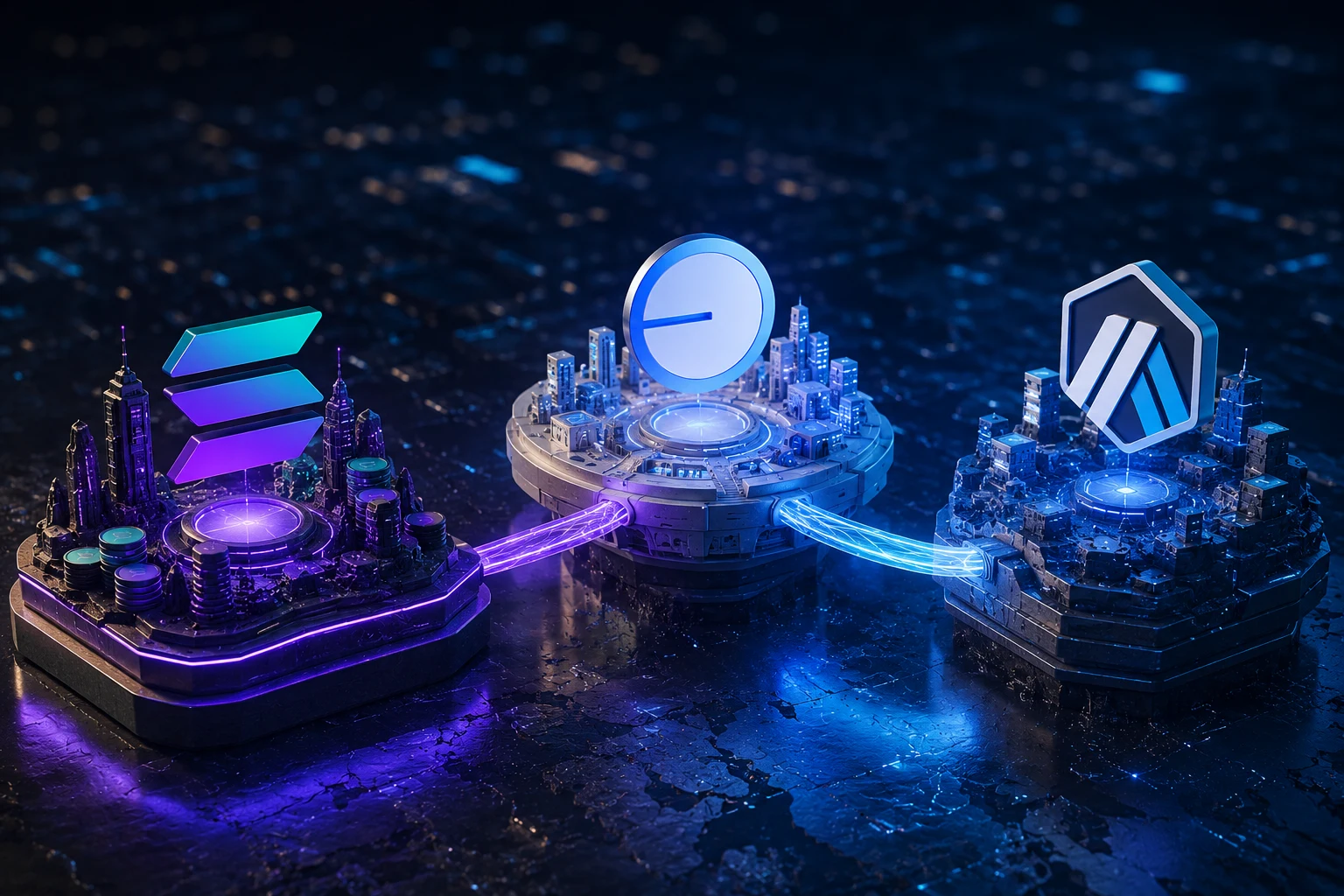
Ethereum's mainnet (often called L1) was deliberately redesigned, especially after the Merge and the rollup-centric roadmap, to be a settlement and data-availability layer. Most user-facing DeFi in 2025 runs on L2 rollups such as Arbitrum, Base, Optimism, and zkSync. These batches compress transactions and post summaries back to L1, inheriting its security while trying to give users cheaper, faster execution. Base-layer DeFi on Ethereum still exists, but is mostly used by high-value traders, market makers, and protocols that specifically need L1 settlement.
That is the core comparison: one tightly integrated stack that optimizes for throughput and has fewer places to hide when things break, versus a layered stack where the L1 is intentionally slower and most user pain (and most fee revenue) sits on independent rollup networks.
Risks that matter before the technical details
Any honest comparison has to flag the user-facing risks first, because the architecture choices below each translate directly into how an everyday person can lose money.
Solana-specific risks. Solana has had multiple network halts since mainnet launch, including the September 2021 outage, several in 2022 and 2023, and a major incident in February 2023 that required validator coordination to restart the chain. Outages are not bugs in the same sense as a smart contract bug; they are the system intentionally pausing while validators agree on a coordinated fork. This has real consequences for users: if you have an open position, a pending swap, or a liquidation that needs to settle during a halt, the state of your trade is frozen. Recovery in past incidents has been fast, but "fast" does not mean free, and there is no guarantee future halts are resolved without loss for someone.
Solana's tight stack also means correlated failures. A bug in a widely used program, in the validator client, or in the token-2022 implementation can cascade across many protocols at once. Token-2022's transfer hooks, which let a token call arbitrary programs on every transfer, are powerful but enlarge the attack surface. A malicious or poorly audited hook can block transfers, trap funds in wallets or DEXs, or create reentrancy paths that older token designs could not.
Ethereum-specific risks. On Ethereum, the dominant failure mode is now per-L2. Each rollup has its own sequencer (the entity that orders transactions), its own bridge, and often its own governance token. If a sequencer goes down, transactions on that L2 halt, even though L1 keeps producing blocks. Bridge exploits have cost users and protocols hundreds of millions of dollars across years, including the Ronin and Harmony bridges in 2022 and multiple L2-related incidents since. L1 itself has been remarkably stable, but the user-facing experience is now a rollup, and rollups carry idiosyncratic risk.
Shared risks. Smart contract risk, oracle manipulation, stablecoin depegs, and phishing are present on both chains. The architectural differences above do not remove these; they change the blast radius and the recovery path.
How the two stacks actually work
Solana's runtime is built around a concept called Sealevel, which allows parallel transaction execution. In plain English, if two transactions do not touch the same accounts, they can be processed at the same time rather than waiting in line. Combined with a high-throughput consensus design (historically described as Proof of History combined with TowerBFT, the protocol's delegated Proof of Stake consensus), this lets the network target tens of thousands of transactions per second under favorable conditions.
The result is a chain where block times are roughly 400 milliseconds and finality is usually under a couple of seconds. For users, this means a swap that feels instant and a lending position update that the UI sees the same heartbeat. It also means MEV extraction is fast: bots can see, simulate, and act on transactions within the same block. Jito runs a stake-weighted block engine that bundles these opportunities and pays validators through tips, alongside standard staking yield.
Ethereum's base layer runs on Proof of Stake and produces blocks roughly every 12 seconds, with full finality taking about 12 to 15 minutes. This is by design: the L1 is optimized for security and data availability, not speed. Most of the speed users actually feel, sub-second swaps and sub-cent fees, comes from rollups.
A rollup executes transactions off the L1, then posts a compressed summary plus cryptographic proof (a fraud proof for optimistic rollups or a validity proof for zero-knowledge rollups) back to Ethereum. The L1 acts as the court that punishes fraud or verifies the math, depending on the rollup type. This gives users most of Solana's speed, at the cost of a slightly longer withdrawal period, an additional trust assumption about the sequencer, and an extra hop if you want to move assets between rollups.
Composability and the real meaning of "monolithic vs modular"
Composability is the property that lets one DeFi protocol read the state of another in the same transaction. It is what makes things like flash loans, atomic arbitrage between DEXs, and one-click leverage loops possible. The architectural choice of monolithic versus modular has direct consequences here.
On Solana, because nearly all DeFi lives on the same base layer and uses the same account model, composability is "synchronous" in a strong sense. A program can call Jupiter, Kamino, MarginFi, and a token program all within a single transaction, atomically. This is what enables complex multi-leg strategies, points farming, and tightly coupled vault products that update each other's state in one user action.
The trade-off is blast radius. A bug or an outage affecting the base layer affects every app at once. There is no "only one rollup is down" story; it is the whole network or nothing. Validator economics amplify this. A relatively small validator set, plus the dominance of Jito's block engine, means that operational concentration is high. Decentralization and client diversity have improved, but Solana is still meaningfully more centralized at the consensus and MEV layer than Ethereum mainnet.
On Ethereum, composability is now mostly cross-rollup, which is asynchronous. You can do a swap on Uniswap on Arbitrum in a single transaction, but moving from Arbitrum to Base and back within one transaction is not straightforward; it usually involves a bridge and a wait. This is the source of much of the user friction in Ethereum DeFi. The compensation is that a failure on one rollup does not affect the others, and L1 remains an independent, high-value settlement layer that anyone can audit or exit to.
Ethereum's mainnet MEV ecosystem is more fragmented too. Proposer-builder separation (PBS), enshrined and via MEV-Boost, splits the role of proposing a block from the role of building its contents, creating a market between searchers, builders, and relays. This reduces validator-level MEV centralization pressure but introduces its own set of trust assumptions about relays and censoring transactions at the policy layer.
Wallet UX, token standards, and what users actually touch
Most users do not interact with consensus or rollups directly; they interact with a wallet. On Solana, the dominant wallet is Phantom, with Backpack and Solflare as common alternatives. Phantom and its peers are non-custodial, hold the user's private keys, and sign transactions locally. The user-facing UX is largely built around Solana's account model: each token has an associated account, and the wallet manages these behind the scenes.
Ethereum's dominant wallets are MetaMask and Rabby, with WalletConnect enabling connections to many other wallets. Wallets on Ethereum have to manage L1, multiple L2s, custom networks, and bridges, which is a more complicated mental model. Most modern wallets auto-detect the network you are connected to and route to the right RPC (Remote Procedure Call endpoint, basically a server your wallet talks to), but responsibility for understanding which network you are on still sits with the user.
Token standards are another place the difference shows. ERC-20 on Ethereum is intentionally minimal: balance, allowance, transfer. Features like transfer fees, blacklist support, or rebasing logic are added in wrappers or separate contracts. Solana's SPL token program was similarly minimal historically, but token-2022 (sometimes called Token Extensions) brings hooks, confidential transfers, transfer fees, interest-bearing tokens, and other primitives on-chain. This lets issuers add compliance or royalty logic directly, but also shifts more risk into the token definition itself, where a bad hook can break wallet displays, DEX integrations, and bridges.
What this means for the user in practice
If you care most about speed, low fees for small transactions, and a wallet experience that masks the underlying complexity, Solana DeFi is likely to feel better. Swaps on Jupiter are typically final within a second and cost fractions of a cent under normal conditions. Jito staking adds MEV rewards on top of normal staking yield, and liquid staking tokens (LSTs) like JitoSOL can be routed into other DeFi positions.
If you care most about where value ultimately settles, the breadth of audited protocols, and the ability to exit to a base layer that does not depend on any single sequencer or team, Ethereum's L2-centric DeFi is the more conservative bet. You pay that in higher friction: bridging between rollups, confirming you are on the right network, and understanding that "Ethereum DeFi" usually means "Arbitrum DeFi" or "Base DeFi" rather than mainnet itself. L1 is still relevant for high-value trades, certain perpetuals, and protocols that specifically want Ethereum settlement.
Both ecosystems have well-known risks. On Solana, weigh outage history, MEV centralization via Jito, and token-2022 hook risks. On Ethereum, weigh rollup sequencer trust, bridge risk, and the cost of cross-rollup composability. Either way, do not size any position to a level where a coordinated network halt, a bridge exploit, or a token-hook bug would be life-changing.
How to follow Solana and Ethereum DeFi the smart way
Solana and Ethereum DeFi both evolve fast, and so does the news and on-chain signal around them. Tracking outage reports, validator client changes, L2 sequencer issues, bridge incidents, and token standard updates by hand is a losing game. Zippfeed surfaces Solana and Ethereum DeFi headlines with sentiment scoring (bullish, neutral, or bearish) and an importance rating, so you can focus on the changes that actually move risk and pricing, not the noise.






 Lookonchain
 WuBlockchain
 Crypto Capital Venture