What crypto actually is, and what it is not
Crypto is a family of digital assets built on public ledgers called blockchains. The most familiar ones, Bitcoin (BTC) and Ethereum (ETH), are simply networks whose native tokens people buy, send, and use in apps. Every transaction is recorded on a chain that anyone can inspect, which is the opposite of a private bank ledger. That transparency is the core innovation; the price charts you see on news sites are a secondary, much louder layer on top.
What crypto is not, despite the marketing: it is not anonymous, it is not guaranteed to appreciate, and it is not a shortcut to retirement. Most beginners enter through hype and leave through a lesson. The honest framing is that crypto is an open, programmable alternative to traditional finance with genuine utility, real technical risk, and a market that punishes impatience.
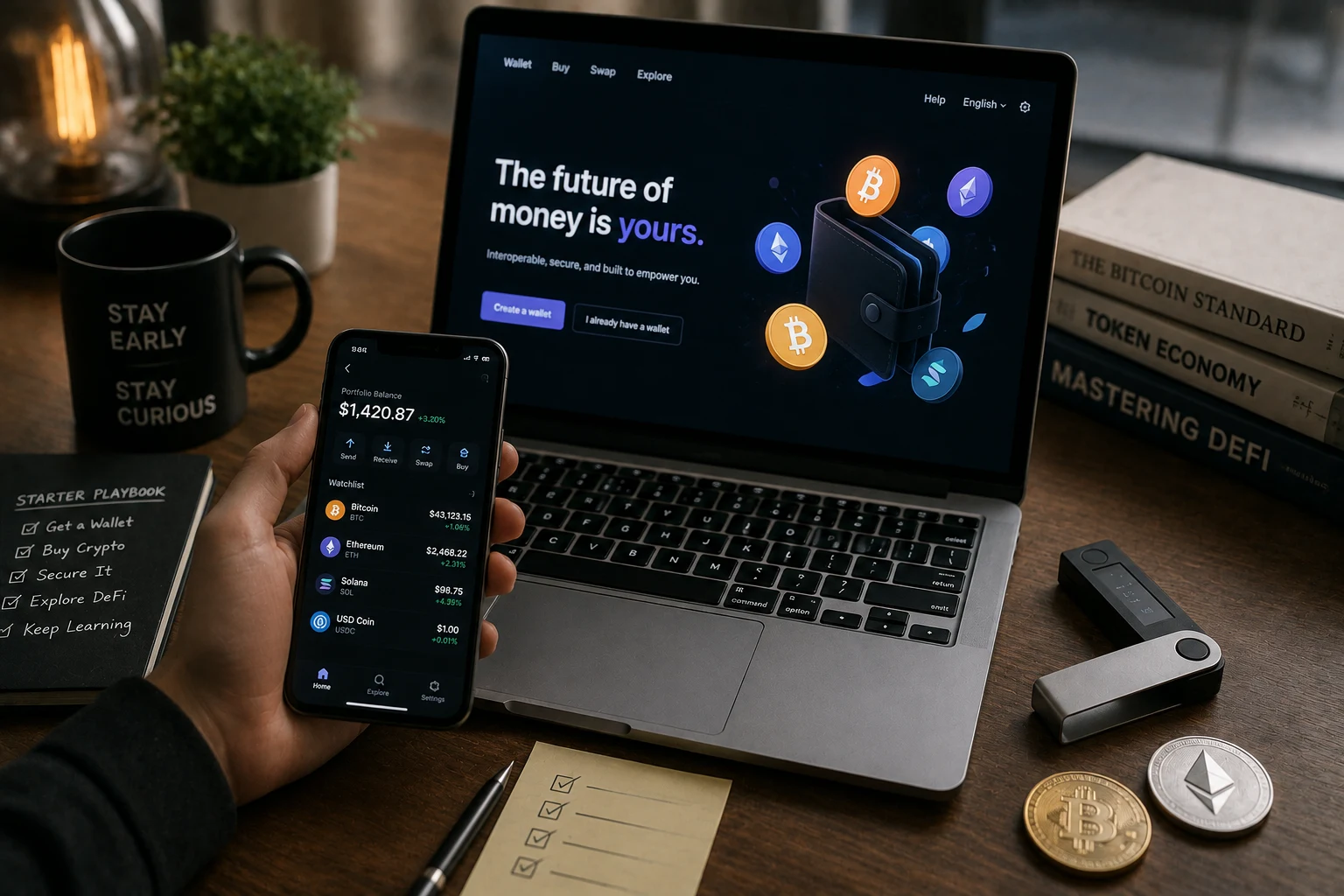
You will hear three words constantly. A coin or token is the asset itself (BTC, ETH, SOL). A wallet is the software that holds the keys that prove you own the asset. An exchange is where you trade dollars for those assets. Most beginners confuse the wallet with the exchange, which is the single biggest source of first-month losses. The exchange is a bank; the wallet is the vault. You want both, and you want to know which is which before you fund either.
How beginners actually lose money in the first month
This section comes second on purpose. If you only read the optimistic half of crypto guides, you are walking into the same trap thousands of new buyers hit every week. The failures are mundane and repeatable. Knowing them in advance is the cheapest edge in crypto.
Wrong network sends. Every token has multiple versions across chains. USDC on Ethereum, USDC on Solana, and USDC on Polygon are three different assets even though they share a name. Sending USDC on Ethereum to an exchange that only accepts USDC on Solana will look like a normal transaction, succeed on-chain, and then vanish into a recovery process that may or may not return your funds. Always copy the deposit address and confirm the network twice.
Phishing sites and fake support. Scammers clone exchange login pages, run Google ads that point to them, and staff Telegram and Discord channels pretending to be support. Real support will never DM you first, never ask for your seed phrase, and never ask you to install screen-share software. If someone contacts you, you are talking to an attacker.
Screenshotting or cloud-syncing seed phrases. A seed phrase is a list of 12 or 24 words that backs up your wallet. It is the master key to your funds. Storing it in a phone photo, an iCloud backup, a Google Drive folder, or a notes app means a single account compromise drains your wallet. Write it on paper, keep it offline, or use a hardware wallet.
Leaving everything on the exchange long-term. Exchanges are custodial, meaning they hold the keys for you. They can be hacked (history is full of examples), they can freeze withdrawals during investigations, and they can fail. The standard rule is to treat an exchange like a checking account: park funds there only while you trade, then withdraw to a self-custody wallet where you control the keys.
Starting with leverage, perps, or memecoins. Perpetual futures (perps) let you trade with borrowed money and can liquidate your account on a small move. Memecoins move 70 percent in an hour in both directions. Both are how beginners turn a $200 starter into a $0 lesson. Day-one trades should be spot (buying the asset itself, not a derivative) in BTC, ETH, or a stablecoin.
The wallet-first sequence beginners should follow
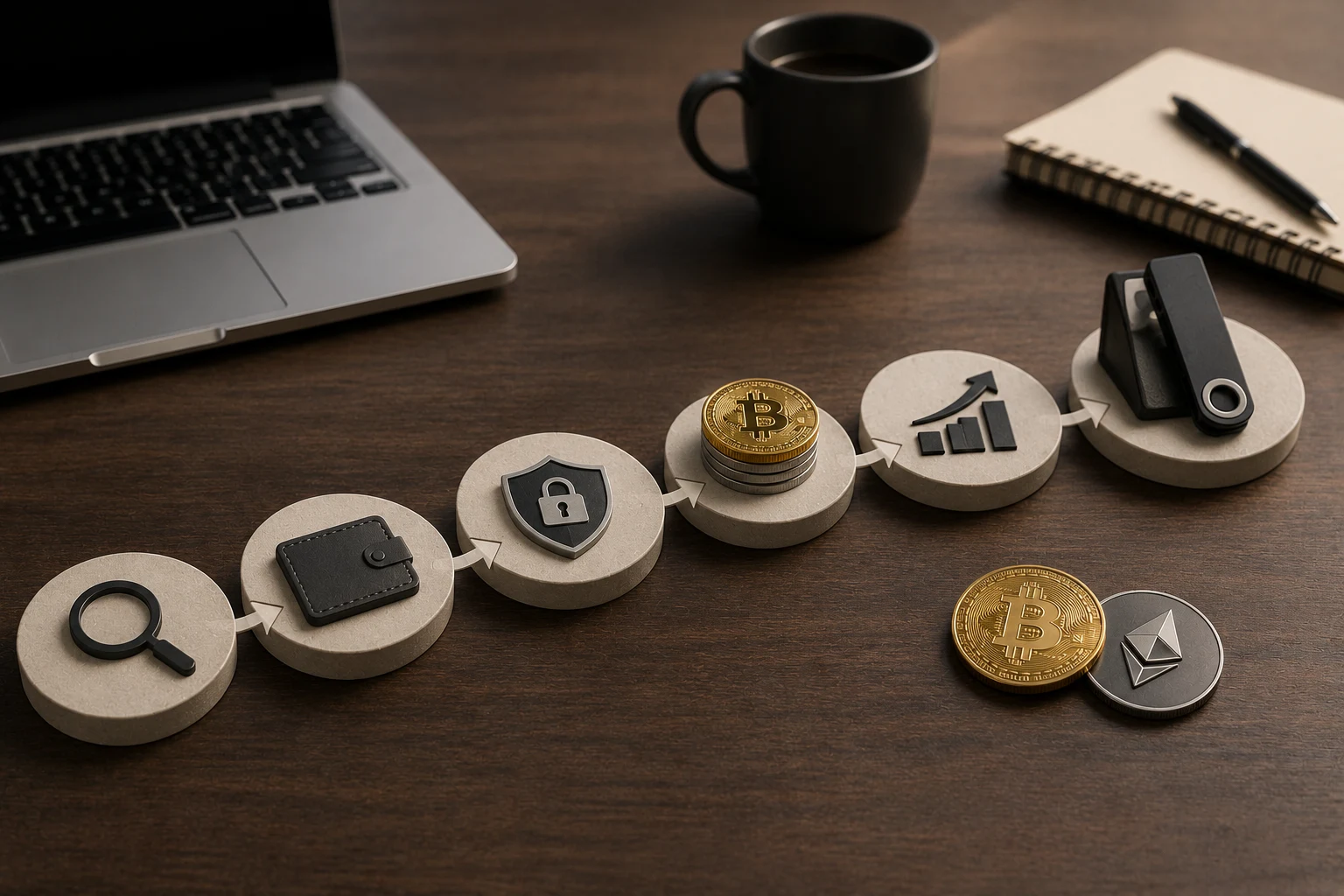
The order matters because each step assumes the previous one is done. Most guides dump all of this on you at once, which is why beginners freeze. Instead, run this checklist in order.
Step 1: install a self-custody wallet before funding anything
Download a reputable self-custody wallet such as MetaMask, Phantom, or Rabby for desktop and browser, plus a hardware wallet like Ledger or Trezor for long-term storage. During setup, the wallet generates a seed phrase. Write it on paper, store it somewhere safe, and never type it into any website or screenshot it. The wallet is now yours; no company can reset it for you, which is the trade-off for true ownership.
Self-custody means you hold the private keys. The phrase is not stored on a server. Lose it, and the coins are gone forever. This is the part that feels scary at first and feels powerful once it clicks. The single most important sentence in this guide: not your keys, not your coins.
Step 2: choose a centralized exchange to convert dollars to crypto
A CEX (centralized exchange) like Coinbase, Kraken, or Binance is the easiest fiat on-ramp. You sign up with an ID, link a bank account or card, and buy crypto directly with dollars. The exchange custodies your assets until you withdraw. This is convenient and appropriate for small starter buys, but it is not where long-term holdings should live.
Two facts to know before signing up. First, regulated exchanges require KYC (know your customer) verification, which means uploading an ID. Second, withdrawals can be delayed during high-traffic events or compliance reviews. Plan for both.
Step 3: make a small first buy, ideally into a stablecoin
Your first purchase should be small enough that losing it would hurt but not ruin you. Many beginners start by buying USDT or USDC, the two dominant stablecoins. A stablecoin is a token pegged 1:1 to the US dollar, so $100 in stays roughly $100 in. That removes price volatility from your learning curve.
Step 4: withdraw the stablecoin to your self-custody wallet
Buy USDC on the exchange, then withdraw it to your wallet address. This is the moment most beginners panic because the exchange shows networks (Ethereum, Solana, Polygon, Arbitrum, Base) and asks which one. Pick a network your wallet supports and that the exchange lists for that asset. For most beginners, USDC on Ethereum or USDC on Solana is a safe default. Confirm the address character by character; do not trust address-book autofills the first time.
The funds arrive in your wallet within minutes to an hour depending on the network. You now hold crypto with no intermediary. This is the actual milestone, not the buy button.
Step 5: only then consider BTC and ETH
Once the round trip works, repeat it with BTC or ETH in small amounts. These are the two largest assets by liquidity and the safest entry points for a beginner. They are also the most boring buys in crypto, which is exactly the point. Boring is the goal in month one.
CEX vs self-custody wallet: what the difference actually means
A CEX is a company. When you buy BTC on Coinbase, Coinbase owns the BTC in their treasury and shows you an IOU on their database. Your account balance is a promise. You can log in tomorrow and sell, but only because Coinbase honors the promise. If Coinbase is hacked, bankrupt, or sanctioned, your IOU may be paused, delayed, or lost. Mt. Gox, FTX, and Celsius are the historical examples that turned this risk from theory into headlines.
A self-custody wallet is software that holds your private keys directly. No company sits between you and the chain. Send, receive, and interact with apps directly. The trade-off is total responsibility: lose the seed phrase and no one can recover it. Get phished into signing a malicious transaction and no one can reverse it. Used carefully, self-custody is the safest place for assets you plan to hold. Used carelessly, it is the fastest way to lose them.
For a beginner, the practical split is simple. Keep the small amount you are actively learning on the exchange so you can trade, experiment, and make mistakes cheaply. Move anything you would not want to lose back to a self-custody wallet, ideally a hardware wallet for amounts above a few hundred dollars.
Why USDT and USDC exist as on-ramps
Stablecoins solve the volatility problem for new buyers. If you fund your exchange account with dollars and the market drops 20 percent the next day, you learn about market risk before you learn anything useful about crypto. With USDT or USDC, your dollars become a dollar-pegged token you can move anywhere, swap into BTC or ETH when ready, or send to a wallet without timing the market.
USDT (Tether) is the largest by trading volume and works on almost every chain. USDC (Circle) is issued by a US-regulated company and is favored by institutions and many DeFi apps. Both are pegged to the US dollar, but the peg is maintained by reserves, not magic. Pegs have broken before (USDC briefly depegged during the SVB crisis in March 2023) and reserves have been questioned for years. For learning purposes, either is fine; do not park your life savings in stablecoins without understanding the issuer.
The risks of leverage, perps, and chasing memecoins
Leverage trading is borrowing money to make a larger bet. On a 10x long, a 10 percent move against you wipes your position, and on a 100x long, a 1 percent move does the same. Perpetual futures add funding rates, liquidation cascades, and order book games that even professionals struggle with. For a beginner, the only correct leverage amount is zero.
Memecoins are tokens whose price moves almost entirely on community hype rather than utility. The wins are spectacular and the losses are more common. The pattern is the same every cycle: a coin pumps, late buyers chase the move, insiders sell, the chart collapses 90 percent, and a new ticker takes its place. The survivors (DOGE, PEPE, SHIB) are exceptions that the marketing hides behind.
Spot buying BTC or ETH with money you can afford to leave untouched for years is the unglamorous beginner path that actually works. The boring version of crypto is the version that still has money in it after the next drawdown.
Your first month checklist
Treat the next 30 days as a learning sprint, not an investing sprint. Install a self-custody wallet, write the seed phrase on paper, and store it offline. Sign up for a regulated CEX, complete KYC, and link a payment method. Buy $50 to $100 of USDC or USDT. Withdraw it to your wallet on a network you have confirmed twice. Send it back to the exchange to test the reverse direction. Only after that round trip succeeds should you buy a small amount of BTC or ETH and withdraw it the same way.
Do not interact with DeFi protocols, do not buy memecoins, do not open leverage, and do not click links from strangers. If a project promises guaranteed returns, that is the signal to leave. Most beginners who lose money in the first month skipped at least one of these steps.
Read crypto news critically with Zippfeed
Crypto news moves in minutes and the signal-to-noise ratio is brutal. Tracking every headline, every influencer post, and every chart manually is how beginners end up buying tops out of FOMO. Zippfeed surfaces the stories that actually matter for BTC, ETH, stablecoins, and the wider market with a sentiment score (bullish, neutral, or bearish) and an importance rating, so you can filter the noise and stay focused on learning the fundamentals instead of reacting to the cycle.



 Crypto News
 Crypto Rank News
 Lookonchain
 CoinDesk