How to read a "crypto regulation by country" map
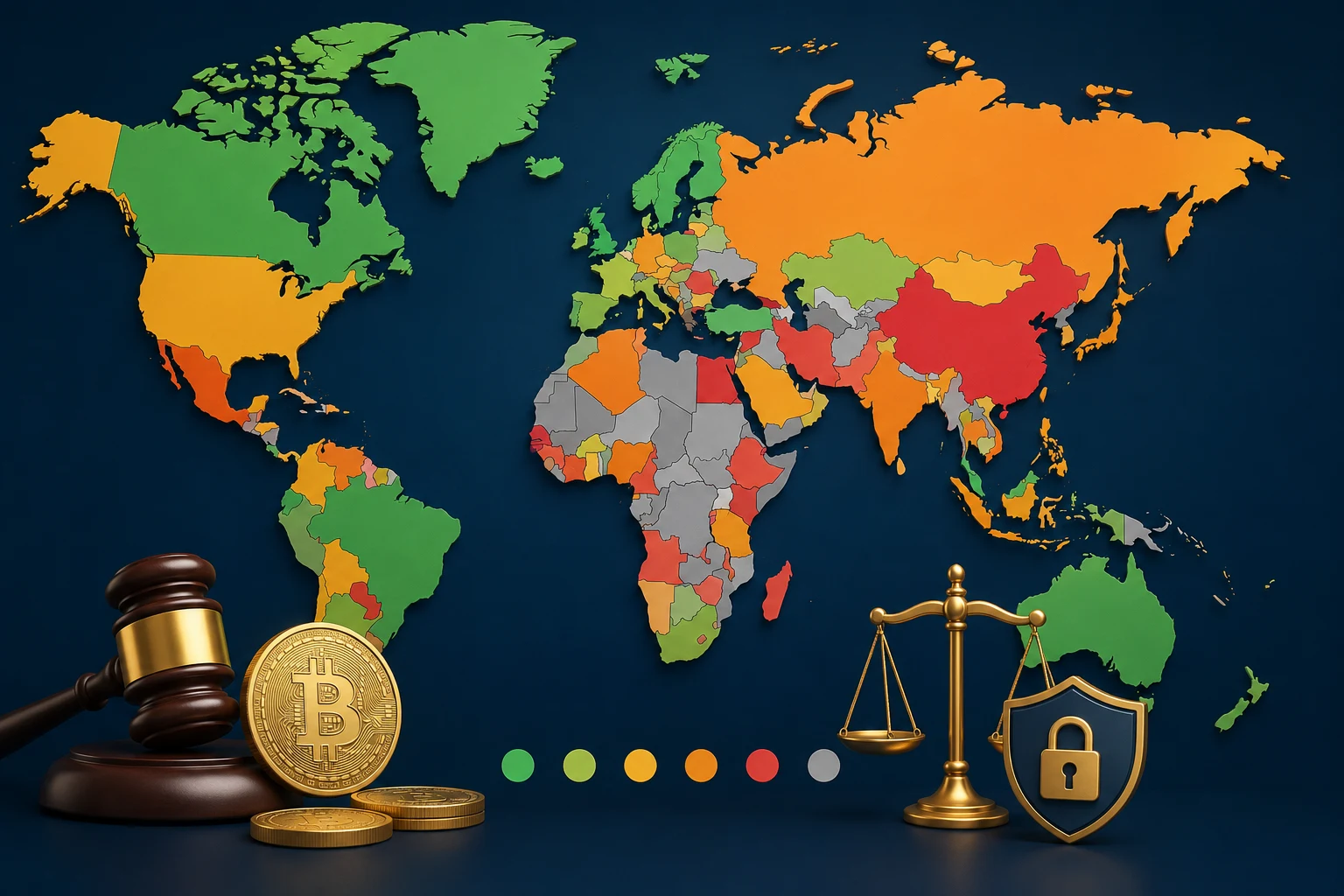
If you have ever googled "crypto regulation by country" and bounced off a wall of acronyms, you are not alone. There is no single global rulebook. Instead, roughly 200 jurisdictions each apply their own mix of securities law, banking law, payments law, and tax law to crypto assets. The result looks chaotic, but a simple four-tier model makes it scannable.
The tiers most regulators, lawyers, and the Financial Action Task Force (FATF) use, broadly speaking, are: ban (crypto activity prohibited or effectively impossible), restrictive (some activity allowed but tightly limited, often via banks refusing service), regulated (licensed virtual asset service providers operating under clear rules), and crypto-friendly (active courtship of crypto firms through tax breaks, sandboxes, or dedicated licenses). A country can sit in different tiers for different activities: Japan, for example, is regulated for exchanges but restrictive for certain derivatives.
Two caveats before we tour the map. First, "regulated" is not the same as "safe." A regulated exchange can still fail, defraud users, or get sanctioned years later. Regulation sets a floor, not a ceiling. Second, the snapshot below is current as of 2024 and shifts quickly. Treat any country guide, including this one, as a starting point, and verify with a local lawyer or compliance adviser before acting on it.
The four tiers, and where the major jurisdictions sit
Think of the tiers as a ladder from least to most permissive, but be careful: climbing the ladder does not mean more freedom, only more explicit rules. Here is how the major economies cluster.
Tier 1: Outright bans
A small but loud group of countries ban crypto activity outright. China is the headline case: in 2021 the People's Bank of China declared all crypto transactions illegal, banned mining, and severed onshore bank access. Enforcement has been uneven, with peer-to-peer (P2P) trading still flowing through OTC desks, but the legal posture is unambiguously hostile. Other jurisdictions in this tier include Algeria, Bangladesh, Egypt, Morocco, and Qatar for ordinary retail activity, and North Korea and Iran for sanctioned use.
These bans usually rest on capital-control and monetary-sovereignty arguments rather than consumer-protection ones. In practice, they push activity underground, into peer-to-peer markets, or into foreign venues. They rarely make crypto disappear.
Tier 2: Restrictive or gray-zone regimes
A larger group allows some crypto activity but makes it operationally hard. Nigeria is the most cited recent example: the central bank restricted banks from serving crypto firms in 2021 and in late 2023 cracked down on Binance, detaining executives and pushing the peer-to-peer market offshore. Yet Nigeria also runs one of the world's most active retail crypto trading cultures, driven by naira devaluation. Turkey sits here too, with no formal ban but persistent bank hostility, and a 2024 move to license crypto service providers that has yet to fully settle.
India occupies a complicated middle ground. Crypto is not banned, but the regulatory framework is fragmented: a controversial 30% capital-gains tax plus a 1% tax deducted at source (TDS) have gutted trading volumes on Indian exchanges since 2022, pushing users to offshore venues. Draft legislation to ban "private" crypto has circulated for years without passing, leaving the sector in legal limbo.
Tier 3: Regulated frameworks
This is where most G20 economies now sit, and it is the fastest-growing tier. The EU's Markets in Crypto-Assets Regulation (MiCA) is the most comprehensive framework in force, fully applicable since late 2024. It creates a single licensing passport for crypto-asset service providers across all 27 member states, plus tailored rules for stablecoin issuers, asset-referenced tokens, and NFT-like assets above a threshold.
The United Kingdom brings crypto into the existing Financial Services and Markets Act (FSMA) framework, with the Financial Conduct Authority (FCA) regulating marketing, intermediaries, and stablecoins through phased rules that began in 2023 and continue to roll out. Japan was an early mover and remains one of the strictest regulated regimes: registered exchanges under the Payment Services Act, with rules around custody, cold storage, and the planned move to permit certain tokenized securities.
In the United States, regulation is a federal-plus-state patchwork. There is no single crypto law; instead, the Securities and Exchange Commission (SEC) treats many tokens as securities, the Commodity Futures Trading Commission (CFTC) treats others as commodities, FinCEN applies anti-money-laundering (AML) rules, and individual states issue money transmitter licenses (MTLs) or, in a few cases, dedicated crypto regimes. New York's BitLicense remains the most onerous state-level license, while Wyoming and Texas have built deliberately friendly frameworks. The 2024 FIT21 discussion draft and ongoing legislative work suggest a federal framework is coming, but the patchwork is unresolved.
Tier 4: Crypto-friendly hubs
A small set of jurisdictions actively court crypto firms. Singapore issues MAS-regulated digital payment token licenses and runs a tightly scoped friendly regime, with high entry barriers but a clear rule of law. Hong Kong launched a mandatory Virtual Asset Trading Platform (VATP) licensing regime in mid-2023, rolled out spot Bitcoin and Ether ETFs in 2024, and courts Chinese-speaking capital under one-country-two-systems.
The United Arab Emirates, particularly Dubai (VARA) and Abu Dhabi (ADGM), has positioned itself as a regional hub with dedicated regulators, zero personal income tax, and residency-by-investment pathways for crypto founders. Brazil passed the Marco Legal das Criptomoedas in late 2022, formalizing a virtual asset service provider (VASP) license under the central bank, with rules that took effect in 2024. El Salvador remains the headline case for Bitcoin-as-legal-tender, a stance largely symbolic in practice but politically loud.
Where the framework is converging: MiCA, GENIUS, and the FATF travel rule
Underneath the tier model, a quiet convergence is happening. Most "crypto-friendly" jurisdictions are no longer pitching themselves as regulation-light; they are pitching themselves as regulation-fast. The same building blocks keep appearing.
The MiCA template
MiCA's structure, asset classification (utility, asset-referenced, e-money tokens), white-paper disclosure requirements, capital and governance rules for issuers, and passporting for service providers, is being studied or copied. The UK has chosen a different statutory route (FSMA) but with similar substance. The UAE's VARA and Hong Kong's VATP frameworks share a lot of conceptual DNA with MiCA. Even jurisdictions that publicly reject Western regulation, like parts of the Gulf, often build FATF-aligned licensing with discretionary licensing terms that look MiCA-adjacent.
Stablecoins as the new front line
Stablecoins have become the regulation battleground. The EU's MiCA reserves issuance to licensed e-money and asset-referenced token issuers. The US Senate's 2025 GENIUS Act draft proposes a federal payment-stablecoin license with reserve and disclosure rules. Hong Kong's Stablecoin Ordinance, passed in 2024 and taking effect in 2025, follows a similar template. The Bank for International Settlements and the Financial Stability Board have repeatedly flagged stablecoins as systemic risk, so this is the area where global rules are likely to harden fastest.
The FATF travel rule
The single most widespread rule is the FATF "travel rule," which requires virtual asset service providers to collect, store, and share sender and recipient information for transfers above a threshold (often around USD 1,000). Adopted in 2019 and now enforced in over 50 jurisdictions, the travel rule has effectively forced even the most permissive hubs to require licensed intermediaries. If you have ever wondered why offshore exchanges ask for address and counter-party details, this is why.
What this means if you are a user, founder, or traveler
The practical question is rarely "is crypto legal here?" It is usually one of three narrower questions.
If you are a user holding or trading crypto
You mostly care about whether your bank will let you transact with the exchange or counterparty you want to use, and whether your gains will be taxed. Bank hostility is the real barrier in restrictive regimes, more than the law itself. In regulated regimes, your exchange must be licensed, which gives you some recourse if it fails, but does not insure you against losses. Tax treatment varies wildly: capital gains in the US and UK, no personal capital-gains tax in the UAE and (for now) much of the Gulf, a flat 30% in India, and a 0% rate on long-term gains under EUR 600 in Germany after a one-year hold.
If you are a founder or a fund
You mostly care about licensing, banking access, and tax structure. A MiCA license gives you passporting across 27 EU countries, which is why several large exchanges have set up European entities even when their home market is friendlier. A Dubai VARA license gives you a regional base with tax efficiency but a smaller market. A Cayman or BVI setup remains common for fund vehicles, but operating exchanges from those jurisdictions without a local license is increasingly risky as travel-rule enforcement tightens.
If you are a traveler
You mostly care about whether your hardware wallet will cause problems at the border, whether your exchange app will work, and whether declaring holdings is wise. The honest answer: rules are inconsistent and enforcement is selective. A small number of jurisdictions (notably the US, where you must declare holdings above USD 10,000 on entry) have explicit declaration rules; most do not. Carrying seed phrases across borders is its own risk, separate from regulation.
Risks and failure modes to watch for
Country-level rules shape individual risk in three ways that are easy to underestimate.
First, regime risk: a jurisdiction's stance can flip in months, not years. China went from permissive to hostile inside 18 months. India's tax regime gutted domestic exchange volumes in weeks. The UK pivoted from "crypto-skeptic" to "pro-innovation" under Chancellor Hunt, and back toward stricter conduct rules under the next administration. Any plan that depends on a country's posture staying friendly is fragile by design.
Second, enforcement gap risk: a license is not a guarantee. Several regulated exchanges, including some with major licenses, have still failed, defrauded users, or been sanctioned for sanctions-bridging (notably in recent years). The travel rule and KYC regimes have been unevenly enforced, especially through offshore VASPs that claim to be regulated but operate from lightly supervised jurisdictions.
Third, tax clawback risk: even where rules look favorable, tax authorities have aggressively pursued crypto gains. The US IRS, UK HMRC, German Finanzamt, and others have used blockchain analytics to identify unreported holdings. Treat any "no tax" jurisdiction as a tax-residency question, not a nationality one: most people pay tax where they live, not where their exchange is incorporated.
How to follow crypto regulation the smart way
Crypto regulation moves fast and so does the news around it: draft bills, enforcement actions, licensing approvals, and sudden U-turns land every week. Tracking which jurisdiction just moved, and whether the signal is bullish, neutral, or bearish for users, manually across regulators and trade press is a losing game. Zippfeed surfaces crypto regulation headlines with sentiment scoring (bullish, neutral, or bearish) and an importance rating, so you can see which rule changes actually matter and which are noise.