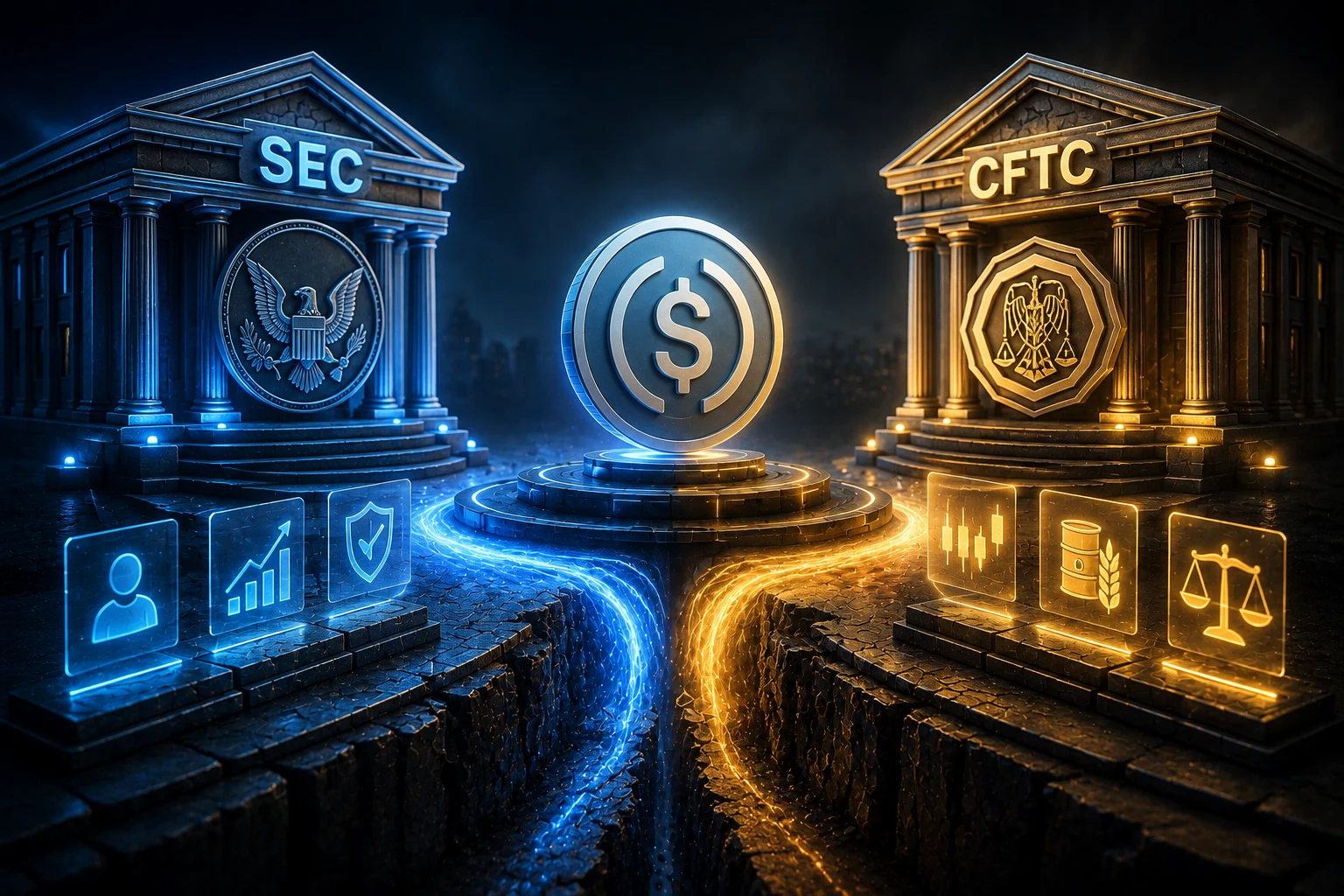
Why the SEC vs CFTC stablecoin question has no clean answer
Stablecoins sit awkwardly between two long-standing US regulatory frameworks. The SEC regulates securities, while the CFTC oversees derivatives and, since 2025, certain spot digital commodities. A token pegged to the US dollar can plausibly fall under either agency's net depending on how it is structured, marketed, and used.
The trouble is that neither agency has been willing to wait for Congress or the courts to draw the line. The SEC has brought enforcement actions against stablecoin issuers and yield programs using its Howey framework. The CFTC, after its 2025 reauthorization, has asserted spot authority over digital commodities that include some payment stablecoins when they are traded on registered venues.
This matters because compliance teams, product designers, and treasury operators need to know which agency they answer to when they launch, list, or integrate a stablecoin. The honest answer today is that the answer depends on the specific token design, the distribution method, and the use case, and that litigation could redraw the map within months.
The risks: enforcement reach, classification whiplash, and user exposure
The biggest risk for anyone building with stablecoins is classification whiplash. A product deemed a commodity by the CFTC one day can be treated as an unregistered security by the SEC the next. Several USDe-related programs and staking-style offerings have already received Wells notices and informal guidance suggesting the SEC views their yield mechanics as investment contracts.
Historical wipeouts also matter. The TerraUSD collapse in 2022 wiped out roughly $40 billion in market value and triggered the SEC's case against Terraform Labs, which resulted in a fraud finding in 2024. That case is now on appeal. If the SEC's view prevails broadly, algorithmic and yield-bearing stablecoins could face retrospective liability even if they launched in good faith under CFTC guidance.
Scam patterns remain common. Tether and USDT have weathered years of questions about reserves and counterparty exposure, and any product that promises stablecoin yield above money-market rates should be treated as higher-risk by default. The CFTC's own enforcement record against offshore exchanges shows that even fully reserved tokens can become enforcement targets when the venue is unregistered.
For end users, the practical risk is simpler. If the platform holding their USDC, USDT, or USDE collapses or is seized, recourse runs through bankruptcy courts and whatever receivership the relevant agency sets up. Holding stablecoins on a registered venue under US oversight is meaningfully different from holding them on an offshore platform with no federal regulator in the loop.
How the SEC reaches stablecoins through Howey
The SEC's claim over stablecoins rests almost entirely on the Howey test, the 1946 Supreme Court framework for deciding what counts as an investment contract. Under Howey, a transaction is a security if there is an investment of money, in a common enterprise, with a reasonable expectation of profits, derived from the efforts of others.
Pure payment stablecoins, designed to hold a 1:1 peg with no yield, have generally been treated by the SEC as outside Howey. That is consistent with statements from former SEC officials that well-collateralized payment tokens used for remittance and settlement are not securities. The trouble starts when a stablecoin adds yield, staking rewards, rebasing mechanisms, or structured return programs.
Yield-bearing stablecoins like USDe and similar products effectively argue that the holder is pooling capital that is actively deployed to generate return, with the issuer's efforts producing that return. That structure looks much closer to an investment contract under Howey, which is why the SEC has taken the position that several of these programs are unregistered securities offerings. The agency's enforcement reach here does not require new legislation; it is the same statutory authority it has used against ICOs since 2017.
The ongoing Ripple litigation is the closest thing to a binding ruling on this question. In 2023, the district court held that XRP sales to retail investors on exchanges were not securities transactions, while institutional sales directly to sophisticated buyers were. The SEC is appealing portions of that holding, and the Second Circuit's eventual decision will likely set the tone for how stablecoins with both retail and institutional distribution are classified.
How the CFTC reaches stablecoins through the 2025 reauthorization
The CFTC's authority over stablecoins comes from a different direction. Historically, the CFTC regulated derivatives on digital assets but had limited spot jurisdiction. The 2025 CFTC Reauthorization, part of a broader appropriations package, expanded that authority by giving the CFTC explicit oversight over spot digital asset transactions on registered venues.
Under this framework, certain spot digital commodities, including payment stablecoins that meet specific collateral and redemption criteria, fall under CFTC jurisdiction when traded on CFTC-registered platforms. The agency has used this new authority to bring enforcement actions against offshore perpetual DEXs, arguing that even decentralized infrastructure offering perp contracts to US persons requires registration under its expanded spot and derivatives rules.
The practical effect is that a USDC spot market on a registered venue is now a CFTC-regulated activity, while the same USDC offered through a yield program may be a SEC-regulated activity. This is the core of the SEC vs CFTC stablecoin jurisdiction tension. Two agencies can simultaneously claim authority over the same token in different contexts.
The CFTC's perp DEX enforcement is the most active frontier. Several decentralized exchanges offering perpetual futures have received CFTC letters arguing that their front-end interfaces, oracles, and matching engines constitute a US-regulated facility even when the underlying protocol is non-custodial. WLFI and other governance-token projects have been pulled into this debate because their treasuries hold and deploy stablecoins that the CFTC argues flow through regulated activity.
The GENIUS Act: what it changed and what it did not
The GENIUS Act was the first US federal statute to create a dedicated payment-stablecoin framework. It established licensing requirements for stablecoin issuers, mandated 1:1 reserve backing in cash and short-dated Treasuries, and required regular attestations and redemption guarantees. It also gave state regulators a primary role for issuers below a specific market cap threshold.
What the GENIUS Act did not do is settle the SEC and CFTC overlap. The statute explicitly preserved the authority of both agencies, and it carved out yield-bearing and algorithmic stablecoins from its licensing regime. That carve-out is critical: USDe, similar rebasing tokens, and any staking-style program sit outside GENIUS entirely, which means their regulators are still the SEC and CFTC arguing through enforcement actions.
For compliance teams, the practical takeaway is that a token can be a fully GENIUS-compliant payment stablecoin and still attract SEC attention if it is marketed or structured in a way that triggers Howey. The act did not create a safe harbor for the investment-contracts question, only for the payment-instrument question.
Industry response has been mixed. Circle's USDC has been positioned as a clean payment stablecoin that fits the GENIUS framework, which has helped it gain market share against USDT in US-regulated venues. Tether's USDT remains the dominant token by volume but has not pursued GENIUS licensing, which limits its availability on US-regulated platforms and creates ongoing jurisdictional ambiguity for users who bridge it in from offshore venues.
Open litigation that will reshape the map
Three cases will do more than any congressional hearing to define SEC vs CFTC stablecoin jurisdiction. The Ripple case, currently on appeal, will set the precedent for how tokens with both institutional and retail distribution are classified. The Terraform case, which produced a fraud finding against Do Kwon in 2024, is being appealed on the narrower question of whether the underlying token transactions were securities at all.
The Coinbase case is the broadest. It challenges the SEC's authority to treat spot trading of digital assets on Coinbase's platform as an unregistered securities activity. A ruling against the SEC would shrink its reach over exchanges listing stablecoins; a ruling for the SEC would pull nearly every major US venue into its jurisdiction and arguably preempt portions of the CFTC's new spot authority.
For compliance officers, the practical move is to track these three cases as a single basket. A win for the SEC in Coinbase plus an adverse Ripple ruling would produce a much more restrictive environment for stablecoin yield and exchange listings. A win for Coinbase plus a favorable Ripple outcome would push most activity toward the CFTC's newly expanded spot framework and away from SEC enforcement.
Practical implications for builders, issuers, and users
If you are issuing or wrapping a stablecoin for US users, the design choices matter more than the marketing. A clean 1:1 reserve-backed token with no yield, audited attestations, and a GENIUS-compliant structure can credibly argue it sits under the GENIUS framework with secondary CFTC oversight on registered venues. Add yield, rebasing, staking, or structured return mechanics, and you have likely entered SEC territory regardless of how the token is collateralized.
If you are operating a venue, the split between CFTC-regulated spot activity and SEC-regulated securities activity now needs to be drawn at the product level. The same platform can offer USDC spot trading under CFTC rules and a yield program on USDC under SEC rules, with different compliance obligations for each. Several venues are already structuring products this way, treating stablecoin yield as a separate, securities-style offering from payment-stablecoin rails.
If you are a user or treasury operator, the simplest heuristic is that registered US venues under CFTC or SEC oversight carry meaningfully more recourse than offshore platforms. Holding USDC on a registered venue is not risk-free, but the path back to your dollars if the issuer fails is clearer than holding USDT on an unregulated exchange. Yield-bearing products like USDe should be evaluated as investment products with all the disclosure and risk that implies, not as cash equivalents with a bonus.
How to follow stablecoin regulation the smart way
Stablecoin oversight moves fast, and so does the news around it. Tracking SEC enforcement actions, CFTC spot rulings, and the Ripple, Terraform, and Coinbase appeals manually is a losing game for anyone outside a dedicated legal team. Zippfeed surfaces stablecoin and digital-asset regulation headlines with sentiment scoring (bullish, neutral, or bearish) and an importance rating, so you can separate signal from noise and stay ahead of the next jurisdictional shift.




 WuBlockchain
 CoinDesk
 TheBlock