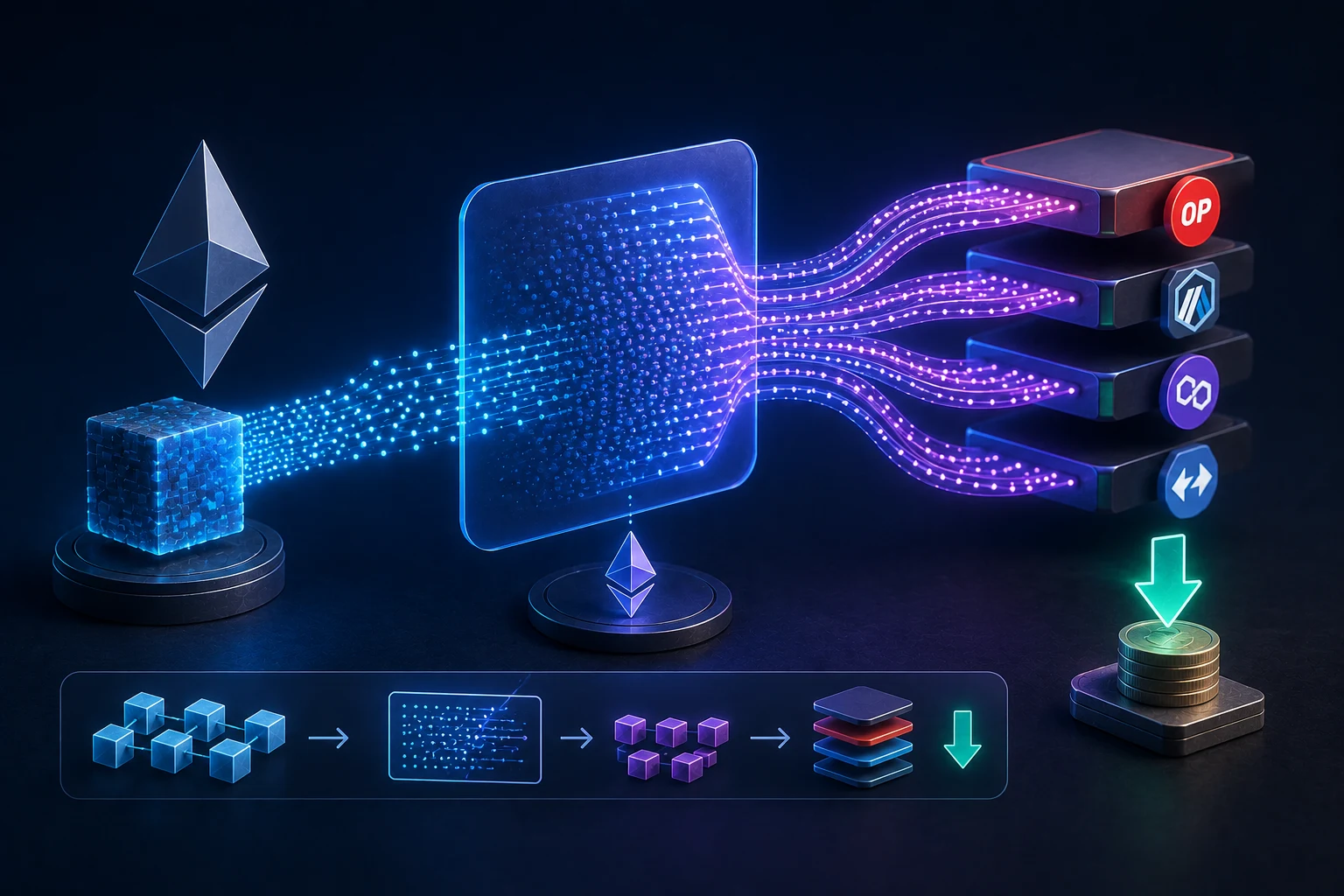
Why Ethereum needed a new way to publish rollup data
For years, the Ethereum mainnet was the bottleneck for every rollup sitting on top of it. A rollup is a layer-2 network, often called an L2, that bundles thousands of user transactions, compresses them, and posts the result back to Ethereum so anyone can verify it. The cost of that posting was the single biggest line item in an L2's fee structure.
Before March 2024, rollups posted their compressed data as calldata. Calldata is the data field inside a normal Ethereum transaction, the part that tells a smart contract what to do. Every node on the Ethereum network had to download calldata, store it forever, and process it. That created two problems at once. First, calldata competed with regular ETH transfers and DeFi trades for the same limited block space, so its price was pushed up by unrelated demand. Second, rollup data sat on disk forever, even though the rollup only needed it for a few days while disputes were possible.
For users, the symptom was high fees on Arbitrum, Optimism, Base, and other rollups. For developers, the constraint was clear: Ethereum could not scale to thousands of transactions per second by squeezing everything into the same on-chain market. Something had to change about how data got posted, not just how it got executed.
What EIP-4844 actually changed
Proto-danksharding, the informal name for EIP-4844, shipped with the Dencun upgrade on March 13, 2024. It did not increase Ethereum's transaction throughput, and it did not lower gas costs for users transacting directly on mainnet. What it did was introduce a new kind of transaction, called a type-3 or blob-carrying transaction, that attaches a separate chunk of data called a blob.
A blob is a piece of binary data, up to about 125 kilobytes, that travels alongside an Ethereum transaction but lives in a different place. The Ethereum Virtual Machine, the EVM, cannot read blob contents, which is the key design choice. Smart contracts on Ethereum can verify that a blob exists and check its commitments, but they cannot reach inside it. This is intentional: it keeps blob data out of the EVM's execution path, which means the mainnet does not have to do extra computation to use it.
The practical effect is that rollups can now post their compressed batch data as a blob, pay a fee in a separate market, and let Ethereum validators hold onto that data for about 18 days before discarding it. That window is long enough for fraud-proof and validity-proof systems to do their work, and short enough that validators do not drown in stored data over time.
Blobs vs calldata: what is the practical difference
Calldata and blobs look similar to a casual observer, since both are just bytes attached to a transaction, but they behave very differently inside Ethereum's machinery.
Calldata is part of the execution layer. Every node has to download it, store it permanently in the chain history, and make it accessible to smart contracts through the EVM. Blobs are part of the consensus layer. They are stored separately, accessed only through cryptographic commitments, and pruned after roughly 4,096 epochs, which works out to about 18 days.
This separation is what makes blobs cheaper. Before EIP-4844, rollups had to pay the same gas price that a Uniswap swap or an NFT mint paid, because they all competed in the calldata market. After EIP-4844, rollups pay a separate blob gas price, and the cap is roughly six blobs per slot, or about 0.75 megabytes of blob data per block. The supply of blob space is its own number, and demand for blobs is mostly from rollups, not from DeFi traders, so the two markets rarely spike at the same time.
The separate fee market: how blob pricing works
EIP-4844 introduced a new mechanism, similar to EIP-1559, for pricing blob space. There is a target number of blobs per block, currently 3, and a maximum of 6. If more than 3 blobs are posted, the blob base fee rises. If fewer are posted, it falls. This is a floating price designed to keep blob usage near the target over time, rather than letting one busy day spike the cost for weeks.
You can see this market in action on dashboards like ultrasound.money, which tracks the blob base fee in gwei. In the months after Dencun, blob space was often under-utilized and the fee hovered near zero. During busy periods, when a popular mint or a viral app pushed multiple rollups to post at once, the blob fee would rise, but rarely to the dollar levels that calldata had charged before.
For rollup users, the win was that L2s could keep their posting costs predictable most of the time, and pass the savings through. The win was not uniform. If a rollup decided to keep some of the savings as margin, the user saw a smaller drop. The win was also conditional. Because blobs cap at six per slot, demand spikes can still cause temporary fee increases, and the cap is the binding constraint that full danksharding is meant to remove.
How rollups actually use blobs in practice
From the user's perspective, nothing changed about how they send a transaction. They still sign a message in their wallet, a sequencer (the rollup's transaction ordering service) collects it, and the rollup bundles thousands of transactions into a batch. The change is in step three, when the batch is published to Ethereum.
Before EIP-4844, the rollup would call a contract on mainnet and pass the compressed batch as calldata, paying the full calldata gas price. After EIP-4844, the rollup submits a type-3 transaction that includes the compressed data as a blob and only a small commitment to that blob in the calldata. The on-chain contract verifies the commitment, and the blob itself is held by consensus-layer nodes.
This is why the user experience shifted so quickly. Arbitrum, Optimism, Base, and Polygon zkEVM all integrated blobs in the weeks after Dencun. ZK rollups like zkSync and Starknet followed. The fee drop was real, but the size of the drop varied by rollup, because L2s had other cost components besides data posting, including sequencer fees, proof verification, and the L2's own overhead.
What blobs cannot do, and the real risks
Blobs solve one specific problem: cheap data publication. They do not solve several others, and understanding the limits is part of understanding the upgrade honestly.
First, blobs are temporary. After about 18 days, the data is gone from Ethereum nodes. Rollups, or third-party services like DA layers or block explorers, are responsible for storing any data users or applications need long-term. If a rollup shuts down and no one archived its data, the history can be lost. This is a real failure mode that has not been fully solved across the ecosystem.
Second, blob space is still capped at six blobs per slot. When multiple rollups are busy, they compete for that cap and the blob fee rises. The cap is the main reason L2 fees spike during popular mints, even after Dencun. The fix, more blob capacity, is what full danksharding is for.
Third, EIP-4844 did not magically make every L2 cheap. Sequencer designs, batch posting frequency, compression efficiency, and proof costs all still matter. A rollup that posts one batch per hour pays more per batch than one that posts every few minutes, and a ZK rollup has to verify a validity proof on mainnet, which still costs calldata gas. EIP-1153, which introduced transient storage opcodes, also reduced L2 costs, and it shipped in the same Dencun upgrade. The fee drop is the combined effect of several changes, not a single switch.
From proto-danksharding to full danksharding and PeerDAS
EIP-4844 is named proto-danksharding because it implements most of the logic for danksharding, but only a small slice of the capacity. Full danksharding would expand blob capacity from 6 blobs per slot to 64, and pair that with a technique called data availability sampling so that validators do not have to download every blob to verify the chain.
PeerDAS, short for Peer Data Availability Sampling, is the research step in between. The idea is that validators only download a random sample of each blob's data, use cryptography to confirm the rest is available across the network, and never need to see the whole thing. This is what would make 64 blobs per slot practical without requiring every staker to store gigabytes of data.
None of this is shipped yet. The roadmap as of 2025 is that PeerDAS is in active research and may appear on a testnet, with full danksharding still further out. EIP-4844 gives Ethereum the scaffolding, the new transaction type, the fee market, and the consensus rules, so that later upgrades can be additive rather than disruptive. The interesting part, dramatically more capacity, is still ahead.
What this means for users and builders today
If you are a user, the practical takeaway is that rollup fees on Arbitrum, Optimism, Base, and other major L2s are meaningfully lower than they were in early 2024, and the data-availability portion of those fees is now priced in a market that behaves more like a commodity than a scarce resource. During quiet times, that part of the fee approaches zero.
If you are a builder choosing where to deploy, EIP-4844 does not change the fact that each rollup has its own architecture, sequencer, and trust assumptions. It does mean that data availability, once the dominant cost, is no longer the main reason to pick one L2 over another. Proof systems, ecosystem liquidity, and tooling matter more now than they did in 2023.
The honest framing is that proto-danksharding made rollups cheaper, but did not finish the scaling job. The roadmap has more room to grow, and the next leg depends on PeerDAS research, validator hardware, and consensus-layer upgrades that have not been activated yet.
Follow the rollup-fee story the smart way
Rollup economics move quickly. Blob fees, sequencer changes, and mainnet upgrades all shift L2 costs in ways that dashboards capture only after the fact. Zippfeed surfaces ETH, ARB, OP, and POL headlines with sentiment scoring and an importance rating, so you can spot the moments when fee markets tighten, when a new blob-cap proposal lands, or when a major rollup changes its posting strategy, without having to watch a dozen Discord channels and governance forums yourself.




 WuBlockchain
 Crypto Capital Venture
 Lookonchain
 TheBlock
 Crypto Rank News