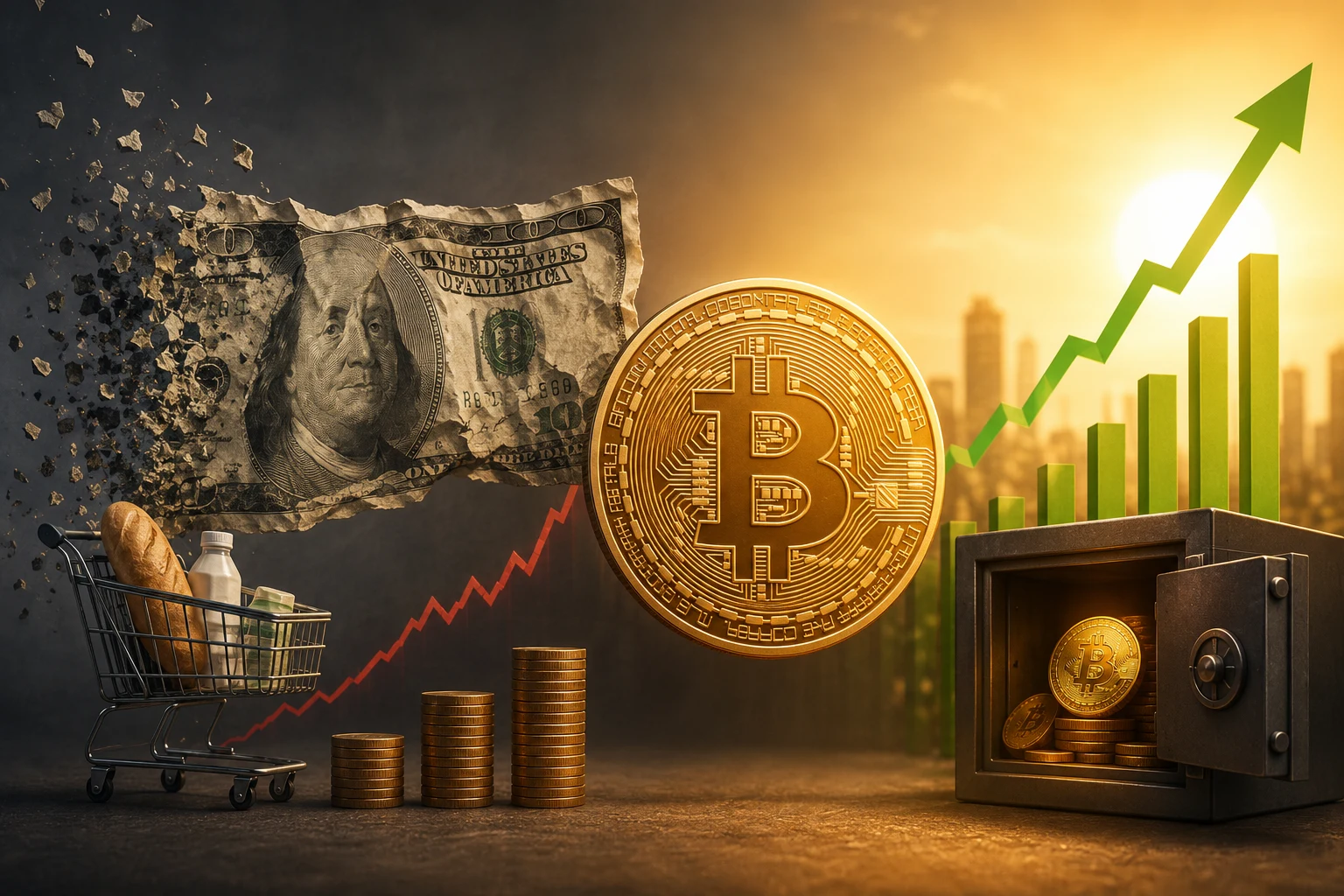
The macro mechanism
Inflation is the loss of purchasing power over time. When central banks expand the money supply and goods do not expand at the same pace, the price of those goods in money tends to rise. The classic hedges against this — gold, real estate, scarce commodities — share a single property: their supply is hard to expand on command.
BTC was designed around that exact property. Its issuance schedule is fixed in code: only 21 million BTC will ever exist, the rate of new supply is halved roughly every four years in the Bitcoin halving, and no central authority can change either. From a pure mechanism standpoint, that makes BTC the most rigorously scarce monetary asset ever created. That is the structural basis of the "digital gold" narrative.
The thesis runs: when fiat money is debased, capital looks for stores of value whose supply cannot be debased in turn. Gold has played that role for thousands of years; BTC, the argument goes, is a digital, portable, programmable update.
The historical pattern
The data is messier than the marketing. Three distinct phases are worth understanding:
- 2020-2021: thesis looks vindicated. Massive pandemic-era stimulus pushed money supply up sharply. BTC ran from roughly $4,000 to nearly $69,000. The narrative — "BTC is the hedge against money printing" — felt confirmed.
- 2022: thesis cracks. US CPI hit a four-decade high above 9%. If BTC were a simple inflation hedge, it should have outperformed. Instead it fell roughly 75% from its peak. The reason: the Federal Reserve responded to that inflation by raising rates aggressively, draining USD liquidity, crushing risk assets and BTC with them.
- 2023-2024: differentiation. As inflation eased and policy turned, BTC recovered, helped by ETF flows and broader risk appetite. The relationship with inflation looked, again, indirect.
The 2022 episode is the most informative. It showed that the response to inflation — tighter policy, weaker risk appetite, draining liquidity — has dominated the direct "more money chasing scarce BTC" channel. Inflation reaches BTC through several steps, not one.
What the data actually shows
Academic and market work on BTC-inflation correlation tends to land in three places:
- The correlation is weak and unstable. Short-term moves in CPI explain very little of BTC's variance. Over rolling windows, the sign of the correlation flips repeatedly.
- BTC tracks liquidity better than inflation. Measures of global liquidity, real yields, or the US dollar index typically explain BTC's medium-term moves better than headline CPI does.
- The long-run story is more defensible. Over multi-year stretches, a fixed-supply asset that has appreciated by orders of magnitude clearly outpaced consumer-price inflation. Whether that is a hedge against inflation specifically or a bet on technology adoption and monetary debasement broadly is genuinely contested.
Put differently: BTC may yet earn its "digital gold" stripes over decades, but it is not a clean month-to-month CPI hedge, and treating it as one set up a lot of investors in 2022 to be disappointed.
What the simple story misses
Several things complicate the inflation-hedge narrative:
- Inflation expectations vs realised inflation. Markets react more to changes in expectations than to current numbers. A rising CPI everyone already expected may not move BTC; a downside CPI surprise can.
- Central bank response matters more. A 5% inflation environment with very easy policy looks completely different to BTC than a 5% inflation environment with aggressive tightening. The latter is what crushed BTC in 2022.
- Real yields are the cleanest signal. Rising real yields (nominal rates above inflation) historically pressure BTC; falling real yields support it. This is closer to what "inflation matters" really means.
- BTC is also a risk asset. When inflation triggers panic in equities, BTC often falls with them — its risk-asset behaviour can overwhelm its hedge story in the short run.
For the broader set of forces around BTC, see what causes Bitcoin price movements. Inflation is one input, often important, rarely decisive on its own.
Reading inflation in context
A useful way to translate inflation news into BTC context:
- Did the print surprise to the upside or downside? The change in expectations is what moves prices.
- What does the central bank likely do in response? Tightening pressures BTC; pivoting toward easing supports it. The how interest rates affect crypto guide covers this channel.
- What is happening to real yields? If real yields fall while inflation rises, BTC has historically benefited. If real yields rise faster than inflation, BTC has historically suffered.
- How is the dollar moving? A weaker dollar amid inflation has been a tailwind; a stronger dollar amid inflation has been a headwind.
The honest framing: BTC may behave as an inflation hedge across decades, but week to week and quarter to quarter, the policy response and liquidity backdrop dominate. Position sizing should respect that volatility rather than assume a hedge that has not historically held in stress.
Read inflation through the news, not just the prints
Inflation prints are single numbers; what moves BTC is the chain of reactions they trigger — central bank pivots, dollar moves, ETF flows, narrative shifts. Zippfeed tracks macro and crypto headlines together — central-bank decisions, inflation data, dollar and ETF coverage — across many sources with sentiment and importance scoring. That way you see the inflation story and the BTC reaction in the same place, and can read price action against the macro currents driving it. This is educational, not financial advice.

 CryptoSlate
 Glassnode
 WatcherGuru
 Altcoin Daily
 WuBlockchain