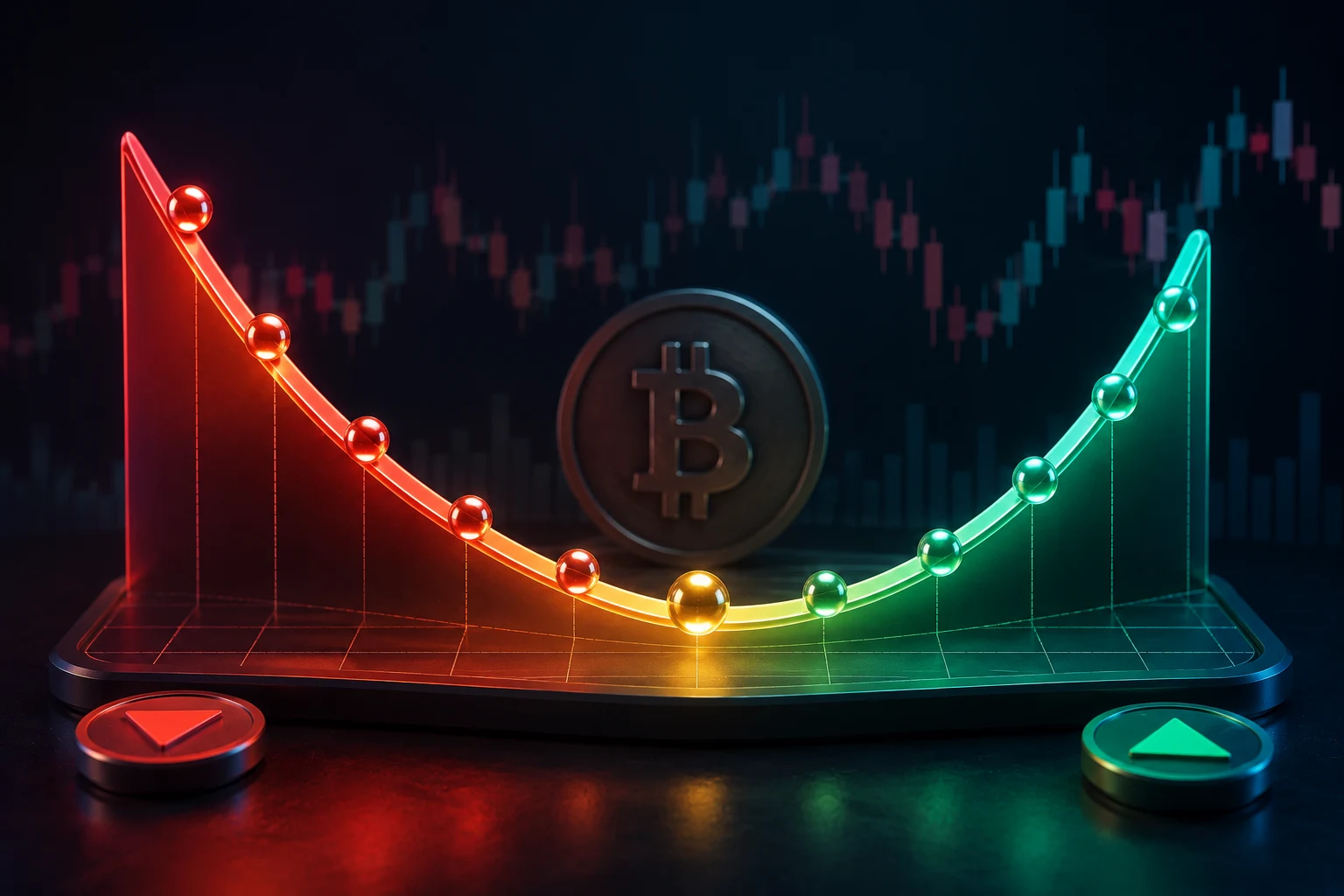
What is a perpetual futures funding rate cascade?
A perpetual futures funding rate cascade is a rapid sequence in which crowded leveraged positions, funding-rate pressure, an adverse price move, and forced liquidations reinforce one another. The funding rate does not directly liquidate anyone. Instead, it helps reveal which side of the market may be crowded and paying heavily to remain exposed.
A perpetual futures contract, often called a perpetual or perp, is a derivative that tracks an asset such as BTC or ETH without having an expiry date. Traders can use leverage, meaning they control a position larger than the collateral they deposited. Exchanges use periodic funding payments to help keep the perpetual contract near the underlying spot price.
When the funding rate is positive, longs generally pay shorts. When it is negative, shorts generally pay longs. An unusually positive rate can indicate aggressive demand for leveraged long exposure, while an unusually negative rate can signal crowded short exposure. Neither condition guarantees a reversal because strong trends can support extreme funding for longer than traders expect.
The cascade begins only when price moves far enough against vulnerable positions. Liquidation engines then close accounts that no longer meet maintenance margin requirements. Those forced orders can push price further in the same direction, threaten the next group of positions, and turn an ordinary move into a violent long squeeze or short squeeze.
Why funding cascades are dangerous
Leverage can turn a manageable price change into a total loss of posted collateral. A trader using high leverage has little room between the entry price and the liquidation threshold. The exact threshold depends on leverage, maintenance margin, fees, collateral type, and the exchange's mark-price calculation, so a simple leverage multiple does not reveal the full risk.
Liquidation is not the same as choosing to sell. Once an account falls below the required margin, the venue's liquidation system may take control and close the position into an already stressed order book. Slippage, which is the gap between the expected execution price and the actual one, can become severe when many accounts must exit at once.
Cross-margin accounts create another failure mode. Under cross margin, multiple positions share the same collateral pool. A losing perpetual position can consume collateral that a trader thought was protecting another trade, while a falling collateral asset can weaken the account at the same time. If the venue suffers an outage, changes margin requirements, or cannot process deposits quickly, adding collateral may not be possible when it matters.
There are also risks beyond market direction. Thin or manipulated markets can display misleading funding, offshore exchanges may have uncertain solvency or withdrawal rules, and social media accounts often promote supposed funding arbitrage without explaining basis, execution, custody, and liquidation risk. Historical crypto wipeouts show that a hedge on paper is not necessarily a hedge when one venue freezes withdrawals, an asset loses its peg, or both legs cannot be closed together.
How perpetual funding rates actually work
A perpetual contract has no expiry date, so it lacks the natural settlement process that pulls a dated futures contract toward spot at maturity. Funding provides an ongoing incentive that encourages traders to take the less popular side. Most venues calculate funding from some combination of the perpetual contract's premium or discount to an index price and an interest component.
If the perpetual trades above the reference spot index, funding will often become positive. Longs then pay shorts at scheduled intervals, commonly every eight hours, although formulas and timing vary. This payment makes expensive long exposure less attractive and rewards traders willing to hold the short side. If the perpetual trades below the index, funding may turn negative and shorts pay longs instead.
Funding is usually exchanged between market participants rather than paid as a guaranteed reward by the exchange. A displayed annualized rate can also be deceptive. It extrapolates a short observation period across a year even though funding can change at the next interval, while price losses, fees, and basis movements can overwhelm the payment.
Exchanges may publish a current rate, a predicted next rate, or both. They can use different index constituents, caps, interval lengths, and averaging windows. A BTC funding rate on one venue therefore cannot always be compared directly with a BTC rate on another. For broader context, traders often examine open interest, basis, spot volume, options positioning, and the material in how perpetual futures work rather than reading funding in isolation.
How the reflexive liquidation loop develops
Consider a market where BTC has risen quickly and leveraged traders keep opening longs. Perpetual prices trade above spot, funding becomes strongly positive, and open interest grows. The funding bill pressures longs, but it does not force immediate liquidation as long as their accounts retain enough margin.
A modest price decline can change that balance. Some traders voluntarily reduce risk, while stop orders add market sells. Highly leveraged longs reach their maintenance-margin thresholds and are liquidated. Because closing a long requires selling the contract, the liquidation engine adds more sell pressure to the decline.
That forced selling can push the mark price lower and liquidate the next layer of longs. Market makers may widen spreads or reduce available liquidity because their own inventory risk has increased. Traders with surviving positions can also sell before their thresholds are reached. Price decline, forced deleveraging, thinner liquidity, and fear then form a reflexive loop.
This is a long squeeze, and extreme positive funding may precede it because the long side was crowded and expensive. The mirror image can happen under extreme negative funding. If price rises against crowded shorts, liquidations require forced buying, which pushes price higher and threatens more shorts. That short-squeeze loop can be equally violent, but negative funding alone does not prove that a rally is about to begin.
How arbitrageurs carry the funding trade
High positive funding attracts arbitrageurs who may buy BTC or ETH in the spot market and short an equivalent amount of perpetual futures. This is often called a cash-and-carry or delta-neutral trade. Delta-neutral means that small price moves should produce roughly offsetting gains and losses across the two legs, allowing the trader to target funding and any favorable basis rather than outright direction.
These hedged shorts can help absorb demand from leveraged longs and pull the perpetual price toward spot. When funding is negative, the theoretical reverse trade is to short spot and go long the perpetual. That version is harder for many participants because borrowing the asset may be expensive, unavailable, or subject to recall, especially during market stress.
The trade is not free yield. Funding can reverse, the spread between spot and perpetual can widen, and one leg can be liquidated before the other offsets it. Trading fees, borrowing costs, withdrawal delays, collateral haircuts, and taxes can erase the advertised return. A trader using different venues also takes counterparty risk on each venue and transfer risk between them.
Arbitrage positioning can influence a cascade in less obvious ways. If positive funding falls or turns negative, spot-long and perpetual-short traders may unwind by selling spot and buying back shorts. Their futures buying can soften a decline, while their spot selling can add pressure elsewhere. If margin stress forces them to close only one leg, a position designed to be neutral can suddenly become directional at the worst possible time.
What June 2022 and March 2024 showed
In June 2022, crypto markets were already damaged by the collapse of Terra's UST and LUNA ecosystem in May. Stress around Celsius, Three Arrows Capital, lenders, and leveraged funds then intensified. BTC fell sharply, including a drop below the previous cycle's 2017 peak, as liquidations and forced balance-sheet reductions spread across centralized and decentralized markets.
Funding during that period was not a single clean advance warning. Rates varied by venue and often became negative as sentiment deteriorated. The lesson was broader: once collateral values fell, leveraged borrowers and traders had to sell into declining liquidity, while uncertainty about hidden counterparties made market makers more cautious. Funding reflected the shifting demand for leverage, but insolvency, credit exposure, and forced asset sales were major drivers.
March 2024 offered a different setup. BTC reached a new nominal record near $69,000 on March 5 before dropping rapidly toward roughly $59,000 on some venues. Data providers reported close to $1 billion in crypto liquidations over the surrounding 24-hour window, although totals differ because providers cover different exchanges and classify positions differently. Long liquidations dominated much of the reversal after a period of strong bullish positioning and elevated funding.
BTC recovered and later set additional highs, which is a useful warning against treating a cascade as proof that a larger trend has ended. The episode showed how crowded leverage can amplify an intraday reversal even during a strong spot-led market. Earlier events, including the April 2021 and December 2021 selloffs, similarly demonstrated that forced liquidations can accelerate movement, but each involved a different mix of leverage, liquidity, news, and market structure.
How traders can interpret funding without overconfidence
Funding is most useful as a thermometer for leverage demand, not a clock for the next reversal. A high positive rate says leveraged longs are willing to pay shorts at that venue and interval. It does not reveal how much collateral those longs hold, whether spot buyers remain strong, or whether the rate will normalize without a price decline.
Open interest adds context because it estimates the value of outstanding derivatives positions. Rising open interest, positive funding, and a widening perpetual premium can suggest new long leverage entering. If price then falls while open interest drops sharply, forced long closures may be under way. Still, public data cannot show every account's liquidation threshold or distinguish every hedge from a directional bet.
Venue differences matter. A rate that looks extreme on a small exchange may reflect local inventory rather than the global market. Compare multiple major venues, check whether spot volume supports the move, and note whether open interest is concentrated in BTC, ETH, or less liquid altcoins. The concepts in open interest explained, crypto liquidation prices, and spot versus derivatives volume can help separate genuine market demand from leveraged positioning.
Questions worth asking before acting
- Is funding extreme across several liquid venues, or only on one exchange?
- Is open interest rising faster than spot volume and available liquidity?
- Would the position survive a sharp wick, a funding reversal, and a temporary venue outage?
- Is the supposed hedge exposed to borrowing, collateral, stablecoin, or counterparty failure?
No indicator removes uncertainty. Traders who use perpetuals can reduce some operational risk by using lower leverage, isolated margin, predefined loss limits, and collateral they can afford to lose. Those controls do not prevent gaps, slippage, exchange failure, or losses, and they are general educational considerations rather than personalized financial advice.
Follow funding and liquidation signals with context
Perpetual markets move quickly, and funding, open interest, liquidation reports, and venue-specific news can change the setup within hours. Tracking every signal manually is difficult. Zippfeed organizes BTC, ETH, and derivatives headlines with bullish, neutral, or bearish sentiment scoring plus an importance rating, helping you identify consequential developments without mistaking a single funding print for a complete market forecast.


 WuBlockchain
 CoinTelegraph