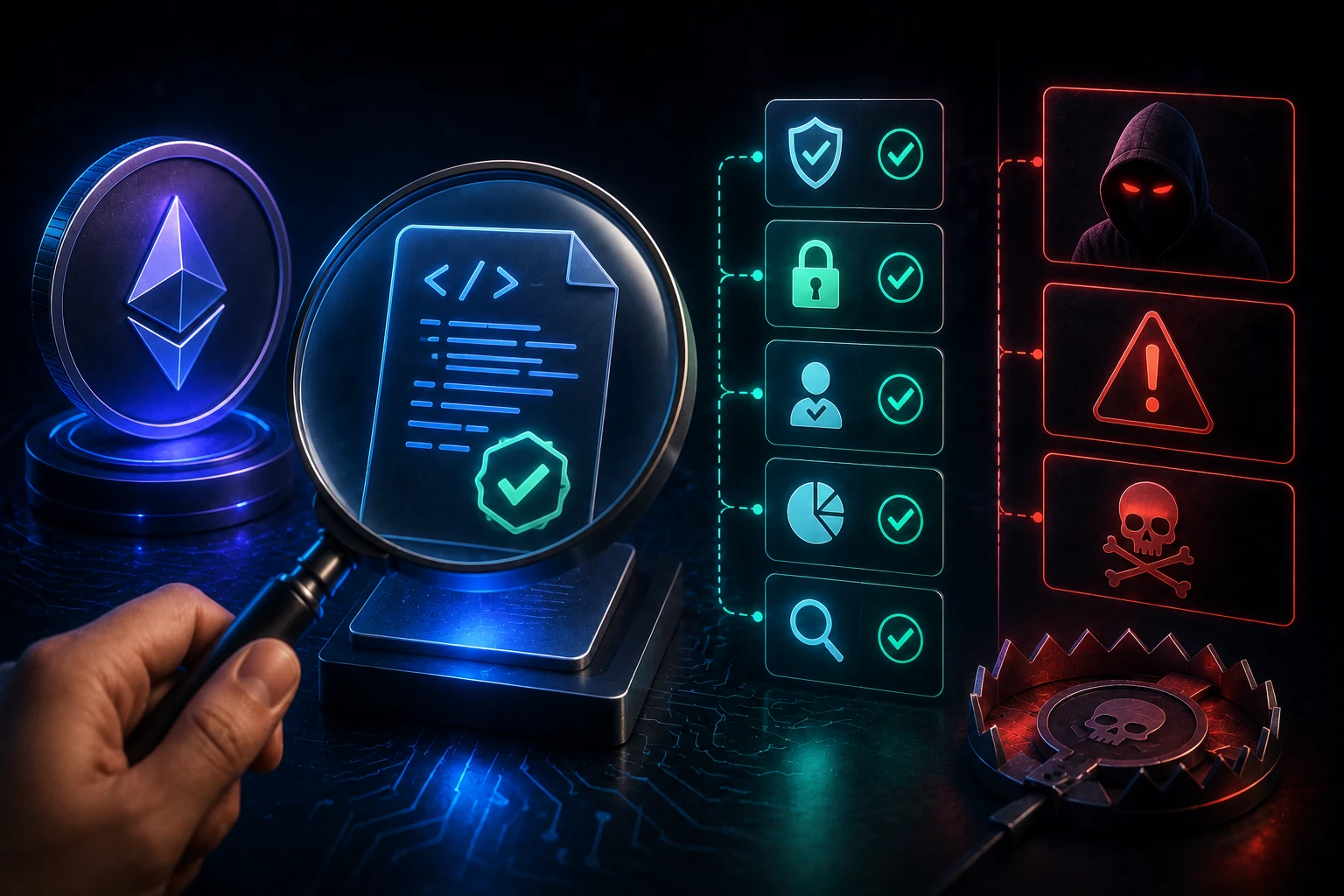
Why token verification matters more than chart reading
Most people who lose money on a new token did not misread the chart. They bought the wrong token. Search engines, Telegram groups, and reply bots are flooded with lookalike tickers, and a single wrong character in a pasted address sends funds to a contract the buyer will never be able to sell. The pattern is so common that the chain analytics firms now label it the single largest category of retail loss in 2024 and 2025, ahead of liquidations and ahead of failed limit orders.
The good news is that verification does not require a security background. It requires patience and a willingness to skip a trade when a check fails. The bad news is that every step has a real failure mode, and skipping any one of them leaves a hole an attacker is happy to walk through. The list below is the minimum that experienced DEX traders actually run, in the order they run it.
What can go wrong: the risk picture before you start
There are four scam shapes that a verification checklist is built to catch, and a fifth that no checklist catches at all. Knowing the difference is what separates a casual buyer from someone who keeps their funds.
The copy-paste scam. A token with the same name and ticker as a legitimate project is deployed hours before a hyped launch. The address is posted in replies, in Telegram, and in paid search ads. The buy works, the price moves for ten minutes, and then sells revert. The contract is a honeypot, the liquidity is owned by a single address, and the deployer has a long history of identical rugs.
The hidden-mint contract. A token launches with a fair supply, runs for a few weeks, and the team mints a huge new batch the moment volume spikes. The new tokens hit the pool, the price collapses to zero, and the original holders find that the team can print supply at will. The contract had a mint function the whole time; nobody read the source code.
The locked-team-wallet dump. A token launches with the team tokens locked in a vesting contract. The lock provider gets compromised, or the unlock is a multisig the team controls, or the unlock date was misread. The team sells into the first real rally and the chart never recovers.
The compromised deployer. A legitimate project ships, gets traction, and a team member's hot wallet is phished. The attacker uses their deployer privileges to call sensitive functions, often pausing trading, changing fees, or pulling liquidity. The contract is exactly what the team wrote; it was never safe to trust a hot key.
What no checklist catches: an honest team that simply runs out of money, gets squeezed by market makers, or decides to stop supporting the project. Verification protects you from the contract. It does not protect you from a bad business.
Step 1: get the address from the project's own source
The first rule of contract verification is that you do not verify a contract until you have a trustworthy address to verify against. Search results, X replies, Telegram pinned messages, and Discord announcements from anyone other than a core team member are not trustworthy sources, because they can be edited, spoofed, or bought. The address you start from should come from one of three places: the project's primary website, a domain the team has controlled since before the token launched, or a block-explorer page the team links to from that domain.
Open the project site in a fresh tab. Type the domain by hand, do not follow a link. Look for a 'token', 'contract', or 'trade' page. The address there is your starting point. If the site does not have a contract address, that itself is a red flag: legitimate projects almost always put the address somewhere obvious. If a search ad is the only place that surfaces a contract, treat the entire project as suspect.
Once you have the address, copy it carefully. Every Ethereum-style address is 42 characters and starts with 0x. A single wrong character sends the transaction to a contract that will probably return an error, but a typo that lands on a real, attacker-controlled contract will route your funds straight to a thief. Many wallets now warn on unknown contracts, but the warning fires after you have signed, not before. Treat your own eyes as the first line of defense.
Step 2: read the contract page on a block explorer
Take the address to Etherscan, BscScan, Solscan, or whichever explorer matches the chain. The contract page is where the first round of real verification happens. You are looking for five things, and any one of them failing is grounds to walk away.
Contract status. The tab should say 'Contract' rather than just 'Address'. If it is not a contract, the asset is not the kind of token you can trade on a standard DEX. Some chains and some launchpads use non-standard implementations that will not interact with the aggregator you intend to use.
Source code verified. The contract tab should show a green checkmark and a 'Contract Source Code Verified' label. Verified means the deployer published the source and the bytecode matches. Unverified does not automatically mean a scam, but it means you cannot read what the code does, and the rest of this checklist depends on being able to read it.
Deployer wallet. Open the deployer address. Look at the deployer's history. Has this wallet deployed ten other tokens, each one rugged? Has it deployed a hundred copy-paste contracts? Has it never deployed a contract before? All three of those are red flags. A team that ships a serious project usually has a deployer with a small number of contracts, often linked to known multisigs or to deployment factories like Create2 helpers.
Deploy date and age. A contract deployed the same day it is being promoted is a high-risk signal. Older contracts with on-chain history are not safe by default, but the absence of history is a strong warning.
Token standards and decimals. Confirm the token is ERC-20 (or the equivalent on the target chain), confirm the decimals match what the project says they are, and confirm the total supply matches the published numbers. A token that quietly runs on 9 decimals instead of 18 will quote prices 1,000,000,000 times higher than they should be, and several scam tokens have used this trick to make a microcap look like a bargain.
Step 3: simulate a sell with a honeypot checker
Once the contract page looks clean, the next check is whether you can actually sell. Many scam contracts accept buys and reject sells, or charge a punishing tax on the way out, or rely on a blacklist function that the team can call on the first sell. None of this is visible on Etherscan. You have to attempt the sell in a sandbox.
Tools like honeypot.is, token-sniffer, and the de.fi scanner run a simulated buy and sell against the live contract and return the result. Paste the contract address, run the simulation, and look for three outcomes: a successful simulated sell with a reasonable tax (often 0 to 5 percent), a partial tax that matches what the project discloses, or a revert on the sell. A revert is a honeypot. Walk away.
Honeypot simulators are useful, but their limits matter. They run a single test transaction against the current state of the contract. A contract that passes today can be upgraded tomorrow by an admin key, the team can turn on a blacklist right before the first real sell, and the contract can include time-based logic that only activates on real volume. Treat the simulator as a filter, not a guarantee. A pass tells you the contract is not a textbook honeypot. It does not tell you it is safe.
Step 4: read the top holders and the unlocked supply
Even an honest contract can be run by a team that owns most of the supply and dumps on the first real buyers. Holder analysis catches this in a way the contract itself cannot. On the explorer, open the 'Holders' tab and look at three numbers: the top holder's share of supply, the top ten holders' combined share, and the share held by the rest of the market.
For most tokens, the top ten should not control more than 30 to 40 percent of supply once you exclude the liquidity pool, the burn address, and any contract addresses that are clearly vesting. If the top wallet alone controls 20 percent or more and is not a known vesting contract, you are looking at a single point of failure. If the top ten together control more than 60 percent, the market is one coordinated sale away from zero.
Then look at the unlocked share. A token can have a healthy holder distribution on paper and still be a trap, because the team holds the rest in a contract that unlocks in 30 days. Cross-reference the top holders with the project's published vesting. If the vesting says 12 months and the unlock fires in 30 days, the math has changed and the chart probably has too. Token unlocks and vesting data are core inputs into Zipp's sentiment model, since a scheduled unlock changes the supply story even when the price looks stable.
Step 5: check the liquidity pool, the lock, and the LP token holders
The contract itself is only half the story. The other half is the liquidity that lets the token trade. On the DEX page, look at three things: how much liquidity is in the pool, who provided it, and whether the LP tokens are locked.
Liquidity size is the floor on what can be lost. A pool with a few thousand dollars in liquidity is a target for a single trade, and a single trade is all an attacker needs to pull the rug. Most experienced traders treat anything under roughly 50,000 dollars in primary liquidity as effectively untradable for their size.
Who provided the liquidity matters because the team can remove it. If the LP was added by a single wallet and the LP tokens are not locked, the team can pull the entire pool in one transaction. If the LP was added by a known locker, click through to the locker's page and confirm the lock is for the full amount, the beneficiary is correct, and the unlock date is far enough in the future to cover your expected holding period. The most common soft rug is a token that looks locked, then quietly unlocks 24 hours after launch.
Finally, look at the LP token holders. A pool where the LP tokens are held by a single address, the deployer address, or a contract that the deployer controls, is a pool that can be drained. A pool where the LP is split across many holders is harder to attack, but a determined attacker with enough LP can still vote to migrate the pool to a malicious implementation. The space is hostile, and the checks have to scale with the size of the trade.
Step 6: cross-reference social signals and watch for context
Contract data tells you what the code does and what the on-chain distribution looks like. It does not tell you who is talking about the token, why they are talking about it, and whether the accounts promoting it are real. A small amount of social context catches a class of scams the contract checks miss.
Look at the accounts that first mentioned the contract address. Are they fresh accounts, or accounts that have been active for years? Are they humans posting in context, or are they accounts that only post a single ticker and a contract address? Is the discussion organic, with disagreements and questions, or is it one-sided praise? Coordinated shilling is not proof of a scam, but the absence of organic pushback is reason to slow down.
Look for independent risk writeups. If respected analysts or security firms have flagged the contract, the flags are easy to find by searching the contract address in quotes. If you find one negative post that names specific concerns, weigh it. The retail trader who lost money is rarely the first person to notice the problem.
Finally, do the basic check that the official channels are actually the official channels. A project with a real community has a long history of posts on its own Discord, its own X account, and its own Telegram. A scam often has a freshly created X handle, a low-follower Telegram, and a website that was registered in the last two weeks. The on-chain contract can be a year old, but the team and the community can be brand new. Verify both.
What contract checks cannot catch
It is worth being honest about the limits of every step above. Verification is a filter, not a guarantee. The classes of failure that slip through are real, and they have cost real money.
Post-launch upgrades. Many contracts are upgradeable, meaning the team can ship new logic at any time. A contract that is safe today can become a honeypot tomorrow. The only mitigation is to buy tokens that are explicitly non-upgradeable, or to accept the risk that a project that ships upgrades is asking you to trust the team with the keys.
Compromised keys. A team with a multisig and hardware wallets can still get phished. A treasury can still be drained. The contract is exactly what the team wrote, and the team is exactly who they say they are, and the funds still disappear. This is why centralization is itself a risk factor, separate from the contract code.
Market risk. Even a token that passes every check can go to zero because the market does not want it. Verification protects you from a scam. It does not protect you from a bad trade.
How to follow token launches the smart way
Token launches move fast and so does the news around them. Tracking which contracts are safe, which are being promoted, and which are being flagged is a full-time job if you do it manually, and a losing one if you try to keep up with it on your phone. Zippfeed surfaces token-related headlines with sentiment scoring (bullish, neutral, or bearish) and an importance rating, so you can spot the launches that are getting real attention and the ones that are being pumped by a handful of accounts. Pair that flow with the verification checklist above, and you have a faster way to decide which contracts are worth the time it takes to run the checks at all.