Why stablecoin rules suddenly exist in four major jurisdictions
The collapse of TerraUSD in May 2022 was the moment stablecoin regulation stopped being a thought experiment. A token marketed as algorithmically pegged to the dollar lost its peg, fell to a few cents, and wiped out roughly 40 billion dollars in market value within a week. Lawmakers who had been content to watch stablecoins from a distance began writing rules.
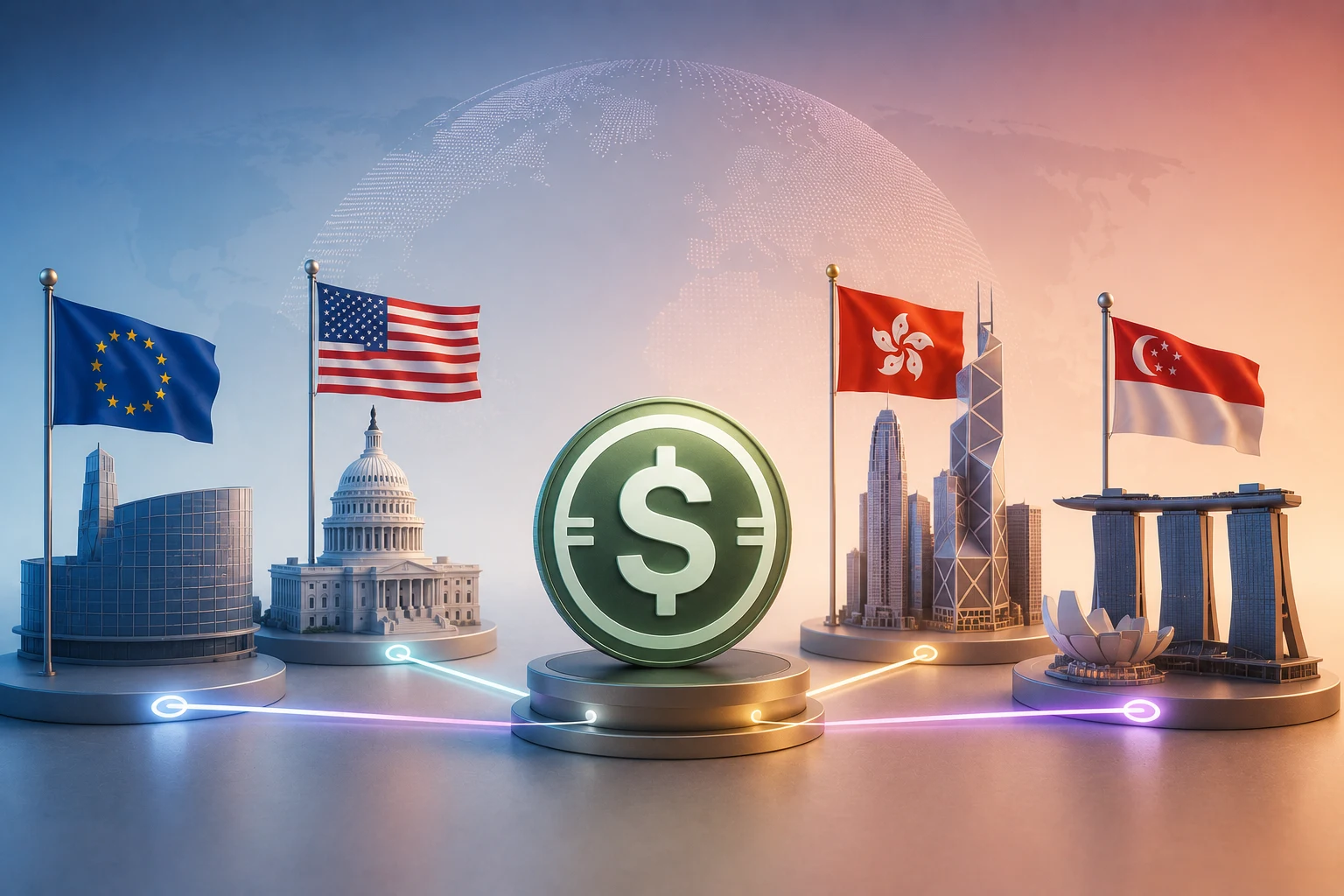
Four jurisdictions moved first, and for different reasons. The European Union wanted a single rulebook for its 27 member states and folded stablecoins into its broader Markets in Crypto-Assets regulation, known as MiCA. The United States had no federal framework and instead relied on a patchwork of state money transmitter licenses plus enforcement by the Securities and Exchange Commission. Hong Kong rebuilt its virtual asset regime after the 2022 exchange failures and put stablecoins under the Stablecoin Ordinance, which began licensing activity in 2025. Singapore, already running one of the more demanding crypto regimes through the Monetary Authority, layered a Stablecoin Framework on top of its existing payment services law.
Each of these frameworks answers the same set of underlying questions: who is allowed to issue a stablecoin, what must back it, what does the issuer have to tell the public, and what happens when the token crosses a border. The differences between them matter a great deal for any crypto business choosing where to incorporate, and they also matter for users who want to know whether a token they hold is regulated at all.
The biggest risks for users and issuers under any framework
Before comparing the rules, it is worth being explicit about what regulation does and does not do. A license does not make a stablecoin risk-free. It sets a minimum operating standard.
Reserve risk is the dominant failure mode. Stablecoins are claims on a pool of assets held somewhere. If those assets are misrepresented, custodied with a risky counterparty, frozen by a court, or simply lost in a hack, the holder is a general creditor of the issuer. The 2022 collapse of the Bahamas-based FTX exchange showed how quickly customer assets can become unrecoverable, and the 2023 depegging of USDC, the second-largest dollar stablecoin at the time, showed that even well-regarded issuers can come within hours of breaking the peg when their cash is stuck at a failing bank.
Redemption risk is the second big category. A token that prints and redeems smoothly in good times may suspend withdrawals under stress. Some issuers gate redemptions behind know-your-customer checks that exclude the very users who most need to exit. Jurisdiction risk is the third: a token regulated in Singapore offers no direct recourse to a holder in Brazil, and an issuer that loses its license can become a stranded token overnight.
Finally, even regulated regimes leave gaps. None of the four frameworks fully insures holders the way a bank deposit is insured. None guarantees par redemption in every scenario. Reading the rules helps a user understand what floor they are standing on; it does not turn the floor into a ceiling.
MiCA in the European Union: regulation by category
The EU's approach is unique because it does not license stablecoin issuers one by one. Instead, MiCA, the Markets in Crypto-Assets regulation, defines two categories of stablecoins and applies rules to each. Asset-referenced tokens, or ARTs, are pegged to a basket of assets such as a currency plus commodities. E-money tokens, or EMTs, are pegged to a single official currency and function much like digital e-money.
An EMT issuer must be a licensed credit institution or electronic money institution authorized in an EU member state. The token must be backed one-to-one by low-risk liquid assets, the definition of which is narrower than many readers expect: cash, deposits at regulated banks, and very short-dated government securities. Commercial paper, corporate bonds, and most longer-dated treasuries do not qualify. Reserves must be segregated from the issuer's own funds so that, in insolvency, the reserve pool belongs to the holders and not to the issuer's other creditors.
Disclosure under MiCA is mandatory. Before any EMT or ART is offered to EU residents, the issuer must publish a white paper approved by the relevant national authority and notify that authority. Marketing communications must be fair, clear, and not misleading, with specific requirements around risk warnings. Holders have a right of redemption at par, in the referenced currency, and the issuer cannot charge unreasonable fees for it.
For issuers, the attraction of MiCA is passporting. Once authorized in one EU member state, the issuer can offer the token across all 27 countries without re-applying for a license in each. The catch is that the authorization threshold is high, and several major non-EU issuers chose not to comply. Tether, the largest stablecoin by volume, is not authorized under MiCA and is delisted from exchanges serving EU customers. Circle's USDC and several euro-denominated tokens did secure authorization.
The GENIUS Act in the United States: a federal pathway
The US has historically regulated stablecoins through state money transmitter laws and through enforcement actions by federal agencies. The Guiding and Establishing National Innovation for US Stablecoins Act, referred to as the GENIUS Act, is the first attempt to create a dedicated federal framework.
The bill creates two routes. A permitted payment stablecoin issuer can be a subsidiary of an insured depository institution, an OCC-chartered nonbank issuer, or a foreign issuer that registers with the US Treasury. To qualify, the issuer must back each token one-to-one with eligible assets, defined as US dollars, short-dated US treasuries with a remaining maturity of 90 days or less, and deposits at insured depository institutions. Reserves must be held in trust for the holder, and the issuer must publish a monthly breakdown of reserve composition audited by a registered public accounting firm.
Redemption rights are explicit. Holders must be able to redeem at par within one business day, and the issuer cannot impose conditions that are not disclosed in advance. The framework also prohibits yielding or paying interest to holders, a deliberate design choice to keep stablecoins out of the securities definition under the Howey test.
The federal pathway pre-empts state law for compliant issuers, which solves a long-running complaint about having to obtain money transmitter licenses in dozens of states. The pre-emption has limits, however: state consumer protection laws and antifraud rules still apply, and state regulators retain enforcement power over non-compliant issuers.
As of mid-2026, the GENIUS Act has passed the Senate and is working its way through conference with the House. Most large issuers, including Circle and the issuers behind first-party bank tokens, support the framework. Critics argue the reserve list is too narrow in some ways and too permissive in others, and that pre-emption may undercut stricter state regimes in places like New York.
Hong Kong's Stablecoin Ordinance: a licensing regime
Hong Kong rebuilt its virtual asset regime after the 2022 exchange collapses and the JPEX scandal, in which a locally marketed exchange turned out to be largely fictitious. The Stablecoins Ordinance, in force from 2025, takes a licensing approach: anyone who issues a stablecoin in Hong Kong, or markets a stablecoin to Hong Kong residents, must hold a license from the Hong Kong Monetary Authority.
To qualify, an applicant must be a Hong Kong-incorporated company, a recognized bank, or a subsidiary of either. The minimum paid-up capital is 25 million Hong Kong dollars, roughly 3.2 million US dollars, and the controllers, directors, and responsible officers must pass fit-and-proper checks. The HKMA has signaled that it expects a small number of licenses rather than a flood of applicants, and it has stated an interest in supporting stablecoins pegged to the Hong Kong dollar as well as to other currencies.
Reserve rules are similar in spirit to MiCA and the GENIUS Act: backing must be high-quality liquid assets with conservative haircuts, reserves must be segregated, and the composition must be disclosed regularly. Redemption at par within a short window is required. The ordinance also gives the HKMA intervention powers to suspend issuance or impose restrictions if an issuer approaches its minimum capital or breaches its obligations.
Hong Kong does not grant passporting rights to issuers authorized in other jurisdictions. A Singapore-licensed or EU-authorized issuer that wants to serve Hong Kong residents must apply for its own Hong Kong license or partner with one. This is the same pattern as Singapore and reflects a deliberate policy choice to keep the local regulator in control of which entities can take Hong Kong dollar deposits, even in token form.
Singapore's MAS Stablecoin Framework: licensing on top of an existing regime
Singapore's approach layers stablecoin rules on top of its Payment Services Act, which has governed crypto businesses since 2020. The Monetary Authority of Singapore published its Stablecoin Framework in 2023 and began accepting applications under it shortly afterward. The framework distinguishes between single-currency stablecoins pegged to the Singapore dollar or another G10 currency, which receive faster and lighter treatment, and multi-currency or algorithmic stablecoins, which sit under the heavier Payment Services regime.
Issuers of regulated single-currency stablecoins must be Singapore-incorporated, hold a Major Payment Institution license, and meet minimum base capital of 1 million Singapore dollars (roughly 750,000 US dollars) or 50 percent of operating expenditure, whichever is higher. Reserves must be held in cash, short-dated government securities, or deposits at a Singapore-incorporated bank, and must be segregated, audited monthly, and disclosed at least monthly. Holders must be able to redeem at par within five business days, a slightly longer window than Hong Kong's day rule but tighter than what most unregulated issuers offer.
The MAS has been notably selective. Few licenses have been granted so far. The framework is widely seen as a quality-over-quantity approach: Singapore wants issuers it can supervise closely, and is willing to forgo market share to keep the regime tight.
Like Hong Kong, Singapore does not recognize foreign licenses automatically. A US-licensed or EU-authorized issuer that wants to offer to Singapore residents must either apply to the MAS for its own license or arrange the offering through a Singapore-licensed intermediary. Cross-border recognition for any of these regimes remains the exception, not the rule.
How the four frameworks compare on the dimensions that matter
Reading each regime in isolation is one thing; comparing them on the dimensions a business or informed user cares about is the real exercise. The table below distills the practical differences.
Authorization route. MiCA authorizes the token category and lets licensed e-money institutions issue. The GENIUS Act creates a federal issuer license available to bank subsidiaries and approved nonbanks. Hong Kong and Singapore both license the issuer directly, and both expect a small number of licensees rather than mass issuance.
Reserve composition. All four require backing with high-quality liquid assets, but the lists differ slightly. MiCA and the GENIUS Act allow short-dated government securities and insured deposits. Hong Kong and Singapore add specific requirements around where reserves can be custodied, with both favoring domestic institutions. None of the four allow commercial paper, equities, or unbacked algorithmic mechanisms under their licensed stablecoin definitions.
Disclosure. MiCA requires an approved white paper before any sale. The GENIUS Act requires monthly audited reserve reports and a public redemption policy. Hong Kong's ordinance and Singapore's framework both require regular disclosures and reserve composition reports, with the MAS going further in requiring monthly attestations. The level of detail varies, and so does the speed with which disclosures must be published after each month-end.
Redemption rights. All four regimes grant holders a right to redeem at par in the referenced currency. MiCA and the GENIUS Act give holders a one-business-day window. Singapore allows up to five business days. Hong Kong's ordinance sets a similar tight window but gives the HKMA discretion to extend it in stress scenarios.
Cross-border treatment. This is where the regimes diverge most. MiCA grants passporting across the 27 EU member states, a real advantage. None of the regimes grant automatic recognition to issuers licensed in the other three jurisdictions. A US issuer authorized under the GENIUS Act cannot sell into the EU under its US license; it must seek authorization under MiCA, often through an EU subsidiary. The same applies in reverse.
Capital floors. The minimum capital varies widely. Singapore's 1 million Singapore dollar floor is the lowest among the four. Hong Kong's 25 million Hong Kong dollar floor is higher in absolute terms but lighter than what a credit institution under MiCA must hold. The GENIUS Act ties capital to the underlying issuer type, with bank subsidiaries subject to existing bank capital rules and nonbank issuers subject to a regulatory minimum set by the OCC.
What this means if you are a crypto business or an informed user
For a crypto business, the choice of jurisdiction is no longer about which country is friendliest in the abstract. It is about which license unlocks the customer base you actually serve. An issuer whose customers are mostly in Europe will likely pursue MiCA authorization, because passporting is a real benefit and the alternative is 27 separate applications. An issuer whose customers are mostly institutional US desks will watch the GENIUS Act closely and prepare for a federal pathway that may eventually allow them to operate nationally without a state-by-state license hunt.
Issuers serving Asian markets face a choice between Hong Kong and Singapore. Hong Kong offers proximity to mainland liquidity and a regime that explicitly invites HKD-pegged issuance. Singapore offers a tighter regime, a more demanding supervisor, and a clearer path to operating from a jurisdiction with strong rule-of-law credentials. Most issuers will pick one rather than try to maintain both, because the compliance overhead is significant.
For an informed user, the practical question is simpler. Is the token you hold issued by an entity that is licensed, audited, and disclosing? If yes, you have a defined floor: a regulated issuer, a segregated reserve pool, a redemption right, and a regulator with intervention powers. If no, you have a claim on an unregulated entity and whatever goodwill that entity decides to extend. The four frameworks do not change that basic asymmetry; they tighten it.
Follow stablecoin regulation the smart way
Stablecoin rules change faster than any framework, and the next 12 months are likely to bring implementing guidance under MiCA, the GENIUS Act becoming law, new license grants in Hong Kong and Singapore, and the first cross-border recognition deals between regimes. Tracking these developments by hand is a losing game. Zippfeed aggregates stablecoin and stablecoin issuer headlines with sentiment scoring (bullish, neutral, or bearish) and an importance rating, so you can cut through the noise and act on what actually moves the regime.