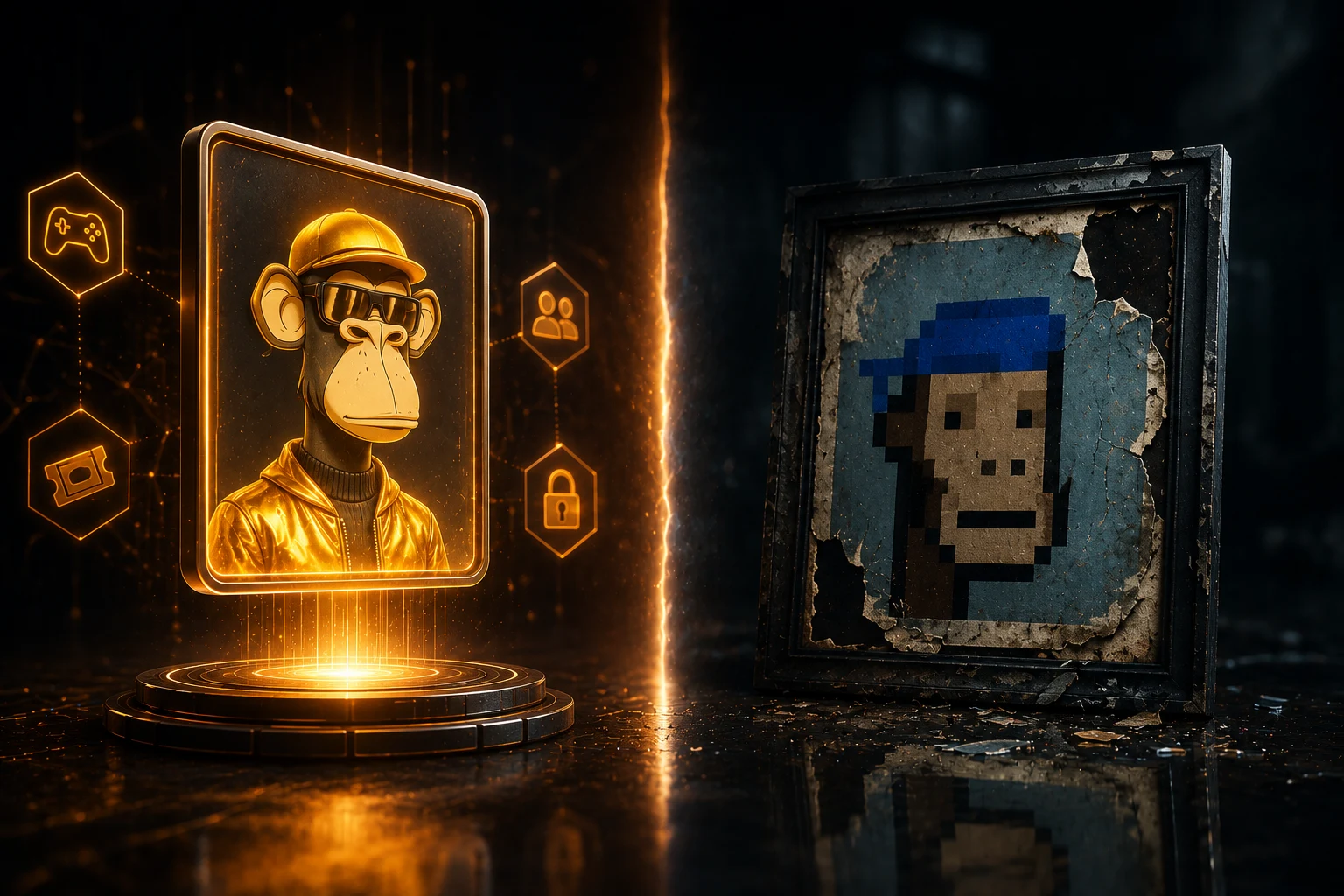
What people actually mean when they say NFT utility
3. ❯If you have spent any time in NFT Twitter, Discord, or launchpad Discords, you have seen the word utility used as a sales argument. A project raises a mint, then tells buyers that holding the NFT unlocks something: a game, a Discord role, early access to a token sale, a physical product, a share of royalties, a vote in a DAO. The pitch usually runs, "this is not just a JPEG."
4. ❯The trouble is that utility is not a single thing. It is a wide spectrum, and the word covers everything from a perk that is hard-coded into a smart contract to a sentence on a landing page that the team can rewrite tomorrow. So when a project tells you the NFT has utility, the honest reaction is not to believe or disbelieve the claim. The honest reaction is to ask which kind of utility they mean, and then to check whether the mechanism actually delivers it.
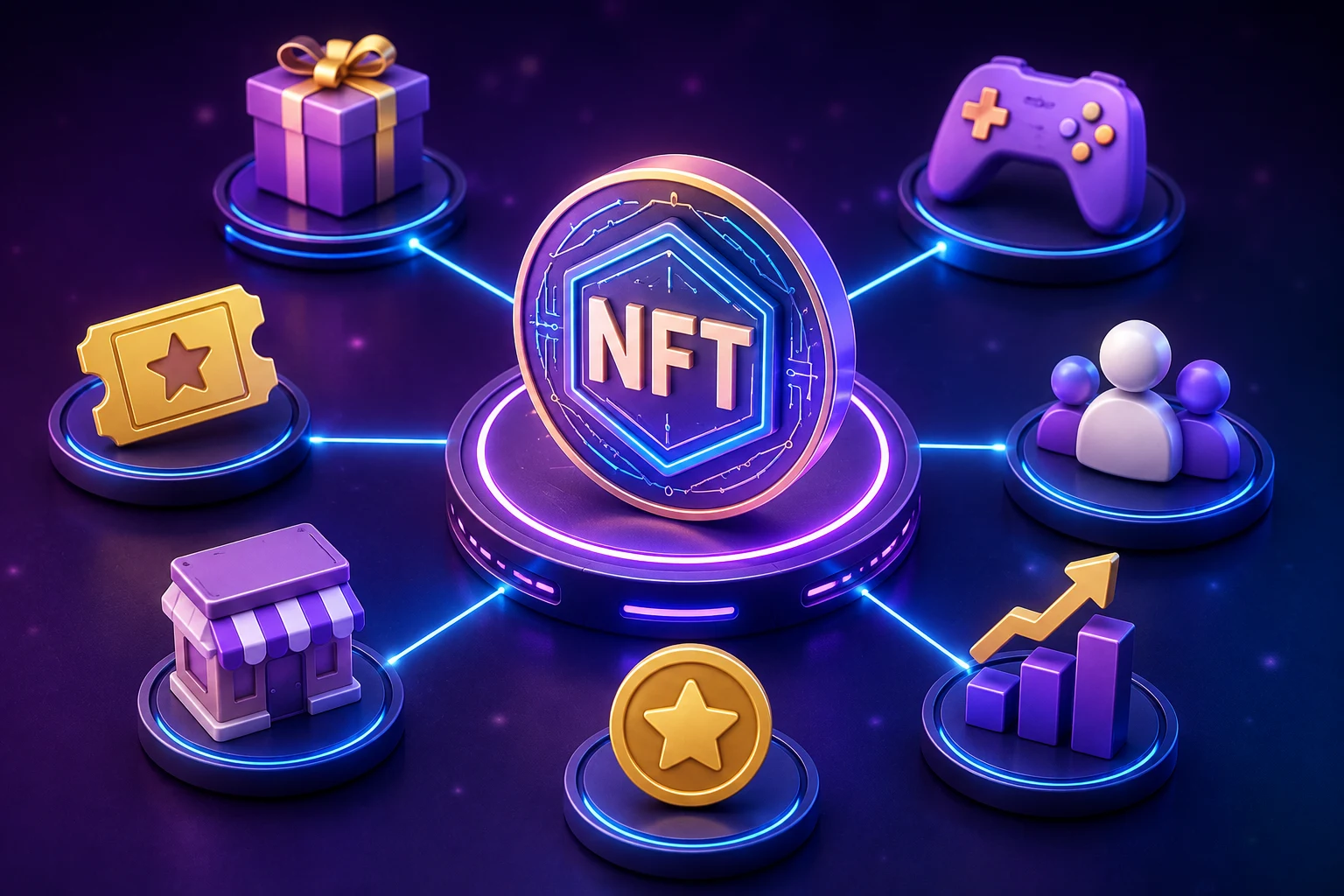
5. ❯Three rough buckets cover most of what gets called utility in 2025:
6. ❯- Art or aesthetic value. The NFT exists to be collected, displayed, or traded. The on-chain image, the artist reputation, the rarity traits, and the cultural signal are the product. This is the "JPEG" end of the spectrum, and there is nothing wrong with it on its own.
- Membership or access. Holding the NFT gets you into a Discord channel, a token-gated store, an allowlist, a private event, or a vote in a community. The perk is real but depends on whoever runs the gate.
- Revenue share or cash flow. The NFT pays you a slice of protocol fees, royalties, or treasury distributions, much like a dividend. This is the only category where the NFT can plausibly function like a yield-bearing asset.
The mistake most new collectors make is treating all three as if they were the same kind of promise. They are not. Each one breaks in different ways, which is why the right framework is not "does this project have utility" but "what kind, and is the mechanism actually enforcing it."
8. ❯The risks of believing utility claims at face value
9. ❯This section comes early on purpose, because too many buyers learn the hard way. NFT markets have produced several high-profile wipeouts that all share a common theme: a roadmap promised utility, the utility never shipped, and holders were left with images of cartoon apes.
10. ❯The single largest risk is that utility is, in most cases, a marketing claim backed by a roadmap, not by enforceable code. A Discord role is a utility only as long as the Discord server exists. A promised game is a utility only after it launches. A revenue share is a utility only if the smart contract actually routes funds to holders without a kill switch the team can flip. When founders disappear, communities dissolve, or tokens go to zero, the utility tends to evaporate with the team.
11. ❯A second risk is dilution through supply creep. Many projects reserve a percentage of the collection for future airdrops, partnerships, or "team expansion" rounds. If those reserved tokens later get distributed, the access perk an existing holder thought was scarce becomes worthless overnight. The right question is not just "does the NFT unlock X," but "can the team mint more NFTs that also unlock X."
12. ❯A third risk is the rug pattern dressed up in utility language. The play goes like this: raise a mint on a hyped roadmap, mint at retail, ship a half-built game in the third quarter, collect fees from secondary trading, and abandon the project once volume drops off. The token-gated benefit turns out to be a Discord role in a server nobody moderates anymore.
13. ❯A final risk is overpaying for illusion. Even legitimate projects sometimes price utility at multiples of what the perk is actually worth, because the bull market multiplies everything. Buying an NFT at 5 ETH because it "unlocks 10 percent off merchandise" is usually a bad deal once you do the math on the merchandise you would have to buy.
14. ❯How utility claims map to on-chain mechanics
15. ❯This is the part most buyers skip, and the part that actually matters. Every utility claim lives somewhere on a spectrum between fully on-chain and fully off-chain, and the position on that spectrum tells you how durable the perk really is.
16. ❯Fully on-chain. The smart contract itself enforces the perk. A good example is token-gated commerce: an NFT acts as a key to a marketplace or to a private mint, and the marketplace's smart contract checks ownership before letting the holder in. Another example is the NFT that distributes a share of fees automatically on every trade, with no human in the loop. The contract is the source of truth. If the team disappears, the perk still works for as long as the chain is running.
17. ❯Hybrid. The NFT is the gate, but a centralized service handles the fulfillment. A token-gated Discord role is the canonical example: a bot reads ownership from the chain and assigns a role, but the Discord itself is a centralized application, and the role can be revoked the moment the team wants. Token-gated storefronts often look hybrid too, because the gate is on-chain but the products, fulfillment, and customer service run through a normal web company.
18. ❯Fully off-chain. The NFT is a receipt of intent. The project promises perks in a roadmap, in a tweet thread, or in a written agreement that is not enforced by code at all. A good test: if you deleted the smart contract, would the perk still exist? If the answer is no, it is off-chain utility, no matter how official the partnership announcement looked.
19. ❯The general rule is that the closer the perk sits to the on-chain end, the harder it is for the team to take it back from you. The closer it sits to the off-chain end, the more you are trusting the team's continued goodwill. There is nothing wrong with off-chain utility in principle. Some genuinely valuable perks (events, real-world goods, exclusive experiences) cannot live on-chain. The problem is when off-chain perks are marketed with the same certainty as on-chain ones.
20. ❯The questions to ask before buying
21. ❯Any collector can copy this checklist and run it against any collection they are considering. Five questions cover most of the ground:
22. ❯- Who controls the gate? Is access enforced by a smart contract, by an API the team runs, or by a Discord bot someone can turn off? The fewer middlemen, the stronger the claim.
- Can the team mint more passes? Read the contract. Look for owner-only mint functions, allowlists the team can extend, or reserved supply that has not been minted yet. If the answer is yes, scarcity is a fiction.
- What happens when the team disappears? An on-chain perk keeps working. A token-gated Discord does not. A roadmap vapor does not. The "sunset test" is the simplest one: imagine the project becomes inactive tomorrow, and ask whether the perk is still alive.
- Is the revenue share actually paid? Read the contract for a fee-routing function, check past distributions on a block explorer, and confirm there is no admin function that can pause or redirect funds. Past payments are the only proof that future payments are real.
- Who is at the other end of the perk? Token-gated access to a busy commerce ecosystem is meaningful. Token-gated access to an empty storefront is not. The utility of an NFT is partly a function of the ecosystem on the other side of the gate.
One more question that often gets skipped: what does the perk cost you to use? A revenue share that requires you to stake the NFT and lock it for 90 days has different risk from one you can sell any time. A token-gated discount that requires you to hold the NFT for two years to qualify is a different beast from one that activates the moment you mint.
24. ❯Examples of utility that worked, and utility that didn't
25. ❯Real cases beat abstract frameworks, so here are a few recognizable patterns.
26. ❯Worked: token-gated commerce. A handful of brands ran token-gated storefronts where holding an NFT unlocked early access to limited physical drops. Because the gate lived in a smart contract, the perk actually worked as long as the storefront was online. Holders turned resell rights into a small business, and the brand got a built-in CRM of its most engaged customers. The mechanism was simple enough that it shipped, which is half the battle.
27. ❯Worked: revenue-share NFTs with audited contracts. Some on-chain royalty systems route a slice of secondary trading fees directly to holders, with no admin override. Whether the volume is sustainable is a separate question, but the mechanism itself does what it says on the tin, and buyers who did their homework got paid according to the contract.
28. ❯Mostly failed: promised games and metaverses. Several large collections raised tens of millions of dollars on the promise of an on-chain game. The games shipped late, played poorly, or never shipped. The NFTs themselves kept trading on speculation about the game, but the actual utility never materialized for most holders. The pattern is consistent enough that "roadmap NFT game" is now a yellow flag, not a green one.
29. ❯Mostly failed: token-gated DAO voting. Several projects gave NFT holders votes in a treasury DAO. In practice, turnout was tiny, vote weights were concentrated among whales, and most decisions were made in Discord anyway. The voting perk was real but rarely meaningful, which is a useful reminder that "access to governance" is not the same as "influence over a treasury."
30. ❯The takeaway is not that one form of utility is good and another is bad. It is that utility is delivered when the on-chain mechanism is simple, the off-chain fulfillment is professional, and the perk addresses a need holders already have. It is not delivered when the perk is a vague promise, the team is anonymous, and the only deliverable in two years is a Discord role.
31. ❯How to read a smart contract well enough to verify utility
32. ❯You do not need to be a Solidity developer to check the basics. A few habits cover most of the useful surface.
33. ❯First, read the function names on a block explorer. Look for anything marked onlyOwner or onlyAdmin. Functions with those modifiers are reserved for the deployer wallet and represent leverage the team still holds. A mint function with onlyOwner means the team can mint more supply at will. A setRoyalty function with onlyOwner means royalties can be changed.
34. ❯Second, check for upgrade patterns. Many NFTs use proxy contracts where the logic can be swapped out by the team. A well-designed project acknowledges this openly and uses a timelock so changes take effect days later. A poorly designed one hides the upgrade path behind several layers of contracts.
35. ❯Third, look at distribution behavior. If the contract claims a revenue share, scroll through past transactions and confirm payouts actually happened. A claim that has never paid out is just a promise.
36. ❯Fourth, look at ownership concentration. A few wallets holding a large slice of the supply is not automatically bad, but it changes how you should think about votes, allowlists, and scarcity. Tools that visualize holder distributions make this easy to check.
37. ❯None of this requires reading Solidity line-by-line. It requires being willing to spend fifteen minutes confirming what a project already claims about itself. The buyers who do this consistently tend to lose less money than the buyers who treat the Discord pin as the final word.
38. ❯Practical implications for a new collector
39. ❯If you are new to collecting, the practical framework is short enough to fit on an index card.
40. ❯First, decide what you are actually buying. Art you like is a legitimate reason to own an NFT, and you do not need to apologize for it or pretend there is a hidden yield underneath. Membership to a community you want to be part of is also a legitimate reason, and you should size your position to the value of that membership, not to the implied future market cap.
41. ❯Second, treat any utility claim as marketing unless you can point to the line of code or the signed agreement that backs it up. The cost of verification is fifteen minutes on a block explorer. The cost of skipping it can be your entire position.
42. ❯Third, do not pay a yield premium for a perk that has not paid out yet. A revenue share with six months of clean distributions behind it is a different asset from a revenue share that is "coming soon" on the roadmap. The first has evidence. The second is a pitch deck.
43. ❯Fourth, size positions so that a total loss is tolerable. NFTs are illiquid, and the upside cases get all the press while the washout cases get no coverage at all. If a collection you own goes to zero overnight, you should still be fine. If that is not true, you are overconcentrated.
44. ❯Finally, remember that the long tail of NFT history is mostly stories about projects that did not deliver. The survivors tend to share a few traits: small teams, simple contracts, on-chain perks, low overhead, and a community that actually shows up. Everything else is decoration.
45. ❯Read NFT utility claims critically
46. ❯NFT utility moves fast, and so does the news around it. Sorting "real utility" from "marketing pitch" by hand is a losing game, because the loudest collections are rarely the ones that ship. Zippfeed surfaces NFT headlines with sentiment scoring (bullish, neutral, or bearish) and an importance rating, so you can filter hype from contract-level updates and spend your time on the projects that actually have something to show.