What NFT royalties were supposed to be
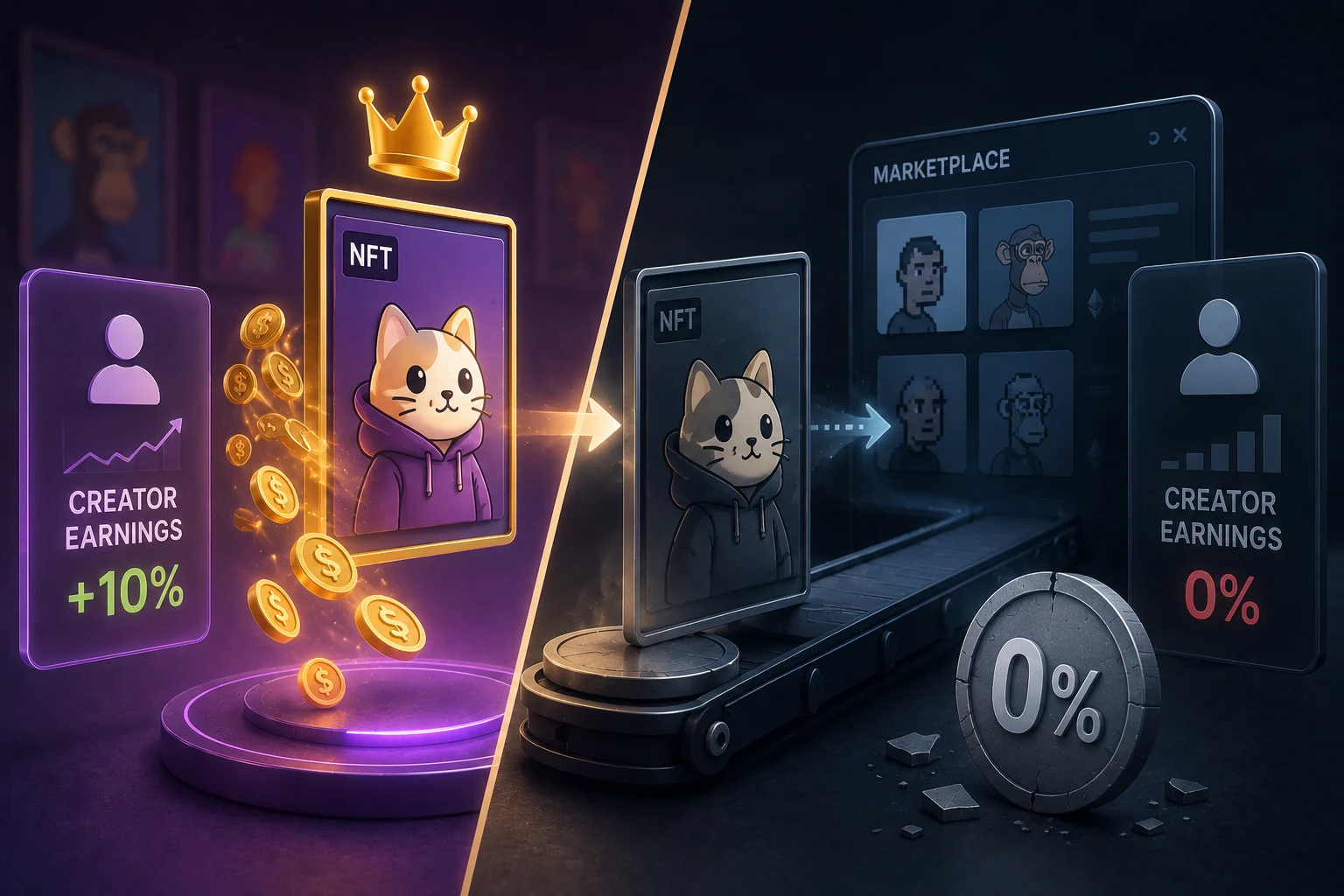
When NFTs first went mainstream in 2021, creator royalties were one of the most-hyped features. The pitch to artists was simple and seductive: mint once, and earn a percentage of every future resale, forever. A painter who sold a piece for 0.1 ETH could wake up years later to find that the same piece had flipped for 100 ETH, and collect 5 ETH (or 7.5, or 10, depending on the royalty they set) without doing any additional work. For digital artists who had spent decades watching their work be copied and resold for nothing, the idea felt revolutionary.
Under the hood, royalties were never quite as automatic as the marketing suggested. A royalty is a number the creator sets when they mint, usually between 2.5% and 10%, and that number is stored either in the smart contract that mints the token or in a registry the marketplaces agree to read. Every time a marketplace lists a sale, it checks the registry, takes the royalty percentage out of the sale price, and sends it to the creator's wallet. The creator never has to chase invoices, sign new contracts, or trust the buyer to be honest.
The key word in that last sentence is "the marketplace." Royalties are not enforced by the blockchain itself. They are enforced by the software that sits in front of the blockchain, which means every royalty payment is only as reliable as the marketplace processing the trade. This is the original design flaw that most early creators did not understand, and the flaw that ultimately broke the system.
How royalties were originally enforced, and why it never really worked
In the early OpenSea era, enforcement was actually fairly tight. OpenSea was the dominant marketplace, it controlled a huge share of NFT liquidity (the ease of buying and selling an asset without changing its price), and it simply agreed to honor whatever royalty a creator had set. If you minted an NFT with a 7% royalty and someone tried to list it for resale, OpenSea's smart contract routing would automatically send 7% of the sale to the original creator's wallet and 93% to the seller. The system worked because OpenSea was effectively a toll booth, and almost every transaction had to pass through it.
The problem is that this was enforcement at the application layer, not at the protocol layer. The ERC-721 and ERC-1155 token standards that govern most NFTs (the technical blueprints that define how an NFT behaves on Ethereum) do not contain any royalty logic at all. They are dumb tokens. They know who owns them, they can prove ownership, and they can be transferred, but they have no opinion about who should get paid when they change hands. All of the royalty logic lives outside the token, in the marketplace code or in shared registries that marketplaces voluntarily read.
This created an obvious attack surface. As soon as a competitor marketplace decided not to honor royalties, it could offer traders cheaper effective prices (because the seller received 100% of the sale instead of 90% or 92.5%) and siphon volume away from the royalty-honoring marketplaces. This is what is often called the race to the bottom, and it is the dynamic that broke the system.
The on-chain versus off-chain enforcement problem
To understand why royalties collapsed, you have to understand the difference between on-chain and off-chain enforcement, because the entire collapse comes down to this distinction. On-chain enforcement means the royalty logic is written directly into the smart contract that holds the token, so any transfer of that token has to pay the royalty or it cannot happen. Off-chain enforcement means the royalty logic lives in a database or piece of code that a marketplace chooses to consult, and the marketplace can choose to ignore it.
Real on-chain enforcement is technically possible. A few experimental token contracts, including some of the early Sound.xyz mints and certain custom ERC-2981 implementations, attempted to hard-code royalty transfers into the token itself. The problem with hard-coding is that it makes the token incompatible with any marketplace that does not support the specific enforcement pattern, which dramatically reduces liquidity. Creators who chose strict on-chain enforcement found that their tokens could only be traded on a tiny list of marketplaces, and many collectors simply would not buy them because the resale market was too thin.
Off-chain enforcement, the dominant model, uses shared registries like OpenSea's, where creators register their royalty preferences and marketplaces opt in to honoring them. The registries are useful, but they are advisory. Nothing in the Ethereum or Solana protocol forces a marketplace to read them. When the economic incentives flipped and marketplaces started competing on fees, the registries became irrelevant almost overnight.
Why marketplaces moved to optional royalties after 2023
The trigger event for the royalty collapse was the rise of Blur in late 2022 and early 2023. Blur launched as a professional-trader-focused marketplace that paid out token rewards to active users, and it chose to make creator royalties optional. A trader using Blur could list a Bored Ape, sell it with zero royalty going to Yuga Labs, and pocket the difference. Within months, Blur had captured a majority share of Ethereum NFT volume, and OpenSea, which had been the original enforcer, faced a brutal choice: keep enforcing royalties and lose traders, or follow the market and stay in business.
OpenSea followed the market. In early 2023, OpenSea announced that it would also make creator royalties optional, with a minimum of 0.5% enforced only on certain collections. The same pattern played out on Solana, where Magic Eden, once a strict enforcer, dropped enforcement after Tensor and other competitors gained traction with zero-royalty trading. By the end of 2023, optional royalties were the default across almost every major marketplace, and the share of NFT volume that actually paid meaningful creator royalties had collapsed to a small minority of trades.
The economic logic behind this shift is straightforward, even if it is painful for creators. NFT marketplaces compete on a small set of variables: price discovery, fees, liquidity, and user experience. When a trader can save 5% or 7% on every trade by using a zero-royalty marketplace, that is a meaningful edge, especially for high-volume flippers who treat NFTs as a trading asset class rather than a collectible. Marketplaces that enforce royalties are punished by the market, and marketplaces that do not enforce are rewarded. The collective action problem (where everyone is better off if everyone honors royalties, but each individual marketplace is better off defecting) was never solved, and creators were left holding the bag.
Royalty-enforcing tools that still pay creators
Despite the collapse, a small set of platforms and tools still pay creators reliably. They tend to share three traits: a curated or limited collection model, a token-gated or permissioned marketplace structure, or a chain-level mechanism that makes zero-royalty trades expensive. Understanding these traits is the only way to predict which platforms will still pay royalties in two years.
Sound.xyz is the most-cited example. Sound is a music NFT platform that enforces royalties on-chain through its mint contract, and it does not list tokens on open marketplaces that ignore royalties. Music minted on Sound pays the creator royalty on every secondary trade that happens through the Sound interface, which is where the vast majority of Sound trades occur. The trade-off is that Sound's liquidity is small compared to OpenSea or Blur, but the royalty stream is real.
Zora takes a similar approach for generative art and creator coins, and it has invested in on-chain royalty hooks (small smart-contract modules that enforce fee payments during a transfer) for popular collections. On Solana, certain mint protocols including those used by some Mad Lads and Claynosaurz-style collections have implemented on-chain royalty enforcement that charges a transfer fee whenever the token moves, regardless of where it is sold. The fee is built into the token itself, not into the marketplace, so it cannot be bypassed by switching platforms.
None of these tools is a silver bullet. Sound and Zora are niche, and the Solana on-chain enforcement pattern has its own trade-offs, including friction for legitimate buyers and the risk of breaking compatibility with DeFi protocols that wrap NFTs. But for creators who specifically want royalty income, these are the only structures that have held up in practice.
How artists can design around the broken royalty model
Most artists reading this will not mint on Sound or launch a Solana collection with on-chain enforcement. Most will mint on a general-purpose marketplace and hope for the best. For those creators, the honest advice is to design the project around the assumption that royalties will be zero, and treat any royalty income as a bonus rather than a baseline.
Concretely, this means pricing the primary mint to capture the value the royalty stream was supposed to provide. If a creator would have set a 5% royalty expecting a 10x secondary market, they should price the primary mint as if the NFT will trade at roughly 50% of comparable royalty-enforced prices, because that is what optional-royalty markets actually deliver. It also means thinking about royalties in absolute ETH terms rather than percentages, because percentages on a thin market can be much smaller than they look.
Creators who want guaranteed income should also consider alternatives to the standard NFT royalty model, including subscription NFTs, token-gated access passes, and creative work sold through direct-mint or allowlist channels where the relationship with the buyer matters more than the secondary market. The harsh truth is that the NFT royalty dream, where you mint once and earn forever, was a product of the 2021 bull market, and it is not coming back in its original form. The artists who do well now are the ones who design for the world as it actually is, not the world as it was sold to them.
Read NFT royalty news with the right filter
NFT royalty news moves fast, and most of it is either marketing or post-hoc rationalization. New tools, new chains, and new enforcement proposals are announced constantly, but the underlying incentive problem has not changed: marketplaces that enforce royalties lose volume to marketplaces that do not, and creators are caught in the middle. The only signal that matters is whether a tool enforces royalties at the token level or at the marketplace level, because token-level enforcement survives marketplace competition and marketplace-level enforcement does not.
Zippfeed surfaces NFT headlines with sentiment scoring (bullish, neutral, or bearish) and an importance rating, so you can cut through the noise and focus on the stories that actually affect how creators get paid. Whether you are an artist trying to protect your income or a collector trying to understand what your purchases are funding, Zippfeed gives you the context to make sense of it.


 Lookonchain
 WuBlockchain
 Crypto Capital Venture