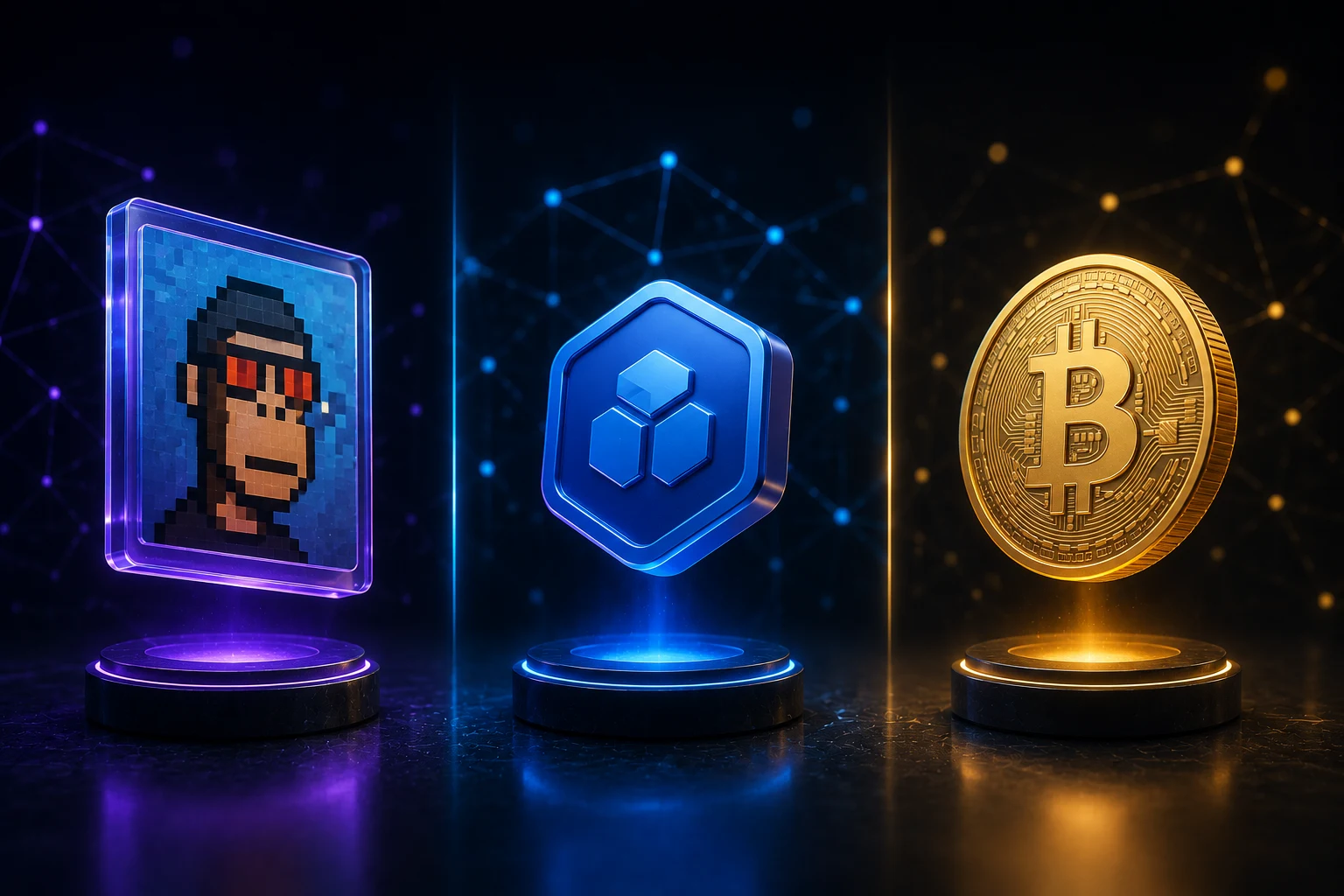
What a coin, a token, and an NFT actually are
People throw these three words around as if they meant the same thing, and crypto marketing does not help. Bitcoin, Ether, and a Bored Ape picture all get called coins in casual conversation, and most beginners walk away thinking the only real difference is the price chart. The real difference is more structural, and it shows up the moment you try to send, swap, or evaluate any of them.
A coin is the native asset of its own blockchain. Bitcoin (BTC) is the coin of the Bitcoin network. Ether (ETH) is the coin of Ethereum. Solana's coin is SOL. These coins are what you pay to use the network itself: miners or validators receive them as rewards, and users pay them as gas (the transaction fee that compensates whoever processes the operation). The coin is also the unit in which the network's security budget is denominated, which is why no single company can simply print more.
A token is a digital asset issued on top of someone else's blockchain. It does not run a network. Someone writes a smart contract (code that lives on a chain and runs automatically when called) and uses a shared token standard so wallets and exchanges can recognize the asset. Stablecoins like USDT and USDC are tokens. Uniswap's UNI is a token. Aave's AAVE is a token. The chain underneath (Ethereum, Solana, Base) is what secures them.
An NFT, short for non-fungible token, is a token whose individual units are not interchangeable. Each unit carries unique data, so a Bored Ape is not the same thing as another Bored Ape even though they came out of the same collection. That is the part that makes them non-fungible. The image, video, or document is usually stored elsewhere (more on that below), and the NFT on-chain is more like a tamper-evident certificate pointing at that file.
The property that actually separates them: fungibility
Fungibility sounds like jargon, but the idea is older than crypto. Something is fungible if any one unit of it is interchangeable with any other unit of the same kind. A dollar bill is fungible: you do not care which serial number you get, because each dollar buys the same amount of stuff. A house is non-fungible: a three-bedroom in Austin and a one-bedroom in Detroit are clearly not the same asset, and no one would price them identically.
Apply that to digital assets and the three categories snap into place. One BTC is identical to another BTC, and the network treats them as such. One ETH is identical to another ETH. One USDT is identical to another USDT. That is why these assets split cleanly into accounts, get blended in liquidity pools, and function as money-like instruments inside the system. They are fungible.
One CryptoPunk is not identical to another CryptoPunk. Each has a serial number, an image, and traits that affect what people are willing to pay. Two NBA Top Shot moments from the same series still differ by serial, play type, and edition number. That is what makes them non-fungible. You cannot pour them into a liquidity pool, you cannot use them as collateral in most DeFi protocols (decentralized finance, meaning financial apps built from smart contracts rather than a traditional bank), and a market has to price each one individually.
Most of the confusion online comes from skipping this step and going straight to standards and use cases. The standards matter, and they are covered below, but fungibility is the property that decides what something can and cannot do. If you remember only one word from this article, fungibility is the one.
Why the standards (ERC-20, ERC-721, ERC-1155) are not the answer
Ethereum Improvement Proposals, or EIPs, are the formal documents that propose changes to Ethereum. A few of them define the most common token standards, and people often point at the standard as if it were the dividing line. It is not. The standard is the implementation. Fungibility is the idea.
ERC-20 is the fungible-token standard on Ethereum. Every ERC-20 token, whether it is USDC, UNI, or a long-tail governance token, has the same basic interface: a balance map, a transfer function, and an allowance function that lets a smart contract spend on your behalf. Any wallet, exchange, or DeFi protocol that knows how to handle one ERC-20 token can handle any other. That is the point of the standard, and it is why ERC-20 became the default format for fungible tokens.
ERC-721 is the non-fungible token standard. Each token has a unique identifier, and the standard gives you a way to track ownership of that specific identifier. CryptoPunks, Bored Apes, and the bulk of the art-style NFT market run on ERC-721. The standard does not store the image itself; it stores a pointer to where the image lives.
ERC-1155 is a hybrid. A single contract can hold both fungible and non-fungible tokens, which makes it cheaper and more flexible for things like game items where you might have 1,000 copies of a common sword and a single legendary helmet. Standards like ERC-404 have also tried to blend the two, and the design space is still open.
Here is the part that trips people up: the standard is downstream of the property. ERC-20 exists because Ethereum needed a common interface for fungible tokens, ERC-721 exists because the same need appeared for non-fungible ones, and ERC-1155 exists because some use cases want both at once. If you understand fungibility, the standards line up by themselves. If you start with the standards, you spend the rest of the conversation playing catch-up.
How each one is actually stored and where the value sits
Coins and tokens look similar on a wallet screen, but the storage is not identical, and the difference matters for security. A coin like BTC or ETH lives directly on the base layer of its blockchain, and your ownership is a function of which private key (a secret number that lets you sign transactions for a given address) controls the address. Lose the key and you lose the coins, with no support desk to call.
A token's value is bound to the same chain, but the actual token is a record inside a smart contract. Move your ETH to a new address and you move your ether. Move your USDC to a new address and the USDC contract updates a balance mapping; the chain underneath does not know what a USDC is. This is why a token can be worthless even when the chain is fine: the contract could be broken, malicious, or simply abandoned, and the chain will still happily record whatever the contract does.
NFTs add a third layer. The on-chain record is usually small: an owner address, a token ID, and a pointer. The pointer is often a URL or a content hash. The actual image, video, or document usually lives on IPFS (InterPlanetary File System, a peer-to-peer storage network designed for tamper-evident files) or, more often, on a regular web server somewhere. If that file disappears, the NFT on-chain still points at it, but what it points at may be blank, broken, or swapped out for something else.
This is where a lot of the NFT disappointment comes from. People assumed buying an NFT meant owning the file. In most cases, what you own is a token that says you own a token ID issued by a particular contract, with license terms that may or may not give you commercial rights to the image. The actual pixels can be hosted by a company that goes out of business. Some projects, like CryptoPunks and Autoglyphs, store the image data on-chain directly, which sidesteps this risk. Most do not.
What each one is actually used for, and what it isn't
Coins are used as the native asset of a network. That is their actual job. They pay for gas, they reward validators, and in networks like Ethereum or Bitcoin, they also function as a settlement layer for the assets that sit on top. Some chains, like Ethereum, have pushed the coin toward a hybrid role: a fee asset, a staking asset (an asset locked up to help secure the network in exchange for rewards), and a form of money. The rise of Bitcoin ETFs (exchange-traded funds, which let people gain price exposure through a regular brokerage account) has added a third use, namely a tradable representation of a scarce digital asset, but the underlying coin still does the same job on the network.
Tokens are the general-purpose asset format of a smart-contract platform. They are used for stablecoins pegged to a fiat currency, governance tokens that give holders a vote in a protocol, utility tokens that unlock some service, and security tokens that represent ownership in a real-world asset. A token is not inherently any one of these; the contract and the issuer decide. That flexibility is also a risk, because there is no automatic check that a token is what it claims to be.
NFTs are used wherever a digital item needs to be one-of-a-kind, or at least limited in supply. The actual deployment has been mostly in three areas: profile-picture collections and generative art, gaming items, and event tickets or membership passes. Real-estate and document-tokenization pilots exist, but they remain small. The use case that the original 2017-era NFT crowd talked up, true digital ownership of in-game items, has not materialized in mainstream games. The biggest NFT projects by volume in 2024 and 2025 were mostly memecoins (tokens with no promised utility, valued largely by community) and collections tied to trading-card games, not the digital-property vision the original whitepapers sold.
Risks and failure modes for each
Coin risks center on the chain itself. If the network's security budget falls, the chain becomes cheaper to attack. A 51% attack (where a single party controls a majority of the network's mining or staking power and can rewrite recent transactions) becomes more feasible, and the coin's value can collapse alongside confidence in the chain. Bitcoin has not seen one; smaller coins have. There is also the concentration risk of coins held in centralized exchanges, where the actual custody belongs to the exchange, not the user, and a bankruptcy or hack can wipe out the on-paper balance.
Token risks are concentrated in the contract layer. The chain can be perfectly healthy and the token can still go to zero. Common failure modes include:
- Unaudited contracts that contain a hidden mint function, which lets the issuer print unlimited new tokens and dump them.
- Honeypots, where the contract is written so only the deployer can sell, locking retail buyers in.
- Rug pulls, where the team liquidates the liquidity pool and disappears, leaving the token with no buyers.
- Stablecoins that lose their peg because the reserves were overstated (TerraUSD in 2022 is the canonical case).
NFT risks are different again. Liquidity is the dominant one. Most NFTs are illiquid, meaning you cannot easily sell them at a known price, and the spread between the listing price and the realistic sale price can be 30% to 50% or more. Floor prices (the lowest current asking price for any item in a collection) for the top 2021 collections fell by roughly 95% from peak to mid-2024. Counterfeit risk is also large: it is trivial to copy a contract and issue lookalike tokens with the same artwork, and marketplaces sometimes need weeks to delist them. The legal position is also weaker than marketing suggests: buying an NFT is not the same as buying a copyright, and courts have not consistently treated NFT ownership as property rights in the way buyers assumed.
How the three show up in the real world
Coins are the things ordinary investors most often come into contact with through ETFs, exchange products, and large exchanges. A retail user who buys Bitcoin on Coinbase is buying a coin on the base layer of the Bitcoin network. That same user buying Ether is buying a coin on Ethereum. The price is set by the market, and the asset is fully fungible: one BTC is one BTC.
Tokens are the format most active crypto users actually transact in. Stablecoins like USDC and USDT settle billions of dollars of value every day, dwarfing the volumes on most traditional payment networks. Governance tokens like UNI, AAVE, and COMP run the protocols that hold tens of billions of dollars in user funds. The user experience of swapping one token for another on a DEX (decentralized exchange, a peer-to-peer market run by smart contracts instead of a company) is built entirely on the token standard.
NFTs show up most visibly in digital art, profile pictures, and digital trading cards. The headline sales (Beeple's $69 million auction in 2021, the Bored Ape collection) drew public attention, but the actual volume settled into a much narrower set of use cases. As of 2025, the largest NFT marketplace by volume is Magic Eden, and most of that volume is gaming-related, not art. OpenSea, the brand most beginners recognize, now runs a much smaller share of activity. Practical ownership questions, like which chain an NFT lives on and where its file is stored, are still the first thing to check before buying.
How to think about the differences in practice
Start with the property, not the asset. Ask whether the thing in front of you is fungible. If it is, it is either a coin or a token; the difference is just whether it runs its own chain or borrows someone else's. If it is non-fungible, it is an NFT, regardless of whether the chain calls it that or whether the marketing uses a fancier word.
When evaluating any asset, the chain, the standard, and the storage matter, but they matter as questions to ask, not as badges of quality. Who secures the chain. What does the contract actually do. Where is the file. Who can change it. The fact that something is an NFT does not tell you whether the project is good. The fact that something is a coin does not tell you whether the chain is sound. The fact that something is a token does not tell you whether the contract is safe.
If the goal is to use crypto as money, coins and stablecoins are the asset class to focus on. If the goal is to interact with a specific application (lending, swapping, governance), tokens are the format. If the goal is to collect, speculate on, or use a unique digital item, NFTs are the format, with all the liquidity and storage caveats that come with that category. Each fits a different job, and none of them is automatically the better choice.
Follow NFT, token, and coin news with Zippfeed
Coin launches, token upgrades, and NFT floors move on different timelines, and the same headline can be bullish for one and bearish for another. Tracking each one manually is a losing game. Zippfeed surfaces coin, token, and NFT headlines with sentiment scoring (bullish, neutral, or bearish) and an importance rating, so you can see at a glance which story is actually shifting the market and which is just noise.